Item-level trace
For ordinary inventory, follow stock through locations, adjustments, transfers, counts, and sales without forcing batch or serial identity on every movement.
Office supplies Bulk consumables General store items
Follow every item from receipt to shelf, transfer, count, sale, adjustment, expiry review, and recall decision. AWRA gives teams a governed chain of custody across ordinary stock, batch-tracked inventory, serialized units, and high-risk movement events.
Batch
Lot and expiry paths
Serial
Unit accountability
Recall
Forward and backward trace
Trace command center
Batch BN-20260523-1677
Receipt
Supplier PO received into Main Warehouse
Storage
Placed on Shelf A with lot identity
Transfer
Moved to branch shelf with same batch
POS / Issue
Allocated by FEFO policy before newer stock
Expiry window
60 days
Trace events
Linked
Why traceability matters
When a manager asks where an item came from, which shelf it occupied, who moved it, whether it was part of a batch, whether it is near expiry, or which sale consumed it, the answer should be available without searching through spreadsheets, messages, and handwritten notes.
AWRA traceability turns stock movement into a structured evidence trail. Each inbound, outbound, transfer, adjustment, POS sale, count correction, serial record, and batch allocation can contribute to a single item timeline. Teams can trace ordinary items at item level, regulated or perishable goods at batch level, and high-value equipment at serial level.
The result is stronger operational confidence: faster recall review, cleaner audit evidence, better FEFO discipline, fewer blind spots between modules, and clearer accountability when stock changes hands.
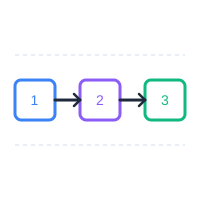
Item
Everyday stock history
Batch
Lot, expiry, recall paths
Serial
Individual unit chain
Trace model
Not every item needs the same tracking burden. AWRA supports practical traceability so organizations can match control depth to operational risk.
For ordinary inventory, follow stock through locations, adjustments, transfers, counts, and sales without forcing batch or serial identity on every movement.
For perishable, regulated, donated, manufactured, or supplier-sensitive items, preserve batch identity through receiving, storage, FEFO allocation, and recall review.
For high-value or unit-accountable stock, trace an individual serial number through receipt, location, transfer, issue, sale, till return and supplier return — every movement names the units it moved.
Serials on every movement
Switch serial tracking on for an item and every stock movement carries the units it moved. A receipt needs exactly one new serial per unit. An issue, an invoice checkout, a till sale, a transfer or a supplier return must name serials that belong to that item and are on that shelf. Each movement sets the unit’s status itself, and writes a trace event that points at that one serial — so “where has unit 4417 been?” is a page, not an investigation.
The life of one unit
Unit history
Solar inverter 5kVA · SN INV5-24-004417
4 Aug 2026
Received into Nairobi main store
Purchase order receipt · supplier and batch recorded on the unit
19 Aug 2026
Dispatched to Kisumu branch · in transit
Stock transfer · 6 units, serials named on dispatch
21 Aug 2026
Arrived at Kisumu branch · available
Transfer receipt · checked against what left
2 Sep 2026
Sold at the Kisumu till
Till sale · the cashier scanned this unit, not just the item
9 Sep 2026
Returned at the till and restocked
Till return · the same serial made available again, not duplicated
What AWRA OpsHub does today
More we can add to your workspace
Where we point you to a specialist
The warranty date and its reminder are the most contained piece in the middle column — the per-unit record and the daily reminder machinery both already run. Tell us what your warranty claims cost you today.
Lifecycle coverage
Traceability is only useful when it follows real work. AWRA ties movement evidence to inventory, warehouses, transfers, POS, adjustments, counts, scanner workflows, and purchase receiving so history is not trapped in one screen.
Create item quantity, batch identity, lot number, expiry date, supplier context, quality status, and inbound source reference.
Track the current remaining quantity by warehouse, shelf, bin, or location so trace paths map to physical reality.
Move stock between locations while preserving the item, batch, lot, and allocation context across dispatch and receipt.
Each item is set to earliest expiry first (FEFO) or earliest received first (FIFO), and that rule decides which batch leaves on every issue, sale and transfer, with event records showing which batch was consumed.
Connect variance corrections and adjustment activity to the item timeline so changes are explainable.
Filter expiring stock, review recall status, and trace forward or backward to identify remaining quantities and affected movements.
Recall and compliance readiness
A recall, quality hold, expiry issue, or supplier investigation cannot wait for manual reconstruction. AWRA gives operators a structured view of what was received, what remains, what moved, where it moved, and which references were involved.
Start from a batch or serial and identify where it moved, what remains, and which downstream events consumed it.
Start from an item, sale, transfer, count, or adjustment and find the source batch, lot, or movement event.
Mark a batch as clear, under review, quarantined, or recalled without losing ordinary stock visibility.
Filter stock approaching expiry so FEFO decisions and review actions happen before risk becomes waste.
| Trace Question | AWRA Evidence |
|---|---|
| Which batches are expiring? | Expiry window, current quantity, location, and item identity. |
| Where did this lot go? | Forward movement events with transfer, adjustment, and sale references. |
| Who changed this stock? | Actor, timestamp, source module, direction, and quantity. |
| What remains on hand? | Batch-aware warehouse and location balances. |
This view is designed for operations, compliance, inventory control, finance, and leadership teams that need one shared answer during investigations.
Smart Recommendations
Once a batch, lot, serial, or item path is visible, teams need the right control around the next move: hold it, scan it, package evidence, or report the exposure.
Quarantine recalled, damaged, expired, returned, or inspection-pending stock while preserving item, batch, warehouse, and release context.
Open recommendationUse mobile scanner sessions to capture barcode identity, movement proof, and floor-level verification closer to where stock changes hands.
Open recommendationPackage trace history, recall posture, approvals, attachments, and operational proof for audits or leadership review.
Open recommendationTraceability teams often add

Floor operations
Linked scanner sessions help teams pair mobile scanning with web operations so item identity, barcode input, and movement capture can happen faster on the floor.
Warehouse and location records give every event physical context, turning “stock changed” into “stock moved from this shelf to that destination.”
Inventory counts and adjustments close the loop when physical stock differs from expected stock, preserving the correction evidence in the item history.
Connected modules
Item records, current quantity, barcode identity, reorder context, and movement history.
Open pageWarehouse, shelf, bin, and location context for where stock physically sits.
Open pageDispatch, receive, return, and in-transit events that preserve stock identity.
Open pageVariance and correction evidence that explains why stock was adjusted.
Open pageQuarantine, inspection, damaged, expired, returned, release, and disposal controls.
Open pageMobile capture for faster floor-level barcode and movement verification.
Open pageAudit-ready exports, operational summaries, and traceability analytics.
Open pageEnterprise controls
Traceability supports practical governance across operations, finance, compliance, and leadership. It clarifies custody, reduces ambiguity during audits, and helps teams move quickly without sacrificing evidence quality.
Trace records stay scoped to the organization that created them.
Events can point back to transfers, adjustments, POS, counts, and receiving flows.
Movement context includes timestamps, users, quantity, direction, and module source.
Search by item, barcode, batch, lot, or trace context for fast investigations.
Track quality review status without hiding stock balances from operations.
Separate clear stock from review, quarantine, or recalled stock.
Operational confidence
AWRA inventory traceability is designed for the moments where accuracy, accountability, safety, and speed meet: recalls, expiry review, movement investigations, finance reconciliation, and everyday warehouse control.
Inventory Traceability
Help Center
Run inventory, procurement, assets, sales, and field work with approved AWRA guidance for setup, migration, integrations, security, pricing, and support.