
Connector Control
Manage connected systems and auth context with clear lifecycle visibility.
AWRA Integrations & Sync Hub centralizes connector management, sync operations, webhook governance, and integration health tracking so teams can trust cross-system data flow at scale.
Sync Hub reduces integration fragility by making job status, retry behavior, webhook endpoints, and connector health visible in one place. Teams move from blind sync assumptions to governed integration operations.
Manage connected systems and auth context with clear lifecycle visibility.
Observe job outcomes, retries, and failure causes before reporting windows are impacted.
Maintain endpoint hygiene, trigger history, and retry discipline for event-driven flows.
Continuously monitor integration reliability and operational drift across connectors.
When integration operations are governed, teams reduce reporting discrepancies, improve troubleshooting speed, and increase trust in system-wide metrics.
Integration Directory
See supported integrations, configurable connectors, and planned integration paths.
We prioritize integrations that remove manual work and keep data synced end-to-end.
Most integrations simply move data from one system to another. AWRA turns that data movement into operational control — mapping events to approvals, alerts, and financial records with full traceability. See how this connects to accounting automation.
Purchase orders, check-ins, and invoices can become traceable operational records across finance, inventory, and sales teams. The strongest live ledger alignment is currently through QuickBooks sync. Explore the procurement workflow that drives those events.
Our integration layer handles live webhooks, API-led access, and configured QuickBooks sync today. Broader legacy formats and custom connector work are scoped as implementation projects. Learn more in the API documentation.
When you connect tools through AWRA, you’re not just syncing records — you’re enforcing policy and enabling decisions at the moment they matter. Need a custom connector? Request an integration.
Smart Recommendations
Connector health needs more than uptime. These recommendations add sync recovery, webhook discipline, and reporting visibility around every integration.
Track mapping readiness, provider messages, retry status, vendor sync, item sync, and purchase order handoff before finance close.
Open recommendationUse trusted API events, webhook retries, idempotent delivery, and payload governance to connect external systems cleanly.
Open recommendationTurn failed syncs, stale mappings, rejected payloads, and retry exhaustion into owned recovery work.
Open recommendationRecommended sync control path
Map connector
Validate payload
Retry safely
Reconcile record
Customers like you also use
AWRA OpsHub can serve as the central hub for your operational data. Live connector coverage is strongest around QuickBooks, webhooks, developer APIs, Paystack billing, email, and SMS workflows.
Whether you're syncing operational data with QuickBooks or broadcasting workflow alerts via SMS, AWRA focuses on clear ownership, retries, and auditability rather than hidden one-off transfers.

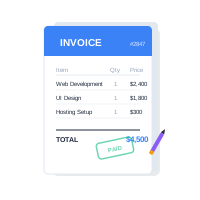
AWRA's live QuickBooks integration supports accounting sync for vendors, items, and purchase orders, with manual sync actions available from integration settings.
For collecting from your own customers, M-Pesa (Daraja), Paystack and IntaSend connectors are live, each on your own account. Paystack is active as a billing and payment rail. PayPal checkout is present behind configuration and is not the primary billing rail. Automated collection reconciliation across Paystack, PayPal, and accounting platforms remains planned/custom integration work.
For teams with custom needs, AWRA offers API access and event-driven webhooks. Current public API coverage includes documented operational endpoints, while deeper object coverage can be scoped for implementation.
Webhooks provide real-time notification capabilities for supported events, including stock transfer completion. Additional event types can be added as part of custom rollout work.

Modernizing operations doesn't have to mean replacing everything at once. AWRA supports CSV and Excel item imports today; broader ERP bridges such as XML or EDI are custom implementation work.
This hybrid approach can protect your historical investment while unlocking modern capabilities like mobile access and cleaner reporting as legacy components are gradually retired.
Operational speed depends on getting the right information to the right person quickly. AWRA supports email notifications and SMS workflows through configured providers such as AfricasTalking, with delivery depending on organization setup and provider availability.
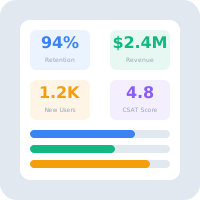
We’ll help you connect AWRA OpsHub with your existing stack.
Request IntegrationIntegration Playbooks
These playbooks turn integration strategy into execution steps, helping teams avoid brittle implementations and reduce post-launch failures.
Whether you are syncing with commerce systems, finance tools, or analytics stacks, this page outlines architecture choices that age well as complexity grows.
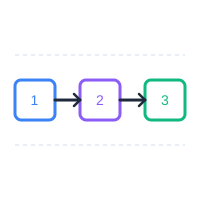
Use API polling for baseline synchronization with deterministic retries, pagination controls, and backoff strategies.
Adopt webhook-driven updates for low-latency events with idempotent consumers and signature validation.
Map transactional events to accounting dimensions with reconciliation checkpoints and exception queues.
Integration failures usually come from hidden assumptions: non-idempotent writes, missing traceability, unclear ownership of retries, and no strategy for partial failures. These playbooks address those fault lines directly so your production behavior remains predictable.
Strong integrations are observable. Every transaction path should be traceable from source event to destination write. This allows teams to audit behavior, recover quickly from anomalies, and prove correctness during finance or compliance checks.
We recommend decoupled processing boundaries. Instead of chaining synchronous calls across multiple systems in critical paths, use resilient queues and state transitions to absorb spikes and third-party downtime.
Data contracts matter. Define explicit field mappings, validation rules, version handling, and fallback behavior. Contract discipline reduces breakage when either side evolves independently.
Start with read-only sync to validate mapping and data quality.
Add write-back paths with strict idempotency controls.
Enable event flows with dead-letter handling for failed payloads.
Introduce reconciliation jobs and alert thresholds before scaling volume.
Writing directly to production ledgers without staged validation.
Treating webhook delivery as guaranteed instead of eventually consistent.
Ignoring timezone and currency normalization in multi-region operations.
Skipping replay tooling, which makes incident recovery slower and less reliable.
Share your systems and target workflows. We can provide a tailored integration rollout model with technical checkpoints.
Before activating production writes, integration teams should validate rate limits, permission scopes, replay behavior, and failure recovery sequencing.
For accounting-linked workflows, we recommend strict reconciliation intervals and exception queues so discrepancies are detected before period close.
For stock-critical workflows, validate timezone, location mapping, and SKU normalization early to avoid silent data drift between systems.
Help Center
Run inventory, procurement, assets, sales, and field work with approved AWRA guidance for setup, migration, integrations, security, pricing, and support.