
Ask AwraIQ about features, pricing, onboarding, login, integrations, security, demos, mobile apps, automation, reports, or support.
KRA eTIMS · Kenya
Make the sale. File it to KRA. Signed and stamped — before the customer leaves.
AWRA submits your customer invoices and POS sales to KRA's eTIMS system live over the OSCU API — under your own PIN, in sandbox or production. Every filed document comes back with a KRA receipt number, signature and QR code, printed right on it.
Live OSCU transmission · Sandbox & production · Auto or manual filing · Receipt signature + QR on every doc
TAX INVOICEYour Company Ltd · PIN P051234567X
INV-2048
24 Jul 2026
24 Jul 2026
Goods & services (excl. VAT)50,000.00
VAT @ 16%8,000.00
Total (KES)58,000.00
KRA eTIMS — filed
Receipt No.0060012345
SignatureA5F2-9C0B-77E1
Internal dataKRA-INTRL-...
FILED
Live OSCUreal transmission to KRA's eTIMS API, not a manual export
2 environmentstest safely in sandbox, then switch to production
Auto or manualfile on save automatically, or on demand per invoice
Signed + QRKRA receipt number, signature and QR on every filed doc
Why it matters
In Kenya, an invoice isn't done until KRA has seen it.
eTIMS turned tax invoicing from something you reconcile at month-end into something that has to happen at the moment of sale. A valid tax invoice now needs a KRA-issued receipt number, a receipt signature and a scannable QR code — proof that the transaction was declared. Bolt that onto a business as a separate step and it becomes a daily source of friction, missed filings and anxious audits.
AWRA makes fiscalisation part of the sale, not a chore after it. When you raise a customer invoice or ring up a POS sale, AWRA can file it straight to KRA over the eTIMS OSCU API, capture the signed response, and print it on the document — so what you hand the customer is already a compliant fiscal invoice. And because tax is configured properly underneath, the numbers you file are the numbers you meant.
From connection to compliant invoice
Five steps, then it just runs.
1
Connect
Enter your KRA PIN, branch ID bhfId and device serial, and pick sandbox or production.
2
Initialise
AWRA calls KRA to initialise your device and securely stores the encrypted communication key it returns.
3
Test
Send a sample invoice to the sandbox to confirm everything is wired correctly before going live.
4
File
Raise an invoice or POS sale and it's submitted to KRA — automatically on save, or on demand — with the customer’s KRA PIN as the buyer PIN when the record has one.
5
Stamped
The signed receipt number, signature and QR come back and print on the invoice and receipt.
The fiscal signature
What KRA sends back — printed for the customer.
A filed document isn't just marked “done” — it carries the actual proof KRA returned, so anyone can verify it.
Receipt number
The unique KRA eTIMS receipt number stored on the document — etims_receipt_no.
Receipt signature
KRA's cryptographic signature for the transaction — etims_receipt_sign — returned by KRA, not generated locally.
Verifiable QR code
The KRA QR — etims_qr_url — rendered on the invoice PDF and POS receipt for instant verification.
Status & timestamp
Every document tracks pending → filed → failed with the exact filed time, plus a clear error if KRA rejects it.
Behind the scenes, filing runs on a background queue with automatic retries and back-off, and each document is locked so a manual file and an auto-file can never submit it twice. If KRA returns an error, AWRA records it against the invoice and lets you retry — nothing fails silently.
The result on paper is a clean, official-looking tax invoice: your VAT breakdown, and beneath it a KRA eTIMS block with the receipt number, signature and a QR the customer can scan — exactly what a compliant fiscal document should show.
Set it and forget it
File automatically — or keep your hand on it.
Choose exactly which documents fiscalise the instant they're created. Or leave auto-file off and file each one deliberately. Your call, per document type.
Auto-file to KRA eTIMS
↳ Customer invoices
↳ POS sales
↳ Draft / unposted docs
- Per-document-type control — auto-file customer invoices, POS sales, or both, independently.
- Files once, guaranteed — each document is unique on the queue, so auto and manual can never double-file.
- Resilient — background jobs retry with back-off if KRA is momentarily unavailable.
- Manual when you want it — a File to eTIMS and Retry button sits on every invoice.
Global tax, underneath it all
Configure tax once. It flows everywhere.
eTIMS files whatever tax you charge — so getting tax right is the foundation. AWRA's global tax engine handles multiple tax types, jurisdiction rates and per-item treatment across invoices, quotations and POS. Withholding on supplier bills — deducted, remitted against a monthly register and certified — has its own page.
VAT GST Sales Tax Excise Service Tax Withholding HST · PST · QST · Custom
| Jurisdiction | Tax type | Rate | Pricing | Item treatment |
|---|---|---|---|---|
| Kenya | VAT | 16.00% | Inclusive or exclusive | Standard |
| Uganda | VAT | 18.00% | Exclusive | Standard |
| Kenya | VAT | 0.00% | — | Zero-rated |
| Kenya | VAT | — | — | Exempt |
Multiple tax types
Enable the taxes your organisation is registered for, each with its own number and registration date, and sum them correctly on every document.
Jurisdiction rates
Set rates by country, region and city from a maintained rate table — pick the jurisdiction and the correct percentage follows.
Per-item treatment
Mark items standard, zero-rated or exempt, so a mixed basket taxes each line the way the law expects.
Inclusive or exclusive
Price tax-inclusive for the shelf or exclusive for B2B — the maths and the invoice adjust automatically.
Everywhere it counts
The same tax context drives customer invoices, quotations and POS sales — one source of truth, no re-entry.
Exemption aware
Flag an organisation as tax-exempt and AWRA respects it across the documents it produces.
A connector, not a rebuild Explore Invoicing
It bolts onto the invoicing you already do.
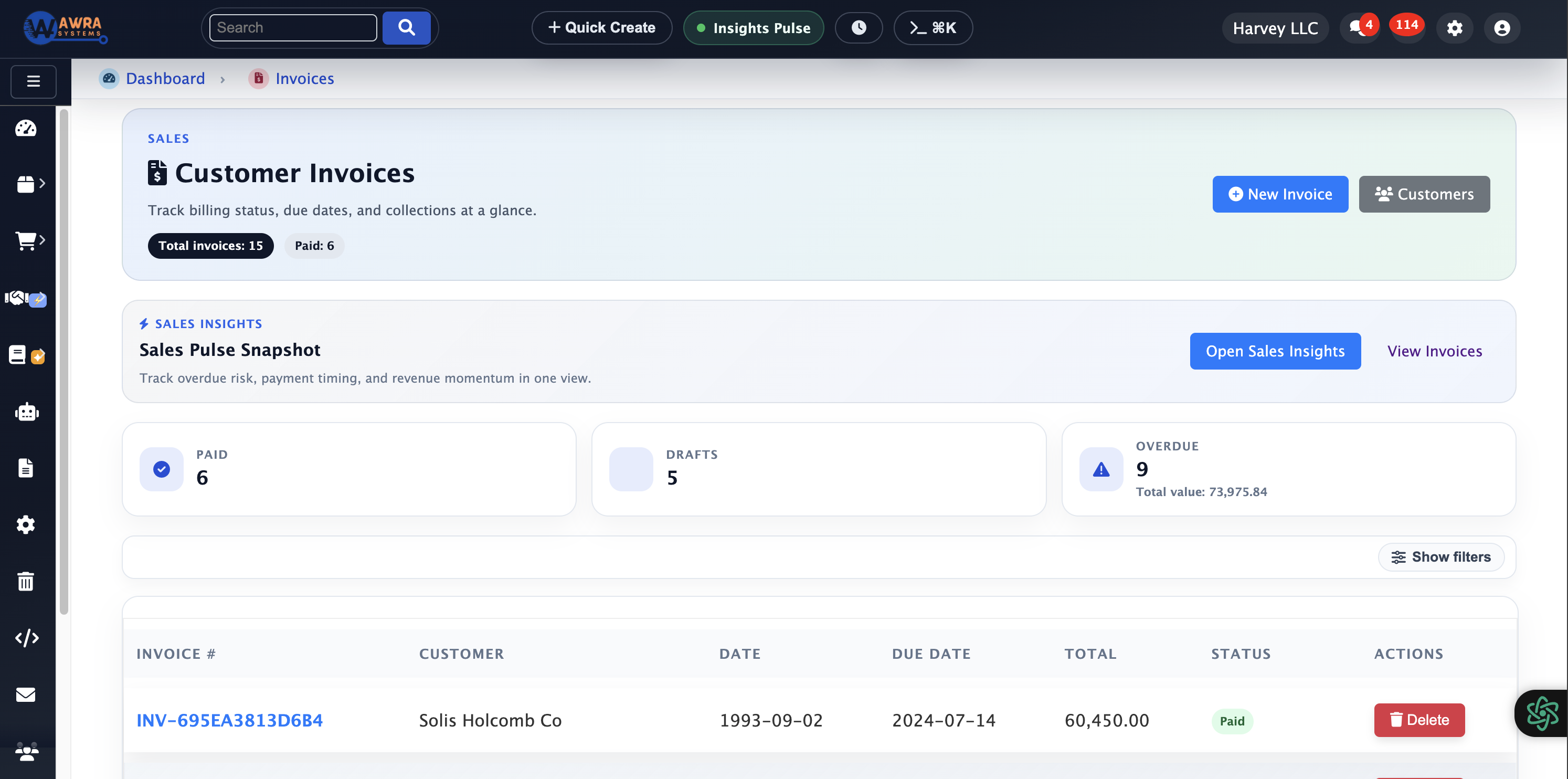
eTIMS isn't a separate app you switch to — it's a connector on your existing sales. Your invoices and POS sales are the same ones you already raise; filing simply adds a KRA step and stamps the result back onto them, with a clear File to eTIMS, Retry or Filed state on every record.
Because credentials live per organisation and the communication key is stored encrypted, each business files under its own PIN — and AWRA even fiscalises the subscription invoices it bills you, under its own KRA registration, so the whole chain is compliant.
Clear scope
Exactly what's live today.
AWRA files invoices and POS sales to KRA eTIMS over the OSCU API — device initialisation, sandbox and production, signed receipts with QR, automatic and manual filing. It's built on modern eTIMS (OSCU), not legacy TIMS/ETR hardware. Tax-category and item-classification mapping is a solid working baseline that we validate against the KRA sandbox and keep refining — so we'd always confirm your specific tax setup with you before you go live in production. Global tax covers multiple tax types with jurisdiction rates and standard, zero-rated and exempt item treatment.
Works across the money flow
Tax touches everything you sell.
The documents eTIMS files and the tax it carries connect the whole revenue side of AWRA:
Questions, answered
KRA eTIMS & tax FAQ.
Does AWRA really file to KRA, or just store the data?
It really files. AWRA connects to KRA's eTIMS OSCU API and submits your customer invoices and POS sales live — in sandbox or production, under your own KRA PIN. KRA returns a receipt number, signature and QR, which AWRA stores and prints on the document.
What do I need to connect?
Your KRA PIN, branch ID and device serial number. You enter them in the eTIMS connector, choose sandbox or production, and initialise the device — AWRA fetches the communication key from KRA and lets you send a test invoice first.
Can filing happen automatically?
Yes. Enable auto-file and choose the document types — customer invoices, POS sales, or both. Filing runs on a background queue with retries, and each document files only once. You can always file or retry manually too.
What appears on the customer's invoice?
Once filed, the invoice PDF and POS receipt show a KRA eTIMS block with the receipt number, signature and a scannable QR code, beneath your normal VAT breakdown — a complete, verifiable fiscal invoice.
Can a business customer claim the input VAT?
Yes. If the customer record carries a KRA PIN, it goes to KRA as the buyer PIN on the invoice, POS sale or credit note, so the sale files as business-to-business and a VAT-registered buyer can claim the input VAT. A PIN in the wrong shape files as a consumer sale rather than having the whole document rejected.
Which taxes and rates are supported?
Multiple tax types (VAT, GST, sales tax and more), enabled per organisation, with jurisdiction rates like Kenya VAT 16% drawn from a maintained rate table. Items can be standard, zero-rated or exempt, and pricing can be tax-inclusive or exclusive.
Is this the old TIMS/ETR or the new eTIMS?
The new eTIMS, using the software-based OSCU approach — no legacy control-unit hardware. We validate the tax-category and classification mapping against the KRA sandbox and confirm your setup with you before you file in production.
Compliant by default
Stop treating KRA as a second job.
Connect your PIN once, and let every sale file itself — signed, stamped and QR-verified — while your tax stays correct underneath.