
Ask AwraIQ about features, pricing, onboarding, login, integrations, security, demos, mobile apps, automation, reports, or support.
Integration Playbooks
Reference patterns for reliable, governed data movement
Turn integration strategy into execution steps for stock, procurement, assets, finance, reports, vendors, mobile offline queues, and governed automation.
Whether you are syncing commerce systems, accounting tools, ERP data, BI dashboards, or field operations, the goal is the same: traceable workflows, predictable retries, clear ownership, and recoverable failures.
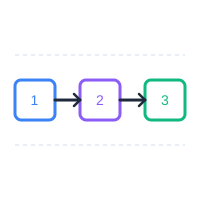
Playbook 1: API-first sync
Use API polling for baseline synchronization with deterministic retries, pagination controls, field mapping, and backoff strategies.
Open API GuidePlaybook 2: Webhook events
Adopt webhook-driven updates for low-latency stock, procurement and finance events — transfers, low stock, purchase orders, invoices created and paid, new customers and vendors — with idempotent consumers and signature validation. Approvals reach a webhook through a workflow action.
Explore workflow automationPlaybook 3: Financial sync
Map invoices, payments, vendor spend, taxes, credits, and reconciliation checkpoints into accounting workflows without losing operational context.
Explore financial governancePlaybook 4: Inventory and asset events
Sync stock movements, transfers, asset custody changes, QR lookups, and GPS-backed field proof into downstream systems.
Explore asset trackingPlaybook 5: Mobile offline sync
Design queue and replay flows for field teams so offline actions can sync safely once connectivity returns.
Explore offline syncPlaybook 6: Reporting exports
Feed BI dashboards and leadership packs with governed exports, stable schemas, and exception-aware refresh cycles.
Explore reports and BI
Architecture principles behind the playbooks
Integration failures usually come from hidden assumptions: non-idempotent writes, missing traceability, unclear ownership of retries, ungoverned exports, and no strategy for partial failures. These playbooks address those fault lines directly so production behavior remains predictable.
Strong integrations are observable. Every transaction path should be traceable from source event to destination write, whether the event is a stock movement, asset custody update, invoice, approval, vendor quotation, or mobile offline sync.
We recommend decoupled processing boundaries. Instead of chaining synchronous calls across multiple systems in critical paths, use resilient queues, state transitions, and reviewable exception queues to absorb spikes and third-party downtime.
Data contracts matter. Define explicit field mappings, validation rules, version handling, permission scopes, export boundaries, and fallback behavior. Contract discipline reduces breakage when either side evolves independently.
Recommended delivery sequence
Start with read-only sync to validate mapping, identity scopes, and data quality.
Add write-back paths for inventory, procurement, finance, or asset events with strict idempotency controls.
Enable event flows with dead-letter handling, replay tooling, and owner alerts.
Introduce reconciliation jobs, audit exports, and exception thresholds before scaling volume.
Common anti-patterns to avoid
Writing directly to production ledgers without staged validation.
Treating webhook delivery as guaranteed instead of eventually consistent.
Ignoring timezone, currency, SKU, warehouse, or asset-ID normalization in multi-region operations.
Letting integration service accounts bypass role and access boundaries.
Skipping replay tooling, which makes incident recovery slower and less reliable.
Need an implementation playbook for your stack?
Share your systems and target workflows. We can provide a tailored rollout model for APIs, finance sync, mobile queueing, BI exports, and governed automation.
Deployment guardrails for integration teams
Before activating production writes, integration teams should validate rate limits, permission scopes, replay behavior, audit trails, and failure recovery sequencing.
For accounting-linked workflows, we recommend strict reconciliation intervals and exception queues so discrepancies are detected before period close.
For stock-critical workflows, validate timezone, warehouse, SKU, bin, and unit normalization early to avoid silent data drift between systems.
For asset, mobile, and reporting workflows, test QR identity, GPS evidence, offline queues, sync conflicts, export schemas, and refresh failure ownership.
Help Center
Need a quick answer while you read?
Run inventory, procurement, assets, sales, and field work with approved AWRA guidance for setup, migration, integrations, security, pricing, and support.