Understocked Locations
Identify branches, warehouses, shelves, or bins sitting below reorder point before teams lose availability.
AWRA Inventory Balancing turns warehouse and branch stock levels into transfer-ready replenishment suggestions. Teams can see which locations are understocked, where surplus exists, how much should move, and which recommendations need urgent action.
Marketable operational intelligence
Multi-location teams often have the same problem twice: one branch is running out while another branch is sitting on surplus. Without a balancing layer, the answer becomes emergency purchasing, delayed fulfillment, manual WhatsApp checks, and expensive last-minute transfers.
AWRA uses reorder points, location quantities, warehouse stock, and item movement context to surface practical internal transfer suggestions. The goal is simple: move stock from where it is idle to where it is needed before customers, field teams, or operations managers feel the shortage.
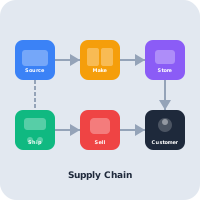
Suggestion engine
The internal `inventory.balancing.*` workflow already reviews item quantities by warehouse and location. This public page explains the value: fewer stockouts, fewer unnecessary purchases, and faster internal movement decisions.
Identify branches, warehouses, shelves, or bins sitting below reorder point before teams lose availability.
Find locations with more stock than they need so internal movement can happen before new buying.
Calculate practical transfer quantities based on target need and source surplus.
Flag zero-stock and high-risk lines so urgent replenishment work rises above routine review.
Workflow discipline
Balancing only works when recommendations can become action. AWRA connects stock health review to transfer creation so warehouse teams can move from “this branch is low” to “create the right transfer” with less manual lookup.

AWRA groups item stock by warehouse and location so the system understands where each quantity actually sits.
Locations below reorder point become replenishment targets, while locations above reorder point become possible sources.
The system pairs understocked locations with surplus locations for the same item and proposes a quantity to move.
Teams can review the recommendation and use it as the basis for a controlled transfer request.
Transfer records preserve source, destination, item, quantity, approval, and movement history for later reporting.
Smart Recommendations
A balancing signal is strongest when teams can prove the source stock is real, move it through a controlled transfer, and watch the operational impact afterward.
Convert a surplus-to-shortage recommendation into a controlled movement with source, destination, quantity, status, and approval history.
Open recommendationUse cycle counts and variance review to make replenishment suggestions more reliable before stock moves.
Open recommendationReview velocity, pressure, slow-moving stock, and risk patterns behind the recommendation before teams act.
Open recommendationTeams balancing stock often add
Multi-location command
A central warehouse may have plenty of a fast-moving item, while a branch, project site, service team, or retail shelf has none. Balancing suggestions help teams see that distinction clearly instead of treating total company stock as a false comfort.
Location
Zero stock on priority item. Needs immediate replenishment from nearby surplus.
Signal
Below reorder point, high velocity, customer-facing location.
Source
Surplus stock available without breaking its own reorder threshold.
Action
Transfer suggestion ready for warehouse review.
Location
Demand window is close, and current stock cannot cover planned work.
Signal
Still moving, but margin of safety is disappearing.
Source
Bulk rack has enough available surplus for planned issue.
Action
Recommended before emergency purchase is triggered.
Prevention economics
The best replenishment decision is not always “buy more.” Sometimes the cleanest answer is to move existing stock to the right place, protect cash, and keep procurement focused on items that truly need external sourcing.
Surface locations falling below reorder point before service, sales, or production is interrupted.
Highlight locations carrying excess stock so capital is not trapped where demand is weak.
Move available stock across branches before creating unnecessary purchase pressure.
Use replenishment suggestions to support procurement timing, vendor planning, and budget control.
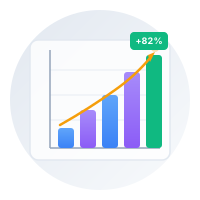
Connected AWRA workflows
The public value story is broader than one suggestions table. It connects stock control, warehouse management, transfers, reports, intelligent insights, and procurement timing into one practical replenishment discipline.
Keep item, warehouse, reorder point, and location quantity data clean enough for recommendations.
Understand where stock sits physically so recommendations point to real movement paths.
Turn balancing recommendations into controlled internal movement records.
Use count accuracy to make replenishment recommendations more trustworthy.
Review pressure, velocity, and risk patterns behind replenishment decisions.
Escalate to purchasing only when internal balancing cannot cover demand.
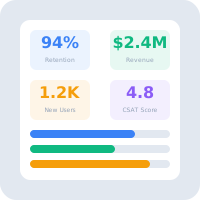
Leadership outcomes
Inventory balancing gives leaders a more useful question than “how much stock do we have?” It asks where stock is needed, where stock is idle, how quickly the gap should be closed, and whether internal movement can solve the problem before procurement spends more money.
Keep high-demand locations stocked with fewer manual follow-ups.
Use surplus stock before triggering external replenishment.
Create recommended moves with clear source, destination, and quantity.
Make replenishment review part of daily or weekly stock health routines.
Help Center
Run inventory, procurement, assets, sales, and field work with approved AWRA guidance for setup, migration, integrations, security, pricing, and support.