/ˈaʊ.rə/ · noun · full name AWRA OpsHub · used worldwide
AWRA is a business operations platform used by organizations worldwide. It runs inventory, procurement, sales and point of sale, fixed assets, HR and payroll, projects, helpdesk and accounting — nine parts of a business working off one set of records, in your own currency and under your own country's tax rules.
Operations don't happen in separate systems. So AWRA doesn't keep separate records.
Most organizations end up running the same event through four places. A purchase is requested in a spreadsheet, ordered by email, received on a paper delivery note, and paid from a bank statement someone reconciles at month end. Every hand-off is a chance for the numbers to drift apart — and by the time they do, nobody can say which version was right.
AWRA treats that as one chain of records. The purchase request becomes the order, the order becomes the goods receipt, the receipt matches the invoice, and the payment closes the loop against the same document. Stock moves when goods arrive, not when someone remembers to update a sheet. The ledger entry is a consequence of the work, not a separate act of data entry.
That is why the modules are not really separate products. Approvals, people, branches, documents and the audit trail are shared underneath all of them, so a stock figure, a supplier balance and a profit number can be reconciled against each other instead of argued about in a meeting.
What AWRA does
Nine modules, one system of record
Each of these is a full module, not a tab. Start with one — most organizations start with inventory or procurement — and switch on the rest as you need them. Nothing gets re-entered when you do.
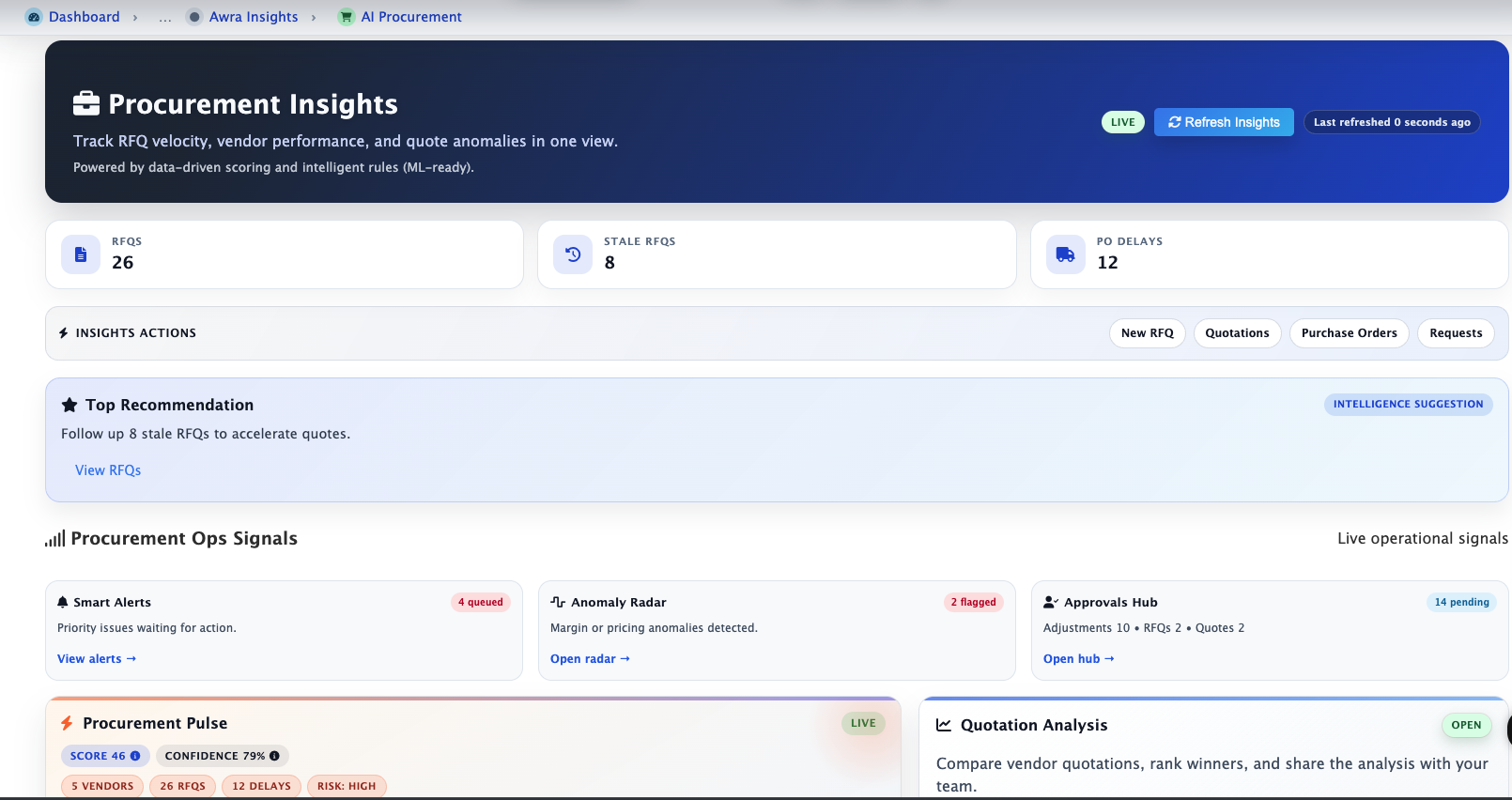
Procurement is where money leaves and where control is usually thinnest. AWRA keeps the whole path in one thread and flags the parts that stall.
Requests route to the right approver by amount, department or budget line.
RFQs go out to prequalified suppliers; quotes come back comparable side by side.
What arrives is matched against what was ordered, with over-receipts caught at the door.
Stale RFQs, delayed POs and pricing anomalies surface as signals, not surprises.
Procurement insights
Inventory
Stock figures you can act on
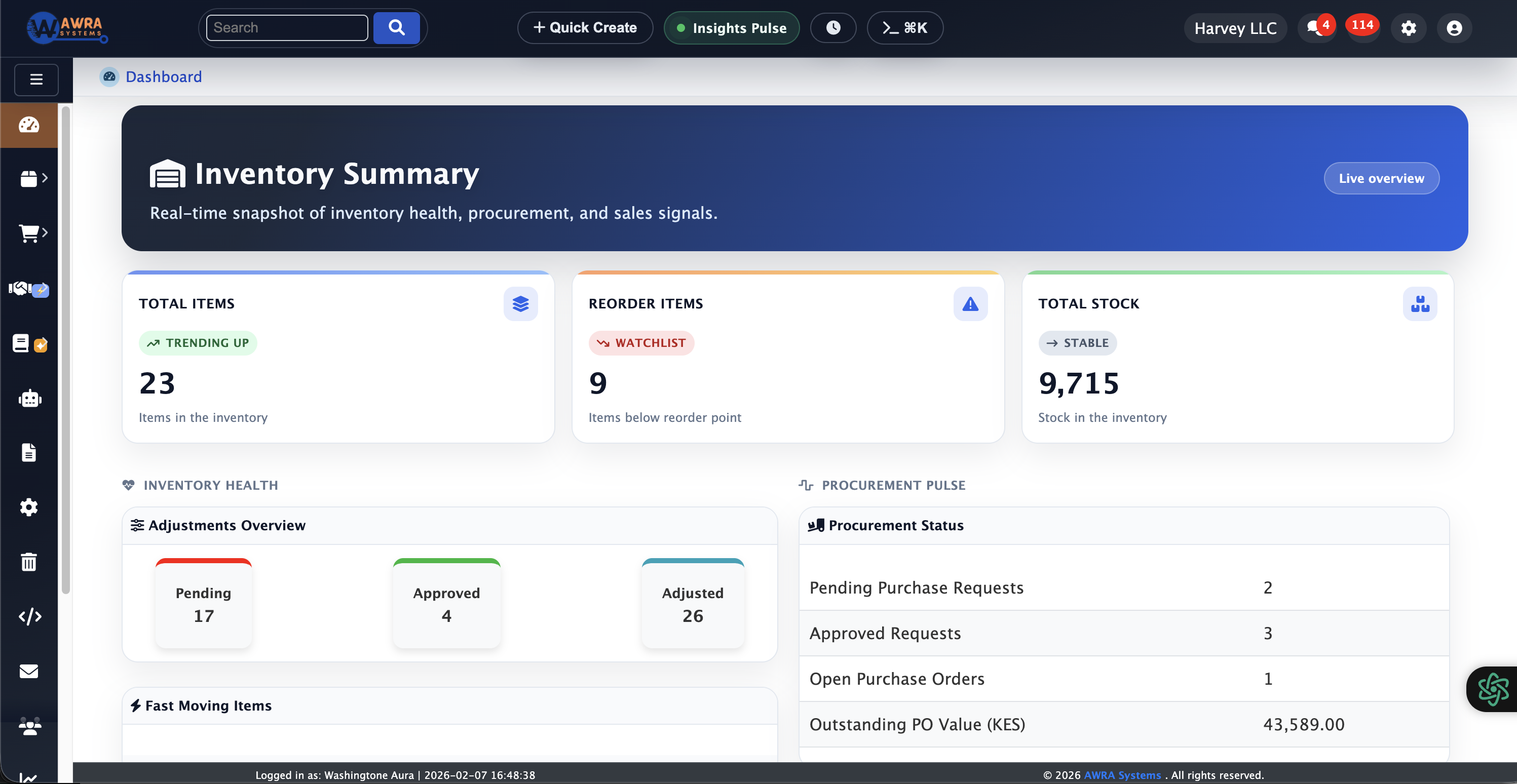
Stock is only useful if you trust it. AWRA tracks movement as it happens and tells you what needs attention today rather than what happened last quarter.
Live quantities per warehouse, store and branch, with transfers in between.
Reorder points, coverage windows and stockout risk flagged ahead of time.
Slow-moving and dead stock separated out so working capital is visible.
Cycle counts and adjustments that leave an audit trail with a name on it.
Inventory dashboard
Finance
Month end that starts already done
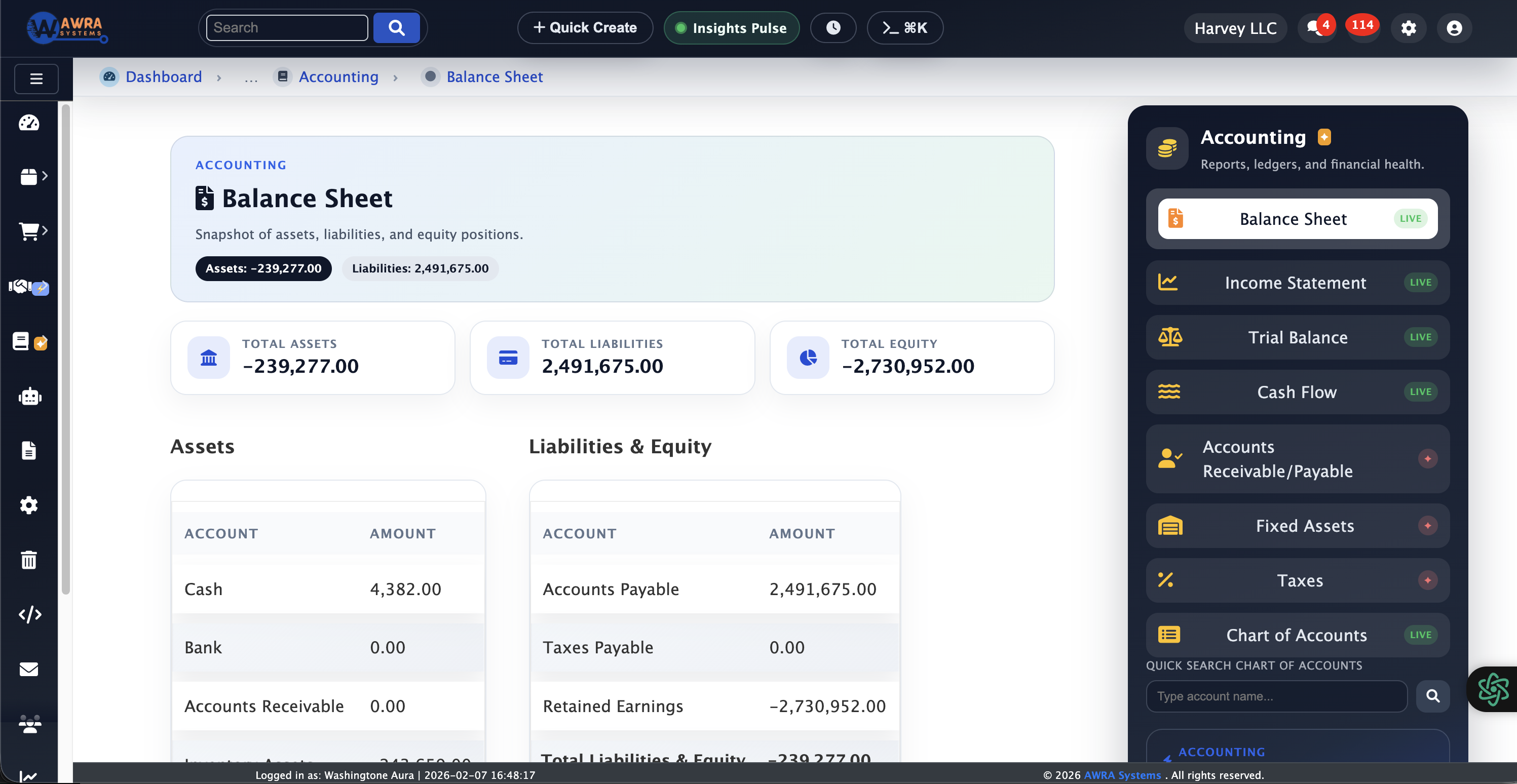
Because every module posts as it goes, closing the books is mostly review rather than reconstruction.
Journals and ledgers built from real transactions, not month-end exports.
Bank, card and mobile money reconciled against actual receipts and payments.
Tax applied by jurisdiction, and e-invoicing filed where the authority requires it.
Reports that trace back to the document that created the number.
Accounting
On the floor
The work happens in the warehouse, not at a desk
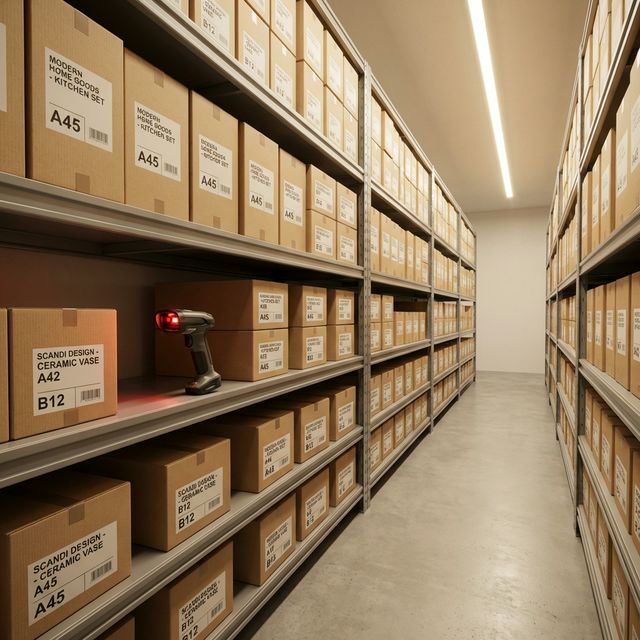
The Android app is where receiving, counting and scanning actually get done. It is built for the conditions those jobs happen in: one hand on a scanner, patchy signal at the back of a store, and no time to type.
It keeps working when the connection drops. Receipts, counts and adjustments queue locally and sync when signal returns, and anything that conflicts is raised for a person to settle rather than silently overwritten. A phone can also pair with the desktop as a scanner, so you don't need dedicated hardware to run a barcode workflow.
AWRA is cloud software with nothing to install, so it runs wherever your teams are. It ships tax and currency profiles for 188 countries across Africa, Europe, the Middle East, Asia, the Americas and Oceania — and every organization operates in its own currency, under its own jurisdiction's rules.
Your currency, not oursEach organization has a base currency, normally resolved from its country. Invoices, receipts and statements are issued in it, and on-screen figures can be displayed in another currency at the live rate for reporting.
Tax by jurisdictionMultiple tax types with per-jurisdiction rates, tax-inclusive or exclusive pricing, and per-item standard, zero-rated or exempt treatment — configured for where you actually trade.
Multi-country operationsGroups running in several countries at once keep separate books and rules per organization while working in the same platform, with the same approvals and the same reporting shapes.
Localized to the last mileWhere a market needs statutory plumbing, it gets it. In Kenya that means live KRA eTIMS filing and M-Pesa as a first-class payment method; that depth is the standard the rest of the localization work is held to.
AWRA is built and operated from Ngong Road, Karen, Nairobi, Kenya. That is where the company is, not where the product stops — it is a global platform engineered under conditions that punish sloppy assumptions about connectivity, currency and compliance, which is a good reason to trust it anywhere else.
If you want the longer version of why it was built this way, that is on our story and why AWRA. For the company itself — who is behind it and how to reach them — see about.
Who uses AWRA
Organizations that need the discipline, not the overhead
Retailers and distributors, schools and churches, NGOs and clinics, construction firms, cooperatives and professional services — on several continents, including groups operating in more than one country at once. What they have in common is not a region: they are big enough that spreadsheets have started to hurt, and not big enough to spend a year on an implementation.
Retail & distributionMulti-branch stock, POS and supplier terms in one place.
NGOs & institutionsBudget lines, approvals and donor-ready audit trails.
Clinics & healthcareBatch and expiry control on consumables that matter.
Sourcing & supply chainSupplier prequalification, RFQs and comparable quotes.
Getting started
What the first week actually looks like
Create your organizationSign up, name your organization, invite the people who need access and set who can approve what. No sales call required to get this far.
Bring in what you haveImport items, suppliers, customers and opening balances from the spreadsheets you already keep. Start with one module rather than all nine.
Run one real cyclePut a genuine purchase or sale through end to end and watch it land in stock and in the ledger. That is the test worth trusting.
Common questions
AWRA, answered plainly
What is AWRA?
AWRA is a business operations platform used by organizations worldwide. Its full name is AWRA OpsHub. It runs inventory, procurement, sales and point of sale, fixed assets, HR and payroll, projects, helpdesk and accounting in one connected system, so the purchase order, the stock it delivers and the payment it settles are the same record rather than three.
Is AWRA the same as AWRA OpsHub?
Yes. AWRA OpsHub is the full product name and AWRA is the short form people use day to day. Same platform, same company.
Can I use AWRA outside Kenya?
Yes. AWRA is a global product. It ships tax and currency profiles for 188 countries across Africa, Europe, the Middle East, Asia, the Americas and Oceania, and each organization runs in its own base currency with its own tax rules, jurisdictions and rates. It is cloud software, so there is nothing to install wherever your teams are.
Who makes AWRA?
AWRA OpsHub is built and operated from Nairobi, Kenya, and was founded by Washingtone Aura. The company is headquartered in Nairobi; the product itself is used by organizations internationally.
Is AWRA an ERP?
Functionally yes, though it is built for organizations that need the discipline of an ERP without the implementation budget of one. You can start with a single module, such as inventory, and switch on procurement, sales, finance or HR as you need them. Nothing has to be re-entered when you do.
Does AWRA handle multiple currencies and countries?
Yes. Each organization has a base currency, normally resolved from its country, and every invoice, receipt and statement is issued in it. On-screen figures can also be displayed in another currency at the live exchange rate for reporting purposes. Tax is configured per jurisdiction, with multiple tax types, per-item standard, zero-rated or exempt treatment, and tax-inclusive or exclusive pricing.
What does AWRA cost?
AWRA is a subscription that scales by the people and modules you use. Plans are quoted in Kenyan shillings with a live-rate US dollar equivalent shown, so international buyers can see the price in familiar terms. You can start free, and current pricing is on the pricing page.
Does AWRA work offline?
The Android app does. Warehouse and field teams can keep receiving, counting and scanning with no signal, and the work syncs when the connection returns. Conflicts are surfaced for a person to resolve rather than silently overwritten.
Where do I log in to AWRA?
Existing users sign in from the login page on this site. Suppliers and vendors invited by an organization sign in through the separate vendor portal login.
How do I get help with AWRA?
Start with the help center, or contact the team directly. There is also an academy with structured courses and certification, and in-app support chat for users inside the platform.