


Ask AwraIQ about features, pricing, onboarding, login, integrations, security, demos, mobile apps, automation, reports, or support.
Blog Category
Real Estate & Property
Rent and service-charge collection, arrears, maintenance and work orders, and the deposits and landlord funds a manager holds in trust.
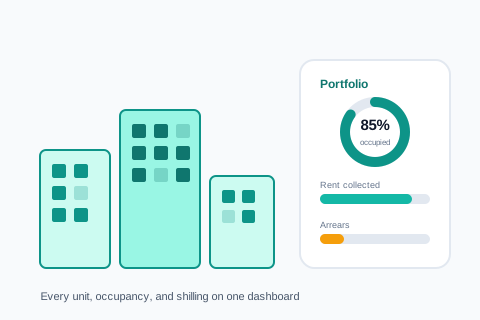
15 articles in real estate and property management.
Real Estate & Property
The Receipt Numbered 58 After 41
A tenant asks why their receipt is numbered 58 when last month's was 41. It is a fair question with an answer — and until August 2026 the honest answer for five document types was that the missing numbers belonged to somebody else's business.
Read
Real Estate & Property
Within One Working Day
A lease promising a response "within one working day" and a system counting twenty-four wall-clock hours agree from Monday to Thursday. On Friday afternoon they part company. Two clocks, which obligation needs which, and the wait that keeps consuming your target.
Read
Real Estate & Property
The Resident Has No Login
A tenant with a leaking tap is not going to be given a user account, a password policy and a role. Two ways of taking work from someone who is not a user already exist — for employees and for suppliers — and neither is pointed at your residents. What that costs, and what a portal would actually save.
Read
Real Estate & Property
The Reminder That Treats Everyone the Same
Arrears chasing works because it escalates — a nudge, a call, a letter, a decision. The plain reminder runs on one organization-wide cadence; the dunning ladder sends a different message at each stage of overdue by email, SMS or WhatsApp. What each is worth, and the rungs that stay human.
Read
Real Estate & Property
The Report Nobody Has to Remember to Send
Owners rarely leave over a bad month. They leave over the month the statement went out on the eleventh because somebody was on leave. What can be scheduled, why the day of month stops at twenty-eight, and the three reports worth automating.
Read
Real Estate & Property
Rent Is Not Rent: Residential, Commercial and the Electronic Invoice
Residential and commercial letting sit in different tax regimes with different invoice obligations. And the compliance risk in eTIMS is not the invoices that transmit — it is the ones that quietly did not.
Read
Real Estate & Property
Under Budget and In Trouble: Service Charge Reconciliation
A scheme can come in under budget and be heading for a special levy, because the operating shortfall quietly ate the reserve contribution. Only line-level variance shows it — a total never will.
Read
Real Estate & Property
The Document That Keeps the Mandate: Owner Statements and Payouts
Owners do not leave because rent was late. They leave because the statement did not tell them whether it arrived. Four numbers that must reconcile, and the client-account check that protects the agency.
Read
Real Estate & Property
No Such Thing as a Unit: Modelling Property in Generic Software
A building becomes a project, a unit becomes a naming convention, a tenant becomes a customer. Which stand-in you pick decides what you can report for five years — and a department will quietly fail you.
Read
Real Estate & Property
Leases, Renewals & Vacancy: The Calendar That Protects Income
A lease that expires unnoticed costs more than a month of rent — it costs the negotiation you never had. Four dates per lease, what a turnover truly costs, and why the renewal conversation belongs at ninety days.
Read
Real Estate & Property
Water, Power & Recharges: Billing Utilities Without Losing Money
A recharge recovering 88% of a bulk bill loses money every month, invisibly. The recovery ratio per building, why you record readings rather than consumption, and the handover reading that ends a whole category of dispute.
Read
Real Estate & Property
Deposits & Landlord Funds: Money You Hold in Trust
Most money flowing through an agency is not the agency's to spend. Keeping deposits, landlord funds, and agency income provably separate is the discipline that prevents disaster.
Read
Real Estate & Property
Maintenance & Work-Order Control for Property Managers
Maintenance is where agencies lose money and trust at once — through repairs nobody tracked, approved, or verified. A work-order discipline from report to verified-closed.
Read
Real Estate & Property
Property Management in Kenya: Rent, Maintenance & Trust (2026)
A managing agent is trusted with other people's buildings and other people's money. The four disciplines — collection, maintenance, trust funds, and owner reporting — that keep both in good order.
Read
Real Estate & Property
Rent & Service-Charge Collection: Billing, Arrears & M-Pesa
Collection is the heartbeat of an agency and where most bleed time. The cycle that ends the monthly matching game, ages arrears into a managed list, and reconciles every channel.
Read
No articles match your search yet — try another keyword.
Product pages for real estate and property management
What is built today for this part of the operation, and what is still on the roadmap.
More topics
Inventory Insights Procurement Insights Sales Insights Accounting Insights Security & Compliance AI & Insights Operations Metrics NGOs & Nonprofits Kenya Business Guides Retail & Distribution Schools & Education Healthcare & Clinics Manufacturing & Agribusiness SACCOs & Microfinance Logistics & Field Service Hospitality East Africa Guides Construction & Contractors Professional Services Churches & Faith Organizations Agribusiness & Cooperatives HR & Payroll Projects & Job Costing Assets & Equipment Point of Sale Helpdesk & Support Reports & BI Africa Business Guides Implementation & Rollout Integrations & Data Pricing, Cost & ROI Automotive & Spare Parts Devices, Scanning & Hardware Pharmacy & Pharmaceutical Distribution Public Sector & County Government
Browse by market instead
Each hub opens with the currency, tax and filing context for that region.
Help Center
Need a quick answer while you read?
Run inventory, procurement, assets, sales, and field work with approved AWRA guidance for setup, migration, integrations, security, pricing, and support.