Maintenance & Work-Order Control for Property Managers
Maintenance is where property agencies lose money and trust at the same time — through repairs nobody tracked, approved, or verified. A work-order discipline turns "someone will send a guy" into an accountable record from report to closed.
Ask a property owner what frustrates them most about their managing agent and the answer is rarely the rent — it is the repairs. A tap was reported leaking three weeks ago and is still leaking. An invoice arrived for a paint job the owner never approved. A "fixed" gate is broken again and nobody kept a record of the first repair. Every one of these is the same root failure: maintenance handled by memory and phone calls instead of a tracked process. A work-order discipline fixes it by making every repair a record that moves through defined stages — and cannot quietly fall through the cracks or bill for work that never happened.
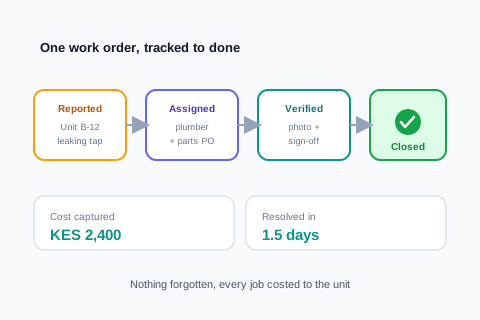
The work-order lifecycle
A work order is simply a maintenance issue that the system refuses to lose. It moves through stages, and each stage adds accountability the phone-call approach never had.
-
Reported
Any issue — from a resident, a caretaker, an inspection — is logged against a specific unit or common area, with a description and, ideally, a photo. It now exists in one place, not in someone's head.
-
Triaged & approved
The issue is prioritised and, if it will cost more than a set threshold, approved before work starts — so owners are not billed for spend nobody sanctioned.
-
Assigned
A contractor or in-house team is assigned, and any parts are bought on a proper purchase order rather than an unrecorded cash run.
-
Verified
The job is confirmed genuinely done — a completion photo, a sign-off, or a resident confirmation — before it can be closed. This is the control that ends "fixed on paper" disputes.
-
Closed & costed
The job closes with its full cost attributed to whatever the smallest dimension you can reach is — which is the test to apply to any system you evaluate, because a lifecycle that ends without a cost against a building tells an owner nothing.
Why verification is the control that matters
Of all the stages, verification is the one that changes the relationship with owners. The most common maintenance dispute is not about price — it is about whether the work happened at all, or happened properly. When a job can only be closed with evidence, the agency can show any owner exactly what was done, when, by whom, and at what cost. That single requirement removes the suspicion that quietly erodes trust, and it protects the honest agency from being lumped in with the ones that bill for phantom repairs.
Planned maintenance beats reactive every time
Work orders also unlock the shift from reactive to planned maintenance. Recurring tasks — servicing a generator, cleaning a water tank, inspecting fire equipment — can be scheduled so they appear before something breaks. Be precise about what carries that schedule, though. For building plant — the generator, the pump, the lift — it is the asset register, where a preventive schedule on a fixed calendar or from the last service opens a work order when the service falls due; for anything that is not a registered asset, it is a recurring task. Planned maintenance is cheaper than emergency repair and protects the building's value, which is exactly what an owner is paying an agent to do. Costing it per machine comes with the work order; per building means adopting the standing-project convention; per unit is not reachable at all.
A repair is not done because someone says so — it is done because it was verified. That one rule ends most owner disputes.
The discipline behind trusted maintenance
Maintenance is one of the four pillars of property management operations, and the one owners judge most directly. Handled as tracked, verified, costed work orders — with parts bought on approved purchase orders — it turns the agency's most complaint-prone function into a demonstrable strength, and gives every repair a place on the owner statement that reconciles without a scramble.
What AWRA OpsHub does today
- Tasks come close on the lifecycle — assignee, priority, due date, checklist items, comments, watchers, attachments including photos, dependencies and recurrence. Reported, assigned, done and closed all have a home.
- Approval before spend exists on the buying side. A purchase requisition crosses a configured threshold and needs approval before a purchase order can be raised, so parts and contractor work bought properly are governed.
- Contractors are vendors — with purchase orders, receiving, three-way matching, on-time performance and payment out by bank or M-Pesa, all recorded.
- Recurring tasks can carry a planned-maintenance schedule: generator service, tank cleaning, fire equipment inspection.
- Work orders on building plant. A generator, pump or lift registered as an asset takes preventive schedules, on a fixed calendar or from the last service, that open work orders automatically — preventive, corrective or inspection — with an assignee, a repair vendor, labour, parts and other cost, and a completion record.
More we can add to your workspace
- A work order on a unit or a property. Work orders exist for registered plant and carry their cost; a leaking tap in Flat 3B has no asset to hang one on, so a unit, a property and an owner on the work order are the addition.
- A repair costed to a unit. An expense codes to a category and a project today and carries no department, so a unit or building dimension needs either that field or one standing project per building. It is also what lets a repair flow onto an owner statement — itself a build: see owner statements and payouts.
- Verification as a gate rather than a convention. You can require a photo by writing it into a checklist today; refusing to close the task without one is the build, and it is the post’s central control.
- An approval threshold on maintenance spend as such — only on procurement. A job done by an in-house team with stock off the shelf passes no gate.
- A resident or reporter role, giving a tenant a channel to report an issue. Today issues are logged by staff.
The lifecycle in this post is a good one and you can approximate four of its five stages with tasks and procurement. But the stage that matters most — verified before it can be closed — is precisely the one we do not enforce, and the costing that makes the whole thing worth doing needs a unit entity we do not have. If maintenance accountability is the single reason you are looking, the standard product does not close it today — so ask us for the scope rather than the demo. A unit entity on a building and a completion that cannot be closed without its evidence are both ordinary builds of the kind clients commission most often, and neither waits on anything outside our control. What you should not do is buy on the assumption that configuration alone gets you there.
Anything above that you need, we can build for you
Everything listed above as something we can add describes what ships in the standard product today — it is a starting point, not a limit on what AWRA OpsHub can do for your organisation. Kenya's eTIMS integration and its maintained payroll engine are both in the product because clients needed them and commissioned them; neither appeared by itself, and the same door is open for whatever you just read about. One qualification so this is worth what it claims: a small number of things on this blog we deliberately leave to a specialist rather than build — a statutory ledger we will not sign our name to, a rule that would decide a tax question for you, a clinical or member-funds record that belongs in a regulated system — and where that is true the post says so in those words. Everything else is a scope, a timeline and a price.
The operational work, which is what most commissions actually are
An extra approval stage in a chain that does not match the standard one, a custom field set on employees or assets that only your sector needs, an expiry that has to block an order rather than send an email, a report your board asks for in a shape nothing produces, or a scanner or weighbridge feeding the goods-in door. These are the commissions we are asked for most often and the smallest ones we quote — and unlike a revenue-authority pipeline, none of them waits on a regulator.
The module-shaped additions, which are the ones readers ask for most often
A price list with real discount authority, a customer-facing quotation that expires, a bill of materials or recipe costing, a staff advance that is issued, acquitted and chased, a member or unit ledger, a matching rule that holds a payment. Each of these is a build rather than a setting, and each has been quoted before — a bigger piece of work than a custom field, with a written spec and a date instead of a roadmap slide.
The report, document or pack nothing currently produces
The board pack in the shape your board actually asks for, a donor or funder layout, an invoice or receipt template carrying what your regulator or your customer expects, a dataset the report builder cannot reach yet. Usually the fastest thing on this list to deliver, because the data is already in the system.
Systems, rails and hardware you already run
The accounting package, CRM, online store, core banking or custom database you intend to keep — connected through our API so a fact is entered once and appears everywhere it is needed. Plus the physical edge: a scanner, a scale, a weighbridge or a till peripheral feeding the door it belongs to.
How it works: you describe the requirement, we return a written scope, timeline and cost, and once agreed it is built into your environment and maintained as part of the product. Nothing here waits on a regulator or a published specification, which is why operational builds are the ones we quote fastest. Tell us the requirement that would otherwise rule us out — that is a better first conversation than a demo.
Tell us what your operation needsMake every repair accountable
Tasks with photos, checklists, approvals and recurrence, plus contractor spend governed through procurement. Work orders with their cost on building plant such as generators and lifts; a unit-costed, verification-gated work order is scoped in the note above.
Explore property management operationsFrequently asked questions
What is a maintenance work order?
It is a maintenance issue tracked as a record that moves through defined stages — reported, triaged and approved, assigned, verified, and closed — with its cost attributed to the right unit and owner. It replaces phone-call-and-receipt maintenance, so nothing is forgotten, spend is approved before it happens, and no job is billed without proof it was done.
Why is verification before closing so important?
Because the most common maintenance dispute is whether a repair actually happened or was done properly — not its price. Requiring evidence (a photo, sign-off, or resident confirmation) before a work order can close lets the agency prove exactly what was done, protecting owner trust and distinguishing an honest agency from ones that bill for phantom repairs.
How do work orders help with owner statements?
In the model this article describes, each job closes with its cost attributed to a unit and owner, so maintenance flows onto the statement with nothing to reconstruct — the owner sees what was reported, done, verified and charged rather than a list of receipts assembled afterwards. Test it rather than assume it, here included: a task carries no unit, no owner and no cost, an expense reaches a building only through a standing-project convention, and the statement that exists models a party who owes you rather than one you owe. That combination is why this specific benefit is not available here today.
Can work orders support planned, preventive maintenance?
Yes, in two ways. Building plant registered as an asset — a generator, a pump, a lift — takes a preventive schedule, on a fixed calendar or counted from the last service, that opens a work order when the service falls due and chases it once it is overdue, with the cost of the job recorded against the machine. For anything that is not a registered asset, the mechanism is the recurring task — tank cleaning, say — reminded to its assignee while it is due, with the next one created when this one is completed; know that trigger, because a task nobody ticks off produces no next occurrence. Costing planned work per building requires the standing-project convention; per unit is not reachable.