Deposits & Landlord Funds: Money You Hold in Trust
Most of the money flowing through a property agency is not the agency's to spend. Deposits belong to those who paid them; rent belongs to landlords. Keeping those pools provably separate is the discipline that protects an agency from the mistake that ends it.
A property agency handles a lot of money and owns almost none of it. Rent passes through on its way to landlords. Service charge belongs to the building. And deposits — often a month or two of rent per unit — are refundable sums the agency merely holds against the day a lease ends. The single most dangerous habit in the business is treating any of this held money as available money: covering a slow month from the deposit pool, paying one landlord with another's rent, "borrowing" from service charge intending to repay. None of it starts as theft; all of it ends the same way. Keeping the pools separate and provable is not accounting nicety — it is survival.
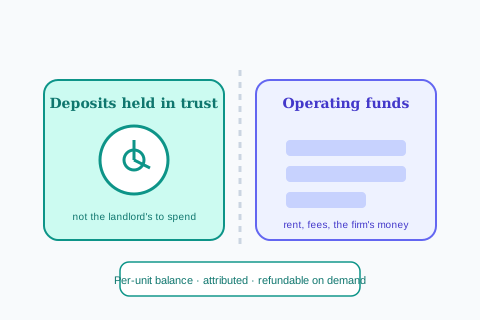
Three pools, never mixed
A clean agency keeps at least three kinds of money mentally and structurally distinct, each with its own accountability:
The distinction sounds obvious and is routinely lost the moment everything lands in one bank account with no per-source tracking. The fix is the same fund-segregation discipline a law firm applies to client money: know, per unit and per landlord, exactly what is held and what is owed, with every movement attributed, so any balance can be demonstrated instantly.
Deposits: refundable money you are minding
A deposit is the clearest case of trust money, because it will almost always be returned. When a lease ends, the deposit is refunded — less any legitimate, documented deductions for damage or arrears — and a renter who paid a deposit is entitled to get it back promptly and in full where nothing is owed. An agency that cannot immediately say what deposit it holds for a given unit, or that has quietly spent deposits on operations, faces exactly the dispute it cannot win. Tracking each deposit as a held, per-unit balance — with any deductions itemised against evidence — makes the refund a routine calculation rather than an argument.
The day you cannot say, to the shilling, what deposit you hold for a unit is the day the agency stopped being trustworthy.
The test every managing agent should pass
Landlord funds: collected is not the same as earned
Rent an agency collects is the landlord's money, not the agency's, until it is remitted. The agency's actual income is only the management fee it has earned. Confusing "money in the account" with "money we can use" is how agencies fund themselves from float they do not own and discover the hole only when several landlords want remitting at once. Tracking landlord funds as a payable — collected, fees deducted, balance owed and remitted — keeps the agency's real financial position honest and visible.
What defensible trust handling looks like
An agency that handles held money well can always:
- State the exact deposit held for any unit, instantly, with any deductions itemised against evidence.
- Show, per landlord, what was collected, what fee was deducted, and what is owed or remitted.
- Keep deposits and landlord funds structurally separate from the agency's own operating money.
- Produce an attributed history of every movement of held money — no anonymous transfers.
- Refund a deposit or remit a landlord on demand, without reconstructing figures from bank statements.
Trust-money discipline is the quiet foundation under everything else in property management. An agency can collect briskly and maintain buildings beautifully, but if it cannot prove that held money is intact and accounted for, it is one dispute away from disaster. Handle the pools separately, track every held balance per unit and per owner, and the agency earns the one thing property owners and renters value above all: the confidence that their money is exactly where it should be.
What AWRA OpsHub does today
- Double-entry accounting with a chart of accounts, so separate accounts for held funds can at least be created and posted to.
- An attributed history on every transaction — who recorded it, when, against what document — across invoices, payments, expenses and vendor payouts.
- One Payments Register covering money in and money out across modules, so no movement is invisible.
- A document vault with access logging, for the lease and deduction evidence a deposit dispute turns on.
More we can add to your workspace
- A trust or client-money capability: a held-funds pool, a segregation rule, a per-source balance, and a block on held money being spent as operating cash.
- A deposit register. A unit and a deposit record, so what is held for a unit is answerable to the shilling.
- A refund workflow, no itemised deductions against evidence, no release approval.
- A landlord ledger. Collected, fee deducted, remitted, owed — per owner — does not exist as a view.
- A sweep or reconciliation between a trust account and its obligations, which is the control that would actually catch a shortfall.
We would rather be blunt here than sell around it, because this is other people’s money and the failure mode is somebody’s deposit. Everything this post recommends is correct, and all of it is a build rather than a setting. Discipline in a spreadsheet, with a genuinely separate bank account, beats our general ledger for this job today. It is high on the list worth commissioning, and it is the same build a law firm needs for client accounts.
Anything above that you need, we can build for you
Everything listed above as something we can add describes what ships in the standard product today — it is a starting point, not a limit on what AWRA OpsHub can do for your organisation. Kenya's eTIMS integration and its maintained payroll engine are both in the product because clients needed them and commissioned them; neither appeared by itself, and the same door is open for whatever you just read about. One qualification so this is worth what it claims: a small number of things on this blog we deliberately leave to a specialist rather than build — a statutory ledger we will not sign our name to, a rule that would decide a tax question for you, a clinical or member-funds record that belongs in a regulated system — and where that is true the post says so in those words. Everything else is a scope, a timeline and a price.
The operational work, which is what most commissions actually are
An extra approval stage in a chain that does not match the standard one, a custom field set on employees or assets that only your sector needs, an expiry that has to block an order rather than send an email, a report your board asks for in a shape nothing produces, or a scanner or weighbridge feeding the goods-in door. These are the commissions we are asked for most often and the smallest ones we quote — and unlike a revenue-authority pipeline, none of them waits on a regulator.
The module-shaped additions, which are the ones readers ask for most often
A price list with real discount authority, a customer-facing quotation that expires, a bill of materials or recipe costing, a staff advance that is issued, acquitted and chased, a member or unit ledger, a matching rule that holds a payment. Each of these is a build rather than a setting, and each has been quoted before — a bigger piece of work than a custom field, with a written spec and a date instead of a roadmap slide.
The report, document or pack nothing currently produces
The board pack in the shape your board actually asks for, a donor or funder layout, an invoice or receipt template carrying what your regulator or your customer expects, a dataset the report builder cannot reach yet. Usually the fastest thing on this list to deliver, because the data is already in the system.
Systems, rails and hardware you already run
The accounting package, CRM, online store, core banking or custom database you intend to keep — connected through our API so a fact is entered once and appears everywhere it is needed. Plus the physical edge: a scanner, a scale, a weighbridge or a till peripheral feeding the door it belongs to.
How it works: you describe the requirement, we return a written scope, timeline and cost, and once agreed it is built into your environment and maintained as part of the product. Nothing here waits on a regulator or a published specification, which is why operational builds are the ones we quote fastest. Tell us the requirement that would otherwise rule us out — that is a better first conversation than a demo.
Tell us what your operation needsKeep held money provably intact
Double-entry accounting, an attributed history on every movement, one register for money in and out, and a document vault. Trust segregation, deposit registers and landlord ledgers are not built — the note above is deliberately blunt about why.
Explore property management operationsFrequently asked questions
Why must deposits be kept separate from an agency's operating money?
Because a deposit is refundable money held in trust — it belongs to the person who paid it and will almost always be returned. Kept separate and tracked per unit, it can be refunded and proven on demand. Spending deposits on operations, even temporarily, is the classic agency failure: it creates a hole that surfaces exactly when a refund is due and cannot be met.
What is the difference between rent collected and agency income?
Rent collected is the landlord's money, owed to them until remitted; the agency's actual income is only the management fee it has earned. Treating all money in the account as usable is how agencies fund themselves from float they do not own. Tracking landlord funds as a payable keeps the agency's true position honest.
How should deposit deductions be handled at the end of a lease?
Any deduction for damage or arrears must be documented against evidence, itemised, and the remaining balance refunded promptly. Tracking each deposit as a held per-unit balance makes the end-of-lease refund a routine calculation with a clear trail, rather than a dispute the agency struggles to substantiate.
How is this like a law firm's client account?
It is structurally identical: money received and held for someone else, kept segregated from the firm's own funds, with every movement attributed so any balance can be demonstrated on demand. Whether it is called a deposit, landlord funds, or client money, the discipline is trust accounting — separate the pools and prove them at any moment.