
Property Management in Kenya: Rent, Maintenance & Trust (2026)
A property manager is trusted with three things that are easy to blur and expensive to confuse: other people's buildings, other people's money, and a promise to keep both in good order. Here is how a well-run agency in Kenya keeps collection tight, maintenance honest, and every shilling accounted for.
Property management looks simple from the outside — collect the rent, fix what breaks, pay the landlord — and is quietly one of the hardest small businesses to run cleanly. The money is almost never the agency's own: rent belongs to landlords, deposits belong to the people who paid them, and service charge belongs to the building. An agency's entire reputation rests on keeping those pools straight, collecting reliably, and being able to show any owner, on demand, exactly what their property earned and what it cost. Do that well and doors keep being handed to you; blur it once and word travels fast. This guide walks the four disciplines that separate a trusted managing agent from a stressed one.
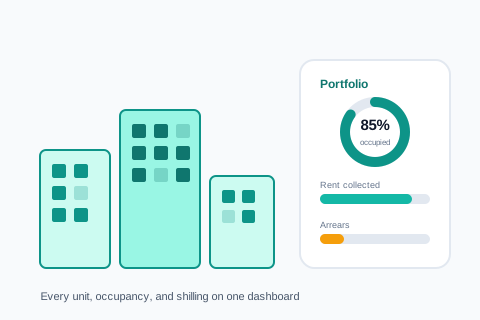
Before the disciplines, the numbers that actually tell you whether an agency is healthy — the ones a good system surfaces without anyone building a report:
1. Collection: reliable, referenced, reconciled
Everything begins with collection, because an agency that cannot collect reliably has nothing else worth discussing. The failure pattern is always the same: rent arrives across M-Pesa, several bank accounts, and the odd cash payment, with no consistent reference, so someone spends the first week of every month matching narrations to units by hand and chasing what "feels" unpaid. The fix is one invoice per unit with a unique payment reference, all channels flowing into one ledger, and overdue balances flagged automatically. That is the whole of rent and service-charge collection done properly — the manager stops being a human matching engine and starts managing the exceptions.
An agency is not judged by the rent it collects, but by how quickly and honestly it can show a landlord where their money is.
The reputation of a managing agent
2. Maintenance: nothing forgotten, everything costed
The second discipline is the one owners feel most: keeping their buildings in good order without money leaking through the repairs. Informal maintenance — a phone call, a handyman, a receipt that turns up later — is where property agencies lose both money and trust, because there is no record of what was reported, who approved it, what it cost, or whether it was actually fixed. Treating each issue as a tracked work order from report to verified completion makes maintenance accountable and costs attributable to the right unit and owner.
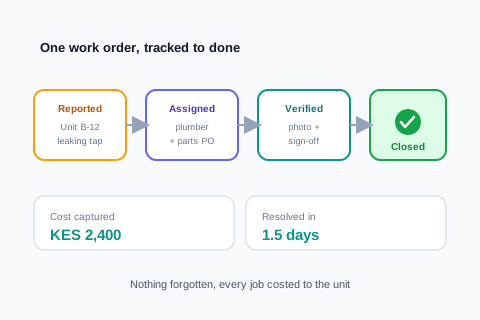
The discipline that makes maintenance trustworthy is verification: a job is not closed because someone says it is done, but because it was confirmed done — a photo, a sign-off, a resident no longer complaining. That single control ends the most common dispute in property management, where an owner is billed for a repair the building never actually received.
3. Trust money: deposits are not income
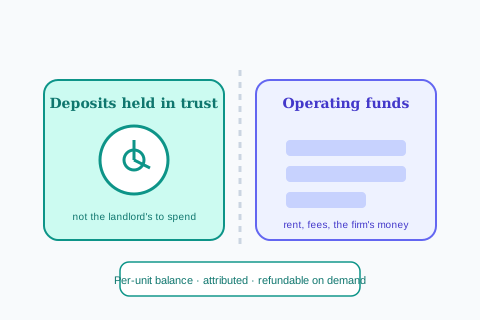
The third discipline is the one that ends careers when it fails. Deposits collected from renters are held in trust — they are refundable money that never belonged to the agency or the landlord — and they must be kept provably separate from operating funds, tracked per unit, and returnable on demand. The temptation, when operating cash is tight, is to dip into deposits "just this once." That is exactly how agencies collapse and managers face claims they cannot answer. Segregating deposits and landlord funds is not optional bookkeeping; it is the line between a managing agent and a cautionary tale.
4. Owner reporting: the statement that keeps the door
The fourth discipline turns the first three into retained clients. Every landlord wants the same thing: a clear, regular statement showing what their property earned, what it cost, what was held back, and what was remitted — without having to ask twice or wait a fortnight. An agency that produces owner statements at the press of a button, backed by a collection ledger and costed work orders that reconcile, earns the trust that makes owners hand over the next building. One that assembles statements by hand, late and inconsistently, loses portfolios to the agency that does not.
Deposits are refundable money you are minding — never the float that covers a slow month.
The one rule that protects a managing agent
None of this requires enterprise software built for a REIT. It requires an operations system for property managers that treats collection, maintenance, trust money, and owner reporting as one connected record — priced for a Kenyan agency and built for how rent is actually paid here. Get those four disciplines onto one system and property management stops being a monthly scramble and becomes the calm, trustworthy service that quietly wins more doors.
What AWRA OpsHub does today
- Invoices, payments and balances per customer — which is how a unit’s rent would be billed and settled today, with the renter or the landlord as the customer.
- M-Pesa Paybill and Till collection — STK push, QR and direct C2B. A payment quoting the invoice number is matched to that invoice automatically and the balance updates without anyone reading a statement.
- An aged receivables report and automated invoice reminders, behind their own permission — the arrears list, if not the arrears-by-unit list.
- Money out, properly — expenses coded to category and project with approval, plus vendor payments including M-Pesa B2C and B2B to a contractor’s phone, and payout runs with an approve-then-post step, all landing on one Payments Register. Note the dimension: an expense carries a project, and no department at all, which is why one standing project per building is the practical convention — see modelling buildings and units.
- Procurement with teeth — requisition, permission-gated approval, RFQ comparison, purchase orders, receiving and three-way matching, with supplier on-time rate, quality score and pricing trend tracked per vendor. The teeth are structural: a purchase order can only be raised from an approved quotation, an over-delivery is refused at the receiving bay, and a mismatched invoice cannot be paid without a written override.
- Recurring invoices — a template per customer that raises its invoice weekly, monthly, quarterly or yearly, and can issue and email it, so a tenant’s rent stops being raised by hand each month.
- Bank reconciliation — a bank statement imported and matched against the ledger, with suggested matches and an auto-match pass.
More we can add to your workspace
- A property, unit, lease, tenancy, landlord or owner entity exists. A building is not something the system knows about. Everything above would be modelled with customers, projects and invoices.
- Trust-money segregation: a held-funds pool, a per-unit deposit balance and a refund workflow, so deposits and landlord funds stop sitting in the same operating balance as everything else.
- An owner statement, computing collected, less fee, less costs, per landlord, per period.
- A work order on a unit. Work orders already exist for registered assets — a generator, a lift, a pump — with labour, parts and vendor cost and a completion record; attaching one to a unit, so a repair is costed there, is the addition.
- Bank receipts matched onto the invoice they pay. M-Pesa payments land on their invoice automatically and bank statements reconcile against the ledger; applying a bank receipt straight to the rent invoice it settles is the addition.
We are publishing this because the disciplines are correct and worth having whatever you run them on. An agency evaluating us should read the middle column first. Property management is a vertical to be built rather than a module to be configured — a set of entities, quoted as scope. If you want us to build it, that conversation is open and we would rather have it honestly than sell you a workaround as a product.
Anything above that you need, we can build for you
Everything listed above as something we can add describes what ships in the standard product today — it is a starting point, not a limit on what AWRA OpsHub can do for your organisation. Kenya's eTIMS integration and its maintained payroll engine are both in the product because clients needed them and commissioned them; neither appeared by itself, and the same door is open for whatever you just read about. One qualification so this is worth what it claims: a small number of things on this blog we deliberately leave to a specialist rather than build — a statutory ledger we will not sign our name to, a rule that would decide a tax question for you, a clinical or member-funds record that belongs in a regulated system — and where that is true the post says so in those words. Everything else is a scope, a timeline and a price.
The operational work, which is what most commissions actually are
An extra approval stage in a chain that does not match the standard one, a custom field set on employees or assets that only your sector needs, an expiry that has to block an order rather than send an email, a report your board asks for in a shape nothing produces, or a scanner or weighbridge feeding the goods-in door. These are the commissions we are asked for most often and the smallest ones we quote — and unlike a revenue-authority pipeline, none of them waits on a regulator.
The module-shaped additions, which are the ones readers ask for most often
A price list with real discount authority, a customer-facing quotation that expires, a bill of materials or recipe costing, a staff advance that is issued, acquitted and chased, a member or unit ledger, a matching rule that holds a payment. Each of these is a build rather than a setting, and each has been quoted before — a bigger piece of work than a custom field, with a written spec and a date instead of a roadmap slide.
The report, document or pack nothing currently produces
The board pack in the shape your board actually asks for, a donor or funder layout, an invoice or receipt template carrying what your regulator or your customer expects, a dataset the report builder cannot reach yet. Usually the fastest thing on this list to deliver, because the data is already in the system.
Systems, rails and hardware you already run
The accounting package, CRM, online store, core banking or custom database you intend to keep — connected through our API so a fact is entered once and appears everywhere it is needed. Plus the physical edge: a scanner, a scale, a weighbridge or a till peripheral feeding the door it belongs to.
How it works: you describe the requirement, we return a written scope, timeline and cost, and once agreed it is built into your environment and maintained as part of the product. Nothing here waits on a regulator or a published specification, which is why operational builds are the ones we quote fastest. Tell us the requirement that would otherwise rule us out — that is a better first conversation than a demo.
Tell us what your operation needsRun your whole portfolio on one system
The money layer under a property agency — invoicing, M-Pesa collection matched to the invoice, aged arrears, approved spend and contractor payouts on one register. Units, leases, deposits and owner statements are not built; the note above is specific about it.
Explore property management operationsFrequently asked questions
What does property management software actually need to do?
Four things, connected: collect and reconcile rent and service charge across M-Pesa, bank, and cash against one invoice per unit; track maintenance as work orders from report to verified completion with costs attributed; hold deposits and landlord funds separately and provably; and generate clear owner statements on demand. Anything that does only some of these leaves the manager doing the rest by hand.
Why must deposits be kept separate from operating funds?
Because deposits are refundable money held in trust — they never belong to the agency or the landlord. Kept separate and tracked per unit, they can be refunded and proven at any moment. Dipping into them to cover operating shortfalls, even temporarily, is how agencies collapse and managers face claims they cannot answer. Segregation is the single most important control in the business.
How do you stop maintenance money from leaking?
Treat every issue as a tracked work order: reported, approved, assigned, and — crucially — verified as actually done before it is closed and billed. That creates a record of what was requested, who approved it, what it cost, and which unit and owner it belongs to. Informal phone-call-and-receipt maintenance is where both money and owner trust are lost.
What makes landlords stay with an agency?
Reliable collection and, above all, transparent reporting. Owners keep handing buildings to agents who can show, clearly and on demand, exactly what a property earned, what it cost, what was held, and what was remitted — backed by a ledger that reconciles. Late, hand-assembled, inconsistent statements are the fastest way to lose a portfolio.
