
Rent Is Not Rent: Residential, Commercial and the Electronic Invoice
Residential rent and commercial rent are taxed under different regimes, invoiced differently, and fail differently. A landlord who runs both through one process is getting one of them wrong.
The most expensive assumption in Kenyan property is that rent is rent. It is not: residential and commercial letting sit in different tax regimes, with different filing rhythms, different invoice requirements and different consequences for getting them wrong. A landlord with four flats and one ground-floor shop is running two tax processes whether or not they know it, and the one they are not thinking about is the one that generates the assessment.
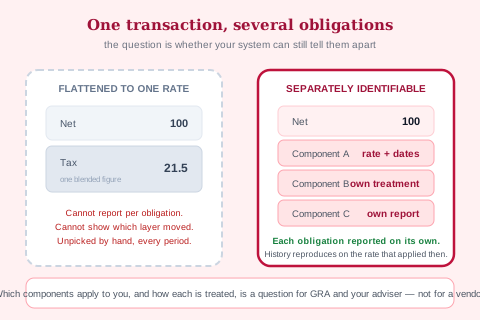
Rates and thresholds change; the structure does not
This post describes how the layers fit together, which is stable, and it names figures as they stood in 2026. Rates, bands and thresholds move with each Finance Act, and eTIMS obligations have been extended more than once. Confirm every number against the current KRA position or with your tax adviser before you act on it — and design your process so a rate change is a configuration edit rather than a rebuild. That last point is the actually useful advice here.
Three layers, and which ones land on you
Layer one is income tax on the rent. Smaller resident landlords fall under the monthly rental income regime — a flat rate on gross rent, filed monthly, with no deduction for expenses. Above the upper threshold, rental income returns to ordinary income or corporation tax on net profit, where expenses, interest and capital allowances all come back into play. The switch between the two is not gradual, and a portfolio growing across the threshold changes tax regime mid-life, which catches people out.
Layer two is VAT, and it is where residential and commercial part company. Residential letting is exempt. Commercial letting is a taxable supply, so a landlord whose commercial rents take them past the registration threshold must register, charge VAT on commercial rent, and issue compliant invoices for it — while charging no VAT on the flats upstairs. Layer three is withholding: agents appointed by the Revenue Authority deduct tax at source from rent they pay over, and rent paid to a non-resident landlord is withheld at a materially higher rate. Withholding is not an extra tax — it is your own tax collected early — but only if you can produce the certificates at filing time.
Where a landlord sits, and what it implies
Two flats, below the lower threshold
Outside the monthly regime entirely. Keep records anyway — the threshold is annual and you can cross it without noticing.
Residential only, inside the monthly band
One monthly filing on gross rent, no expense deductions, no VAT. The simplest position, and the one where poor records cost least.
Mixed residential and commercial, below VAT registration
Still no VAT, but you now need the split recorded, because you will cross the threshold on the commercial side first.
Mixed, VAT-registered
Two invoice types, one of them VAT-compliant and electronically transmitted, plus monthly VAT returns alongside the income filing.
Above the upper income threshold, VAT-registered, using an appointed agent
Net-basis income tax with expenses and allowances, VAT on the commercial portion, and withholding certificates to reconcile. Every layer at once.
The jump that surprises people is the third to the fourth. Crossing the VAT threshold does not make the tax bigger so much as it makes the invoicing a compliance surface — and invoicing was the part being done informally.
The electronic invoice is the real operational change
Of everything on this page, electronic tax invoicing is what genuinely changes how a property business runs day to day. A rent demand used to be a message. Under eTIMS it becomes a document that must be generated in a prescribed structure, transmitted, and stamped with a control number and a signature returned by the system — and it is that returned data, not your copy, which makes the invoice valid. Two consequences follow, and both are practical rather than theoretical.
First, your tenant's deduction depends on your compliance. A commercial tenant who cannot produce a compliant invoice for their rent may lose the deduction, which makes your invoicing their problem — and they will raise it, usually at the point you want a lease renewed. Second, transmission can fail. Portals are down, connections drop, submissions get rejected for a malformed field. An invoice that never reached the system is not merely unfiled; it may be invalid. So the operationally important question about any system is not whether it can file, but what it does with the failures.
What vendors demonstrate
- A successful submission, live on screen, with the control number returned.
- A neat invoice layout carrying the QR code.
- A count of invoices filed this month.
- Configuration screens for credentials and branch codes.
What decides whether you are compliant
- What happens when a submission fails — is it queued, retried, or silently dropped?
- Whether you can list every invoice that was raised but never successfully transmitted.
- Whether the failure is visible to the person who raised the invoice, or only in a log.
- Whether a credit note or a cancellation is transmitted too, not just the original.
- Whether the returned control number is stored against the invoice, so you can prove validity later.
| Obligation | Residential letting | Commercial letting |
|---|---|---|
| Income tax basis | Flat rate on gross within the monthly band; net basis above it | Same regime by income level, but commercial is more often above the threshold |
| Expense deductions | Not available inside the monthly regime | Available on the net basis, which is why the threshold matters |
| VAT on rent | Exempt | Taxable once registered — charge, file and issue compliant invoices |
| Electronic tax invoice | Generally still expected for deductibility purposes | Required, and your tenant's deduction depends on it |
| Withholding at source | Deducted by appointed agents; higher rate for non-resident landlords | Same, and the certificates must be reconciled at filing |
| Filing rhythm | Monthly | Monthly income filing plus monthly VAT return |
You let residential units only, within the monthly band
Keep it deliberately simple
One invoice type, no VAT, monthly filing on gross. Do not build a VAT process you do not need — but do record rent by unit, because the threshold is annual and crossing it without records is what turns a simple position into a reconstruction exercise.
You have any commercial tenant at all
Split the streams from day one
Separate the residential and commercial rent in your records before the VAT threshold matters, not after. Retrofitting the split across two years of undifferentiated rent invoices is the single most common remediation job in this space.
You are VAT-registered and invoicing electronically
Instrument the failures, not the successes
Your compliance risk is in the invoices that did not transmit. Insist on being able to list them, and review that list weekly. A system that files 98% of invoices and cannot tell you which 2% failed is worse than one that files 90% and shows you the queue.
An appointed agent withholds on your rent
Reconcile certificates monthly, never annually
Withheld tax you cannot evidence is tax you pay twice. Match certificates to the rent they relate to each month while both parties still remember the payment, and chase missing ones immediately — they get very hard to obtain a year later.
-
Classify every unit as residential or commercial, once
Written down, on the record, including the awkward cases — a live-work unit, a shop with a flat above, a residential unit let to a company. The classification drives the VAT treatment, and an unrecorded classification becomes an argument during an audit.
-
Raise a document for every rent charge
A numbered invoice with a date, a period and a tax treatment. The habit of collecting rent against a message rather than a document is what makes every subsequent obligation on this page harder than it needs to be.
-
Transmit, then verify the return data landed
The control number and signature coming back are what make the invoice valid. Store them against the invoice. An invoice with no returned data is a failure whether or not anything on screen said so.
-
Reconcile withholding certificates monthly
Certificate to rent, rent to invoice, invoice to filing. Anything unmatched gets chased the same month, because a certificate is far easier to obtain in week three than in month fourteen.
-
File on the deadline, from the records rather than from memory
The monthly rhythm is unforgiving and the penalties are for lateness rather than for error. A filing assembled from a proper ledger takes twenty minutes; one assembled from bank statements takes a day and is wrong.
What AWRA OpsHub does today
- Real KRA eTIMS integration, with dedicated mappers for customer invoices, till sales and subscription billing — so an invoice is transmitted in the structure the system expects rather than exported for someone to re-key.
- The returned data is stored on the invoice — status, receipt number, receipt signature, internal data, the QR URL and the filing timestamp — which is exactly what makes an invoice provably valid later.
- The failure is captured too. An eTIMS error is recorded against the invoice rather than discarded, so an invoice that did not transmit is identifiable on the record instead of being indistinguishable from one that did.
- A maintained tax rate table including Kenyan VAT at 16%, with per-organisation and per-customer tax settings, so the residential-exempt and commercial-taxable distinction is expressible on the invoice.
- Credit notes as first-class documents, which matters because a cancellation or reduction has to be evidenced, not achieved by editing an invoice that has already been transmitted.
- Invoices with tax amounts computed and held separately from the net, plus a country snapshot and a financial snapshot on the record, so the treatment applied at the time survives later rate changes.
- A full ledger behind it — chart of accounts, journal entries and an AR ageing position — so a monthly filing is assembled from records rather than from a bank statement.
More we can add to your workspace
- A monthly rental income tax regime: an MRI computation, a flat-rate-on-gross calculation and a rental income return. The maintained Kenyan tax engine today is payroll, and rental income filing is prepared outside the system from its reports.
- A withholding tax on rent: a withholding rate applied on a receipt, a certificate record, and a reconciliation of certificates against rent received. The tax type exists in the rate table today as a generic entry with a zero rate, which is not the same thing — and this is the layer easiest to lose money on.
- A resident-versus-non-resident landlord distinction, so the higher withholding treatment on rent paid to a non-resident is entirely a manual matter.
- A residential-versus-commercial classification on a property or unit, which needs the property and unit entity to carry it. The distinction that drives the whole VAT treatment lives in your naming convention today.
- A VAT return preparation. VAT is computed and held per invoice; assembling the periodic return is done outside.
- A queue and report of failed transmissions, with automatic retry. The error is already stored on the invoice, which is genuinely useful; a screen listing every invoice that never transmitted is what turns the weekly review this post recommends from a filter you build into one you open.
- A recurring invoice generation, which lands hardest here of anywhere: every rent invoice that must be raised, taxed and transmitted each month is created by hand.
The invoice-level compliance is genuinely strong and better than most of this market — real eTIMS transmission with the returned receipt number, signature and QR stored on the record, the error kept when it fails, VAT held per invoice, and credit notes as proper documents. What the middle column adds is everything above the invoice: the rental income regime, withholding and certificates, VAT return preparation, and the residential-versus-commercial classification the unit entity would carry. So the document is compliant today and the filing is yours, prepared from the reports. Until the failed-transmission report ships, make that weekly filter a named person's job. Do not treat any of this as tax advice — take the current rates from KRA or your adviser.
Anything above that you need, we can build for you
Everything listed above as something we can add describes what ships in the standard product today — it is a starting point, not a limit on what AWRA OpsHub can do for your organisation. Kenya's eTIMS integration and its maintained payroll engine are both in the product because clients needed them and commissioned them; neither appeared by itself, and the same door is open for whatever you just read about. One qualification so this is worth what it claims: a small number of things on this blog we deliberately leave to a specialist rather than build — a statutory ledger we will not sign our name to, a rule that would decide a tax question for you, a clinical or member-funds record that belongs in a regulated system — and where that is true the post says so in those words. Everything else is a scope, a timeline and a price.
The operational work, which is what most commissions actually are
An extra approval stage in a chain that does not match the standard one, a custom field set on employees or assets that only your sector needs, an expiry that has to block an order rather than send an email, a report your board asks for in a shape nothing produces, or a scanner or weighbridge feeding the goods-in door. These are the commissions we are asked for most often and the smallest ones we quote — and unlike a revenue-authority pipeline, none of them waits on a regulator.
The module-shaped additions, which are the ones readers ask for most often
A price list with real discount authority, a customer-facing quotation that expires, a bill of materials or recipe costing, a staff advance that is issued, acquitted and chased, a member or unit ledger, a matching rule that holds a payment. Each of these is a build rather than a setting, and each has been quoted before — a bigger piece of work than a custom field, with a written spec and a date instead of a roadmap slide.
The report, document or pack nothing currently produces
The board pack in the shape your board actually asks for, a donor or funder layout, an invoice or receipt template carrying what your regulator or your customer expects, a dataset the report builder cannot reach yet. Usually the fastest thing on this list to deliver, because the data is already in the system.
Systems, rails and hardware you already run
The accounting package, CRM, online store, core banking or custom database you intend to keep — connected through our API so a fact is entered once and appears everywhere it is needed. Plus the physical edge: a scanner, a scale, a weighbridge or a till peripheral feeding the door it belongs to.
How it works: you describe the requirement, we return a written scope, timeline and cost, and once agreed it is built into your environment and maintained as part of the product. Nothing here waits on a regulator or a published specification, which is why operational builds are the ones we quote fastest. Tell us the requirement that would otherwise rule us out — that is a better first conversation than a demo.
Tell us what your operation needsThe short version
Separate residential from commercial before the VAT threshold forces you to, and instrument the invoices that fail to transmit rather than admiring the ones that succeed. Those two habits prevent most of what goes wrong here.
The collections side of these invoices is covered in rent and service charge collection, the structural question of what a unit even is in your records is dealt with in modelling buildings and units, and the wider Kenyan compliance calendar sits in tax compliance for Kenyan businesses.
Invoices that stand up to an audit
Real eTIMS transmission with the receipt number, signature and QR stored on the invoice, the error kept when it fails, VAT held per invoice with per-customer settings, and credit notes as proper documents. Rental income filing, withholding certificates and VAT return preparation are not built — the note above is exact.
See property invoicing in AWRAFrequently asked questions
Is residential rent subject to VAT in Kenya?
No — residential letting is an exempt supply, so no VAT is charged on it and no input VAT is recoverable against it. Commercial letting is a taxable supply, so a landlord past the registration threshold charges VAT on commercial rent while charging none on residential units in the same building. A landlord with both is running two treatments and needs the split recorded.
What is the monthly rental income regime?
A simplified regime for resident landlords whose annual rental income falls within a defined band: a flat rate applied to gross rent, filed monthly, with no deduction for expenses. Above the upper threshold, rental income returns to ordinary income or corporation tax on net profit, where expenses, interest and capital allowances apply again. Confirm the current rate and band with KRA — both have changed in recent Finance Acts.
Why does my commercial tenant care about my invoicing?
Because their deduction can depend on holding a compliant electronic tax invoice for the rent they paid. If your invoicing is informal or your transmissions fail, their expense may be disallowed — which makes your compliance their financial problem. They will raise it, and usually at the moment you want the lease renewed.
What should I check about eTIMS in any software?
Not that it can file — assume it can. Ask what happens when a submission fails: is it queued, retried, or silently dropped? Can you list every invoice raised but never transmitted? Is the returned control number and signature stored against the invoice? Are credit notes and cancellations transmitted too? Your compliance risk lives entirely in the failures.
How does withholding tax on rent work?
Agents appointed by the Revenue Authority deduct tax from rent before paying it over, at a higher rate where the landlord is non-resident. It is not an additional tax — it is your own liability collected early — but you can only offset it if you hold the certificates. Reconcile them monthly, because a missing certificate is straightforward to obtain in week three and very difficult a year later.
What happens when a portfolio grows past the income threshold?
The regime changes rather than the rate merely rising: you move from a flat rate on gross rent with no deductions to a net basis where expenses, interest and capital allowances all count. That can mean a lower effective rate for a geared portfolio, and it means you suddenly need expense records you may not have been keeping. Watch the threshold before you cross it, not after.
Can general business software prepare my rental tax returns?
It can produce the invoices, hold the VAT per invoice, transmit electronically and give you the ledger and ageing to work from. It generally will not compute a monthly rental income liability, handle withholding certificates, or prepare a VAT return — those are done outside from its reports. Verify which side of that line any vendor sits on, and never treat software output as tax advice.
