
With legacy erp suites
Rollout
Go-live slips by quarters while the business waits.
With AWRA
Rollout
A focused rollout that proves value on the first workflows fast.
AWRA OpsHub vs legacy ERP suites
Legacy ERP suites can model almost anything, which is exactly why they are slow to deploy and hard to change. Implementations stretch across quarters, depend on specialist consultants, and often end with teams working around the system in spreadsheets because the screens are too heavy for daily work.
AWRA OpsHub aims for the control of an ERP with the adoption of a modern app: connected inventory, procurement, sales, POS, and finance context that a team can stand up quickly and actually use, without losing approvals, roles, and audit trails.
The real issue
Traditional ERP suites are powerful but heavy: long implementations, specialist consultants, and interfaces teams quietly avoid. AWRA delivers connected operations that teams actually use.
The question is not whether your team can make legacy erp suites work today. It is whether that approach keeps up when operations need control, accountability, and workflow continuity across more people, locations, and decisions.
Side-by-side comparison
Every row is rated fully supported, partial/add-on, or not designed for — including where legacy erp suites are genuinely strong. This describes the category in general, not any single product.
Breadth is the point — most modules exist somewhere in the suite.
Inventory, procurement, sales, POS, and finance share one core.
Implementations commonly run for many months or longer.
Designed to stand up in weeks with guided rollout resources.
Dense interfaces lead teams to work around the system.
Role-based screens show each team what it needs, not everything.
Licensing plus consultants and customization adds up quickly.
Predictable pricing with configuration over heavy customization.
Governance is a strength of mature ERP platforms.
Approval paths, roles, and audit trails are built in.
Changes often require a project and specialist help.
Configuration-led changes teams can make without a re-implementation.
Usually available, often as a separately licensed handheld or field module, and commonly needing a live connection at the moment of capture.
Included on the same movement screens, and it works in a dead zone because the mark travels as data inside the transaction rather than as an upload.
Workflow examples
Benefits are clearest at the level of real workflows rather than abstract feature lists. These are common pain points with legacy erp suites and what a connected operating system does instead.
Go-live slips by quarters while the business waits.
A focused rollout that proves value on the first workflows fast.
Staff avoid heavy screens and revert to side spreadsheets.
Clean, role-based screens people use without training fatigue.
Consultant time dwarfs the licence cost every year.
Configuration over customization keeps ownership cost predictable.
Every process tweak becomes another project.
Adjust workflows and roles without a full re-implementation.
The hidden cost
Operational gaps rarely announce themselves. They show up as small delays, quiet mismatches, late approvals, repeated reconciliations, and reports that need explaining before anyone trusts them.
Those problems consume management time. A controller waits for supporting records. A buyer confirms a decision manually. A warehouse team checks several places before releasing stock. Leadership delays a call because the numbers do not match. The cost is paid in friction, every week.
AWRA OpsHub reduces the time your team spends proving what happened — not just by automating tasks, but by keeping the operational record connected from the start.
Migration path
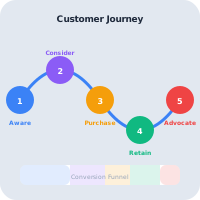
You do not need to change everything overnight. A practical rollout starts with the workflow carrying the most risk, proves it in AWRA, then expands from there.
Separate the controls you truly need from suite features no one uses.
Stand up a high-value flow in AWRA and measure adoption and control.
Expand workflow by workflow instead of a single big-bang go-live.
Decommission modules the connected platform now covers.
Common questions
AWRA covers connected operations — inventory, procurement, sales, POS, and finance context — with approvals, roles, and audit trails. For many growing and mid-market teams that is the operating core they need, delivered far faster than a traditional suite.
Traditional suites commonly take many months and specialist consultants. AWRA is built to stand up in weeks using guided rollout resources, expanding workflow by workflow rather than a single, high-risk go-live.
Keep going
More comparisons
Teams outgrow the workbook when approvals, audit trails, and live stock matter.
When finance is solid but operations still run on add-ons and manual updates.
When stock is handled but every neighbouring workflow is a separate app.
When the bundle is broad but the workflow still falls between the apps.
When flexible boards are doing the job a real operations system should.
When the platform can do anything, but every "anything" is a project.
Help Center
Run inventory, procurement, assets, sales, and field work with approved AWRA guidance for setup, migration, integrations, security, pricing, and support.