With open-source modular erp
Implementation drag
Go-live waits on a partner scoping, building, and testing modules.
With AWRA
Implementation drag
Configure the operations core and start using it the same week.
AWRA OpsHub vs open-source modular ERP
Open-source modular ERPs earn their reputation honestly: the breadth is real, the community is large, and there is a module for nearly every process a business could run. For a team with in-house developers or a committed implementation budget, that flexibility is a genuine strength.
The question for most Kenyan SMEs is not whether the platform can do it, but who will make it do it — and keep it running. AWRA OpsHub takes the opposite stance: operations-first, working on day one, Kenya-native for eTIMS and M-Pesa, with published KES pricing and no developer required to go live.
The real issue
Open-source modular ERPs are genuinely capable, with a module for almost everything. The cost sits elsewhere: implementation partners, developer time, self-hosting, and local compliance you build rather than get.
The question is not whether your team can make open-source modular erp work today. It is whether that approach keeps up when operations need control, accountability, and workflow continuity across more people, locations, and decisions.
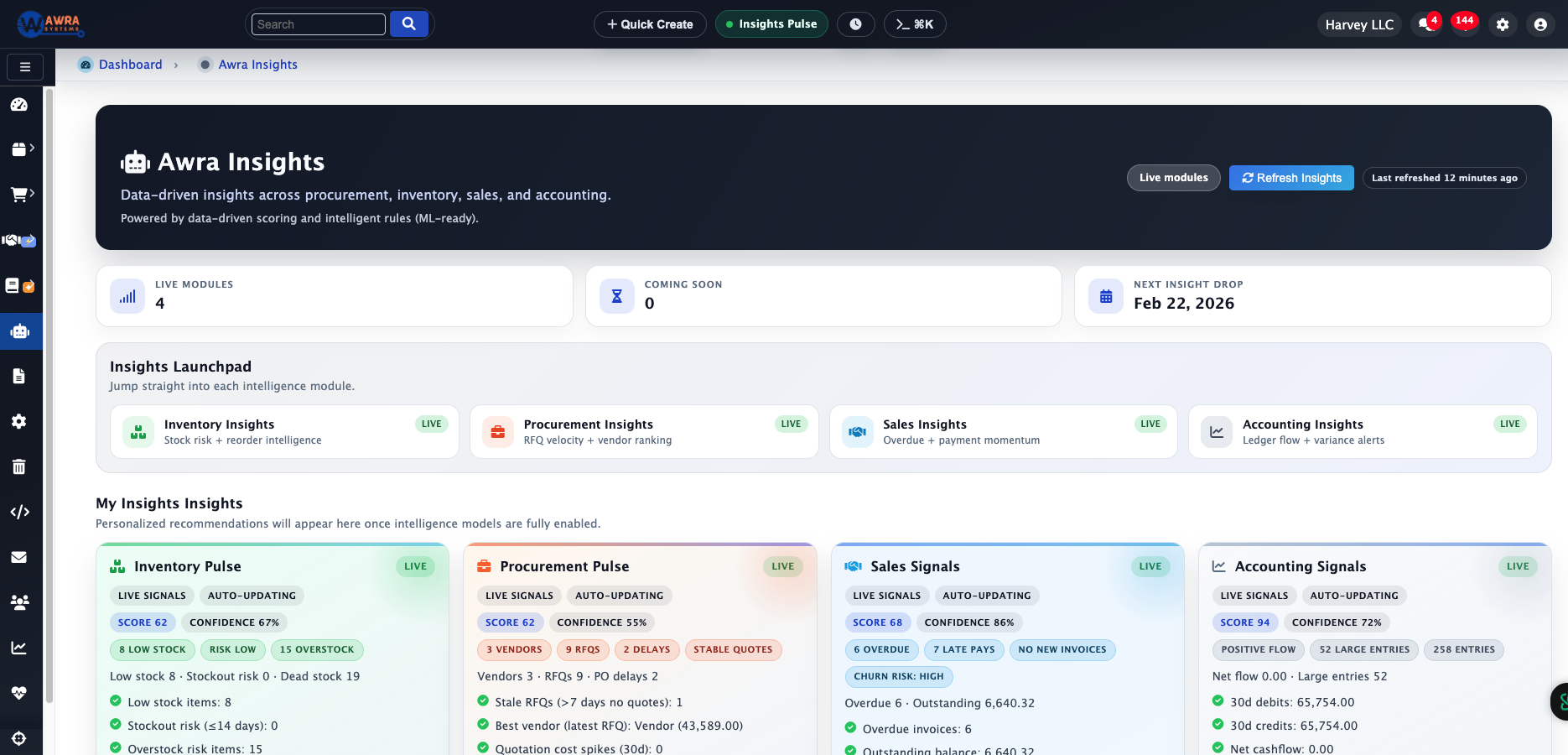
Side-by-side comparison
Every row is rated fully supported, partial/add-on, or not designed for — including where open-source modular erp are genuinely strong. This describes the category in general, not any single product.
A helpdesk module usually exists, as a separate app to install, host and keep in step.
Tickets with SLA clocks by category and priority — elapsed or business hours that skip weekends and public holidays — department routing, escalation, a knowledge base that suggests answers, CSAT and a resolution signature, on the same records as the rest of the platform.
Usually available as a module you assemble, host and keep working yourself.
A nine-lane Control Tower ranked by severity, an Approvals Hub fed by fifteen record types, seven alert rules and a pricing radar.
HR and payroll modules exist. The statutory calculation for your country is usually a community module, a paid localisation or a build you maintain through every upgrade.
PAYE, NSSF, SHIF and the housing levy maintained for you as the rates move, with the rest of HR on the same records.
Project and task modules are available and capable, once installed, configured and kept compatible with the next version.
Projects, tasks, Gantt planning, sprints, and time and budget — live on the same subscription, with upgrades that are not yours to manage.
A very wide catalogue of modules across every function.
Focused on the operations core, delivered ready to use.
Meaningful use usually follows an implementation project.
Working operations out of the box, configured not coded.
Real customization typically needs developers or a partner.
Configured by ops teams; no code to go live or adapt.
"Free" licence, but implementation, hosting, and upgrades add up.
One published KES subscription, hosting and updates included.
eTIMS and M-Pesa flows are usually add-ons you build or buy.
eTIMS and M-Pesa handled natively, maintained for you.
Custom modules can break on version upgrades you must manage.
Managed updates; customization never blocks the next version.
A signature module usually exists or can be written. The enforcement around it — one window per mark, two on a transfer — is yours to specify, build and maintain.
Enforced in the product: each mark has a single status window and is fixed once the movement is decided.
Workflow examples
Benefits are clearest at the level of real workflows rather than abstract feature lists. These are common pain points with open-source modular erp and what a connected operating system does instead.
Go-live waits on a partner scoping, building, and testing modules.
Configure the operations core and start using it the same week.
Every change of substance queues behind developer availability.
Ops teams adjust workflows, fields, and approvals themselves.
Someone must run servers, backups, security, and upgrades.
Hosting, backups, and updates are managed for you.
eTIMS and M-Pesa become custom projects to build and maintain.
Kenyan tax and mobile-money flows are built in and maintained.
The hidden cost
Operational gaps rarely announce themselves. They show up as small delays, quiet mismatches, late approvals, repeated reconciliations, and reports that need explaining before anyone trusts them.
Those problems consume management time. A controller waits for supporting records. A buyer confirms a decision manually. A warehouse team checks several places before releasing stock. Leadership delays a call because the numbers do not match. The cost is paid in friction, every week.
AWRA OpsHub reduces the time your team spends proving what happened — not just by automating tasks, but by keeping the operational record connected from the start.
Migration path
You do not need to change everything overnight. A practical rollout starts with the workflow carrying the most risk, proves it in AWRA, then expands from there.
Add implementation, hosting, developer, and upgrade cost to the "free" licence.
Note which custom modules you truly depend on versus inherited complexity.
Stand up inventory, procurement, sales, and POS in AWRA — configured, not coded.
Drop the modules whose only job was to be maintained.
Migration
You do not need to throw everything away. Most teams keep something they already run and connect it, rather than replacing it on day one.
Import items, suppliers, customers, assets and your chart of accounts.
More we can add
Opening ledger balances by upload. The template is already in the product, and switching the upload on for your workspace is work we can take on.
Keep QuickBooks for the books. Let AWRA run the operational workflow in front of it.
More we can add
Invoices, bills and payments sent to QuickBooks, and records pulled back from it — both are extensions we can build for your workspace.
Run AWRA beside the system you have, connected through its API and webhooks.
More we can add
Write access on the API, so another system can create records in AWRA directly rather than through a webhook-triggered workflow.
Common questions
The licence is free; the system is not. Real cost lands in implementation, hosting, developer time for customization, and the upgrades you must manage yourself. For most SMEs a published subscription with hosting and updates included is lower total cost — and far more predictable — than a "free" platform that needs a partner to run.
Possibly, and we will say so plainly. If you have committed engineering capacity and want to own deep customization, an open-source platform can be the right call. If you want operations working now, adjusted by the people who run them rather than a developer queue, an operations-first system fits better.
Yes — natively, and maintained for you. On an open-source platform those flows are typically add-ons you build or buy and then keep working through every KRA change. In AWRA they are part of the product, updated as the rules do, with no localization project on your side.
Keep going
More comparisons
Teams outgrow the workbook when approvals, audit trails, and live stock matter.
When finance is solid but operations still run on add-ons and manual updates.
When stock is handled but every neighbouring workflow is a separate app.
When you need ERP-grade control without an ERP-grade implementation.
When the bundle is broad but the workflow still falls between the apps.
When flexible boards are doing the job a real operations system should.
Help Center
Run inventory, procurement, assets, sales, and field work with approved AWRA guidance for setup, migration, integrations, security, pricing, and support.