The Two Halves of a Contractor's System: Valuation and Materials
A contractor's system is really two systems: the valuation half that turns work into money, and the materials half that turns money into work. Most Saudi contractors buy the first properly and run the second on a foreman's memory — which is the half where the margin actually goes.
Ask a Saudi contractor what system they run and you will usually hear about the one that produces payment applications. That is reasonable — it is the system that gets money in, everybody in commercial touches it daily, and the main contractor probably dictated it. Ask the same person what a particular project has consumed in materials this month, and the answer arrives slower, hedged, and sourced from a spreadsheet.
That asymmetry is not laziness. It is a structural feature of how contracting software is sold, and it produces a specific and expensive failure that shows up at final account. This post is about the second half.
Two halves, two entirely different products
It is worth drawing the line explicitly, because vendors on both sides of it use the same word for what they sell.
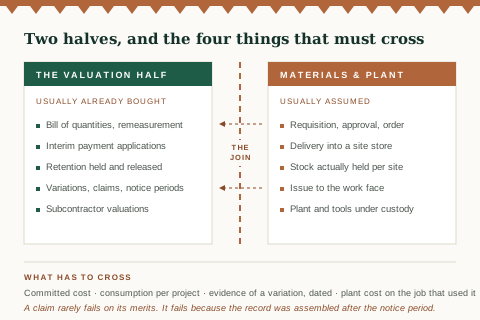
What each half owns, and what has to cross between them
The valuation half
Turning work performed into money claimed. Well understood, well supplied, and usually already bought.
- Bill of quantities, remeasurement and the agreed rates.
- Interim payment applications and the certificates that answer them.
- Retention held, and the arithmetic of when it is released.
- Variations, claims, and the notice periods that govern both.
- Subcontractor valuations and back-charges against them.
The materials and plant half
Turning money spent into work performed. Where the leakage is, and frequently where there is no system at all.
- Requisition, approval, purchase order and supplier terms.
- Delivery to a site store, received against something, by someone named.
- Stock actually held at each site rather than assumed from the last order.
- Issue to a work face, attributed to the project it was consumed on.
- Plant, tools and equipment: where they are, who has them, what condition.
What has to cross the join, and usually does not
- Committed cost. What has been ordered but not yet invoiced, so the commercial view is not a month behind the buying.
- Actual consumption per project, in time to be compared against what was valued rather than after it.
- Evidence of a variation at the moment it happened — the delivery note, the instruction, the date. This is the item that decides whether a claim survives.
- Plant cost allocated to the job that used it, rather than sitting in a general hire account nobody apportions.
Almost every contractor we speak to has the left column covered. The right column is where we are usually invited in, and it is worth being clear that these are separate purchases with separate suppliers — the seam between them is negotiable, but the pretence that one product does both usually is not.
What the second half is actually worth
A worked example, on figures shaped like the projects we are usually shown. These are illustrative arithmetic and not a benchmark — your rates, your materials intensity and your subcontract terms will differ, and the conclusion is about the mechanism rather than the numbers.
One subcontract package, as tendered
Eight per cent is not unusual on a package of this shape. It is also thin enough that a single unrecovered item is material, which is the whole point of what follows.
Materials, at final account
A four per cent materials overrun is unremarkable and would not alarm anyone mid-project. More than half of it was caused by an instructed change and was properly recoverable — at the time.
What the delay costs
The recoverable half was not lost because the claim was weak. It was lost because the notice period in the subcontract had passed before anyone assembled the evidence, and reconstructing a delivery sequence from memory eleven months later does not persuade a quantity surveyor.
The claim did not fail on its merits. It failed because the record was assembled after the deadline rather than captured before it.
And the plant, which is worse because it is visible
Materials disappear quietly. Plant disappears in a way that everybody can see and nobody can prove, which produces a different and more corrosive kind of argument.
Equipment across three sites, one year
The second line is the one worth staring at. Nothing was lost or stolen; the business simply paid to hire a machine it already owned, because ownership was recorded and location was not.
What actually fixes it, in order of return
None of this is sophisticated. It is the ordinary discipline of treating a site as a stock location rather than as a destination.
-
Make every site store a real stock location
Not a delivery address, not a cost code — a location with its own stock position, so a report can ask what is at site B without inferring it from purchase orders. This one change does more than the other four combined, and it is a configuration decision rather than a project.
-
Receive at the point of delivery, on a phone, offline
The record has to be created where and when the material lands, by the person who took it, with the delivery note photographed and attached. Signal on a Saudi site is unreliable and irrelevant — capture offline and sync later. A receipt keyed in the office two days later from a paper stack is not evidence of anything.
-
Issue to the work face, attributed to the project
The moment material leaves the store it belongs to a job. If issues are not captured, consumption is a month-end estimate and the variance you eventually find has no date attached — which is exactly what kills the claim in the example above.
-
Put plant under named custody
An asset register with a holder, a location, a check-out and a check-in. The argument about who lost the compactor becomes a record rather than a conversation, and the hire-what-you-already-own problem simply stops occurring.
-
Attribute purchases and payroll cost to the job as they happen
So that a project's cost position is a query on Tuesday afternoon rather than an assembly exercise at month end. The value is not the report; it is that a problem becomes visible while there is still time to notify it.
Four things worth checking on your own projects this week
- How long does it take to answer "what materials are at site B right now"? If the honest answer involves phoning the storeman, that is your baseline.
- Pick a variation you claimed last year and find the evidence trail. How much of it was reconstructed after the fact, and would it survive a firm quantity surveyor?
- Count your plant against the register. Not to catch anyone — to find out whether the register describes reality, because if it does not, no report built on it means anything.
- Ask when the last three projects' true cost positions were first known. If the answer is "at the end", you have been managing outcomes rather than costs.
Where AWRA OpsHub sits in this, plainly
On the right-hand column only. Site stores as real stock locations, offline mobile receiving and issuing, governed transfers between stores, procurement with approvals that block, landed cost on imported materials, plant and tools under named custody with check-out and check-in, and project cost attribution carried across purchases, stock issues, expenses and payroll. What we do not do is any part of the left-hand column: no interim payment applications, no bill-of-quantities remeasurement, no retention held and released against a certificate, no variation register and no subcontractor back-charge workflow. Keep your measurement package and agree the export between the two at the start, not in month six.
What AWRA OpsHub does today
- Stock across a central store, multiple site stores, containers and vans, with governed transfers, blind counts and valued variance.
- Offline-first mobile capture for receiving, issuing, counting and dispatch — it keeps working with no signal and syncs once without duplicating.
- Procurement that refuses above a threshold, with RFQ comparison, the award reason recorded, and three-way matching before money moves.
- An asset register with named custody, check-out and check-in, condition, maintenance history and depreciation, across plant, tools and vehicles.
- Project budget, hours, milestones and cost attribution, carried from purchases, stock issues, expenses and payroll cost.
- Documents attached to the transactions that justify them, checksummed and access-logged — which is what makes a variation claim assembled from records rather than memory.
More we can add to your workspace
- Interim payment applications and a bill-of-quantities remeasurement.
- A retention held or released against a certificate, and no variation or claims register.
- A subcontractor valuation or back-charge workflow. Subcontractors exist as suppliers with purchase orders and matching, which is not the same thing.
- A ZATCA integration, so we are not the system that issues your tax invoices in Saudi Arabia.
- A Mudad wage file, GOSI calculation, Qiwa registration or Nitaqat tracking. Our maintained statutory payroll engine covers Kenya only.
- An Arabic interface and a right-to-left layout, which on a Saudi site is a serious consideration and not a footnote.
The first three items are the reason a measurement package stays in the picture. We would rather define that boundary than sell a contracting suite we do not have.
What we can build for Saudi Arabia on top of the standard product
Everything listed above as something we can add describes what ships in the standard product today — it is a starting point for Saudi Arabia, not a limit on what AWRA OpsHub can do there. Kenya's eTIMS integration and its maintained payroll engine are in the product because Kenyan clients needed them and commissioned them; neither appeared by itself. The same door is open here. If a clean seam to your ZATCA provider, an Arabic interface, a bank or mobile money feed, a statutory return format, a rule specific to how your operation runs, or a link to a system you already have is what stands between you and a decision, tell us and we will scope it as a build — written spec, timeline and price — before you commit to anything.
The ZATCA seam, not a ZATCA integration
A two-way link to the accredited provider that clears your invoices: our sale handed over in the shape their generation unit expects, and the UUID, hash and clearance status written straight back onto our transaction with the cleared document attached. That turns "which sales have no clearance record?" into a daily report. We will not offer to become the clearing party ourselves — that certificate belongs with an accredited provider and we would rather say so than sell you the pipe.
Arabic interface, banks and acquirers
Arabic interface text with right-to-left layout and bilingual document templates, plus bank statement feeds, card acquirer settlements and SADAD or instant-payment files wired into the Payments Register so collections match invoices without anyone re-keying a statement.
The operational work, which is what most commissions actually are
An extra approval stage in a chain that does not match the standard one, a custom field set on employees or assets that only your sector needs, an expiry that has to block an order rather than send an email, a report your board asks for in a shape nothing produces, or a scanner or weighbridge feeding the goods-in door. These are the commissions we are asked for most often and the smallest ones we quote — and unlike a revenue-authority pipeline, none of them waits on a regulator.
Payroll and statutory returns
A Saudi payroll engine with GOSI contributions calculated on live employee records, Mudad wage files in the layout the Wage Protection System expects, and the establishment's Saudization position visible before a deadline rather than after one.
Systems you already run
The accounting package, CRM, online store or custom database you intend to keep — connected through our API so a fact is entered once and appears everywhere it is needed.
How it works: you describe the requirement, we return a written scope, timeline and cost, and once agreed it is built into your environment and maintained as part of the product. No roadmap slide, and no pretending in a demo that something exists when it does not.
Tell us what you need integratedOur take
Contractors buy the half of the system that argues for money and improvise the half that spends it, then discover at final account that the improvised half is where the margin went. The fix is not a bigger product — it is treating site stores as real stock locations, capturing receipts and issues where they physically happen, and putting plant under named custody. Do those three and the fourth thing follows by itself: a variation claim assembled from records that already existed, inside the notice period, which is worth more than any report.
Run one live project through the materials half
Bring a real project — its site stores, its deliveries, its plant. We will show you the cost position building as it happens rather than at the end, and we will tell you plainly which parts stay with your measurement package.
Talk to us about Saudi ArabiaFrequently asked questions
Do you handle interim payment applications and retention?
No. There is no interim payment application, no bill-of-quantities remeasurement, no retention held and released against a certificate, no variation register and no subcontractor back-charge workflow. Our project module covers budget, hours, milestones, cost and bill rates, and cost attribution — the cost side rather than the valuation side. Most contractors we work with keep a measurement package for valuation and run the materials, plant and cost side with us underneath it. That is a stable arrangement provided the export between the two is agreed at the start rather than improvised later.
Can each site be its own stock location?
Yes, and this is the single most valuable configuration decision on a contracting implementation. Every site store is a distinct stock position with its own balances, its own counts and its own valued variance, and the move between a central store and a site is a governed transfer with documents attached rather than a quantity adjustment. That means "what is at site B" is a report rather than a phone call, and it means a transfer between two of your own sites is visible as an event instead of disappearing into a net figure.
Does receiving work on site with no signal?
Yes. Receiving, issuing, counting and dispatch all work offline on a mobile device and sync when connectivity returns, without creating a second record for the same event. This matters more on a construction site than almost anywhere else, because the alternative is a paper delivery note keyed into the office two days later, which is exactly the practice that leaves a variation claim with no contemporaneous evidence behind it.
How does plant and equipment custody work?
Plant, powered tools and vehicles sit on an asset register with a named holder, a current location, condition, maintenance history and depreciation, with check-out and check-in recorded as events. The practical effect is twofold. Disputes about a missing item become a record rather than an argument, and — more valuable in our experience — you stop hiring equipment you already own but could not locate, which is a cost that never appears as a loss anywhere in the accounts.
Do you handle Saudi payroll for site labour?
Not the statutory side. Our maintained statutory payroll engine covers Kenya only, so no Mudad wage file is produced, no GOSI contribution is calculated, no contract is registered on Qiwa and no Nitaqat position is tracked. This is worth taking seriously in Saudi Arabia specifically, because a missed deadline in those systems can freeze services tied to your establishment — including work permits and iqama renewals — which stops hiring rather than merely costing a penalty. Keep that with a Saudi payroll bureau. What does travel is the employee side: records, contracts, leave with balances, and payroll cost attributed to the projects and cost centres it was incurred on.
We already have an ERP. Is this a replacement?
Usually not, and we would rather establish that early. In Saudi Arabia most contractors are already running at least three things — something that clears invoices through ZATCA, something that produces valuations, and something that handles payroll and the government portals. Adding a fourth only makes sense if the materials and plant half is genuinely unmanaged, which it frequently is. If your existing system already treats site stores as real stock locations and captures issues at the work face, you do not have a software problem and we will say so.