Compliance Dates That Have No Season
Compliance dates that fall on each holder's own anniversary defeat every periodic review, and they fail silently — nothing happens on the day a certificate lapses, which is precisely the problem.
Some compliance deadlines are shared. Everybody files by the same date, the date is in everybody's calendar, and the whole organisation braces for it together. Others belong to the holder: a certificate is issued on a Tuesday in March and renews every March, and the business relying on it has no reason to think about March at all. The second kind is much harder to manage and gets far less attention, because there is no shared moment to organise around.
Guyana's Local Content Act is a clean example. Suppliers to petroleum operations register with the Local Content Secretariat and hold a Certificate of Registration, which is renewable on the anniversary of its issuance. A buyer with a hundred approved suppliers therefore has a hundred renewal dates, scattered across the year in no particular pattern, each one belonging to somebody else's paperwork.
Why every periodic review fails
Work through the options and the arithmetic is unforgiving.
| Approach | What it catches | What it misses |
|---|---|---|
| Annual review | Everything, once | Up to eleven months of drift for anyone who lapses just after it. |
| Quarterly review | Everything, four times | Up to three months, every time, for whoever renewed just after the last one. |
| Monthly review | Everything, twelve times | Up to a month — and it costs twelve times the effort to get there. |
| A spreadsheet of dates | Whatever its owner remembers to check | Everything, from the day its owner changes role. |
| A date on the record, with a job that acts on it | Each one, on its own day | Nothing about timing — see the section below on what it still cannot do. |
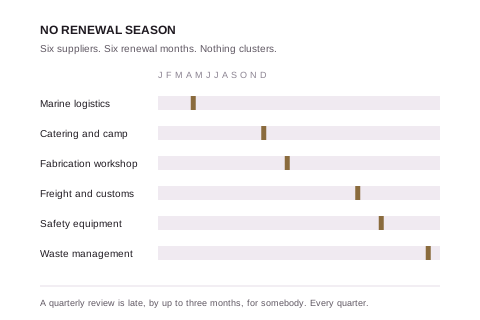
The failure is silent, which is the actual difficulty
If a certificate expires and nothing in your systems knows, then nothing happens. No error, no interruption, no flag. The supplier keeps quoting, keeps delivering and keeps invoicing, and every one of those transactions looks exactly like the ones before it. The approved list on the day after is character-for-character identical to the list on the day before.
That is why this class of problem is usually discovered during something else — an assurance exercise, a contract review, a new finance lead reading through the supplier master. By then the exposure is however many months of purchasing it happens to be, and reconstructing which orders were raised while a certificate was current is the kind of work nobody has budgeted for.
Nothing happens on the day a certificate lapses. That is not a mild version of the problem; it is the entire problem.
What a system can actually do about it
Three things, in increasing order of usefulness. Store the date on the supplier record rather than in a document nobody opens. Make the near-future queryable, so "who renews in the next sixty days" is a question with an answer rather than an exercise. And attach a consequence to the date passing — a state change on the supplier record, not a line in a report that somebody has to choose to read.
That third one is the difference between a system that helps and a system that has a date field. A report is only as good as the discipline of whoever opens it, which puts you back where you started with the spreadsheet.
What ours does, since we keep publishing what it does not
This is one of the few subjects in this corpus where our answer is the good one, so it is worth stating exactly. Approving a supplier sets an expiry date on the qualification, derived from a validity period held per organization — twelve months by default, settable from one month to ten years. Suppliers can be listed by how close they are to lapsing. And a job that runs every morning expires qualifications past their date and deactivates the linked vendor record, so a lapse becomes a state rather than a note. None of that was built for the Local Content Act; it is general supplier prequalification that happens to match the shape of a rolling anniversary, which is luck rather than foresight and we would rather say so.
What none of it does, and this is the part to hold on to
A countdown is a diary. It is not verification. Everything described above operates on a date somebody typed in, attached to a document somebody uploaded. If the certificate was withdrawn last month, or was never valid, a diary will keep counting cheerfully down to the date it was given and report the supplier as qualified the whole way.
That distinction is worth being pedantic about when evaluating software, because "we track supplier certificates" is a sentence that covers both, and the gap between them is where the risk actually lives. Ask the question directly: does the system check anything with anybody, or does it count down? Both are legitimate; only one of them is verification, and a vendor who blurs the two is inviting you to stop checking.
What a buyer can actually check
Four questions, and the last one is the one people forget
What happens on the day a certificate expires?
What you will hear
"It appears in a report", or a state change.
How to read it
A report requires a reader. A state change does not. This is the whole difference between tracking and controlling.
Can I be stopped from raising an order against a lapsed supplier?
What you will hear
A hard block, a warning, or nothing.
How to read it
A block with an override and a recorded reason is the mature answer — there are legitimate reasons to proceed and you want them documented, not prevented.
Do you verify the certificate with the issuing body?
What you will hear
Almost always no.
How to read it
Fine, as long as it is said plainly. Be wary of "we validate certificates", which usually means format validation and sounds like something else entirely.
Show me that a supplier was certified on a date six months ago.
What you will hear
A current document, or a versioned history.
How to read it
Most systems let a replacement document overwrite its predecessor, which answers "are they certified now" and destroys the ability to answer "were they certified then". The second is the question an assurance exercise asks.
The short version
Rolling per-holder expiry beats every review interval, and it fails without a sound. Get the dates onto the records, make the next ninety days queryable, and make sure something changes state when a date passes — a report nobody opens is the same as no system at all. Then be clear-eyed about the limit: a countdown proves you were told a date, not that the document behind it is real. Those are different assurances, and only one of them is something software can give you.