Buying Operations Software in Fiji: A Straight Guide
Ask every vendor what their system does with a credit note raised today against an invoice from July 2024. We publish what ours does, which is not enough, which is the only reason the question is fair coming from us.
There is a single question that sorts the software on your shortlist faster than any feature matrix, and it takes about forty seconds to ask. What does your system do with a credit note raised today against an invoice raised in July 2024? The rate was 9% then and it is 15% now, a credit follows the supply it reverses, and most systems have nowhere to record which of the two they meant.
A note on where we stand, because it should change how you read the rest. We are a Nairobi vendor at UTC+3 with no office here, no implementation partner, and — at UTC+12 — effectively no shared working day with you. We also fail that credit note question. Read this as a guide to evaluating anybody, ourselves included.
The date, and the four documents that straddle it
Fiji's VAT was 9% until 31 July 2024 and has been 15% since 1 August 2024. That is one date and two numbers, and it is all the tax history this guide needs. The rate has moved in both directions over the years, which is worth knowing as a direction of travel — but the argument here only requires the most recent change, and a guide about dates has no business printing a date it has not verified.
Start with the reassuring half. In a competently built system the rate is stored on the invoice line at the moment the document is raised, not looked up when it is displayed. So a July 2024 invoice still shows 9% and will keep showing 9% through every future change. Go and check that in your own system before anything else — open a pre-August-2024 document and confirm the rate on it is the rate it was raised at. If it shows 15%, stop the evaluation and deal with that, because every historic report you have is unstable.
The exposure is not in old documents. It is in new documents about old periods, which are the ordinary business of correcting things.
| Document | The rate it needs | What most systems do |
|---|---|---|
| An invoice from before the change | 9% — the rate it was raised at | Correct. Stored on the line, never re-resolved. This one is usually fine. |
| A recurring schedule crossing 1 August 2024 | 9% before, 15% after | Usually correct — each document resolves the rate when it is generated and then stores it. |
| A credit note against that July invoice | 9% — a credit follows the supply it reverses | Frequently nothing, because the credit note holds a single amount and no tax breakdown at all. |
| A quotation issued 20 July, accepted 5 August | A real question, turning on terms and time of supply | Converts at the rate it was issued at, with nothing prompting anybody that the question exists. |
| "What was the rate in July 2024?" asked of the system | 9% | Answers 15%, instantly and with no warning that it was asked something it cannot answer. |
Our own answer, so the question is fair
Two of those five we get right and three we do not, and we will name the columns rather than the categories. Our invoice lines store the tax rate on the line — history is genuinely safe. Our credit note is a single amount with a customer, a reason and an optional link to the invoice: no lines, no rate, no tax columns, so a credit reversing a 9% supply has nowhere in the record to say so. And our country tax reference holds one rate per country with no effective date anywhere in the file or the resolver, so asked about July 2024 it returns 15. Both are published on our Fiji market page and pinned by a test, so that fixing either has to be deliberate. The credit note is the smaller build and the one we would do first.
The fiscalisation question, and the distinction that matters in it
The Revenue and Customs Service operates a VAT Monitoring System that requires approved point-of-sale equipment for businesses in scope. Whether your business is in scope, and what that requires of you, is a question for the Service and your accountant rather than for a software vendor.
What a buyer needs from a vendor here is one distinction held cleanly, and it is the distinction most vendors blur:
Producing the data
- Generating sales records in a published format from the transactions you already have.
- A specification-and-price conversation like any other integration.
- Sits alongside approved equipment you already own rather than in front of it.
- Legitimately buildable, and a vendor can honestly offer to quote it.
Being the approved equipment
- A status the Revenue and Customs Service grants, attaching to certified equipment.
- Not something a web application holds, applies for, or can acquire by integrating.
- Not ours, not on a roadmap, and not becoming ours later.
- A vendor who blurs this into the first column is describing a compliance position they do not have.
So the question is: "are you approved, or can you produce data for equipment that is?" The honest vendors distinguish these without being pushed. Ours is the second, and only as a build — we produce nothing today.
The operational question: what does "in stock" mean here?
This is where most of the value actually is, and it has nothing to do with tax. A national stock figure in a multi-island business is an average of positions that cannot substitute for each other, because the distances are measured in sailings rather than in hours.
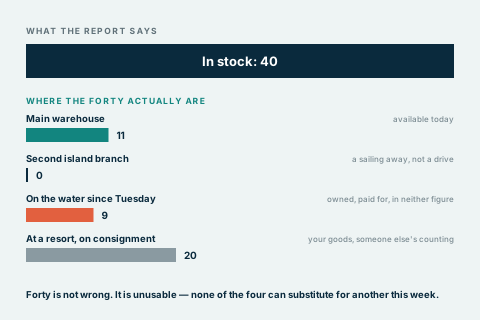
The single most common invisible position is goods on the water: owned, paid for, insured, and counted by neither the despatching location nor the receiving one. A system that treats a transfer as instantaneous makes that stock disappear for the duration of the voyage, which in this market is the duration that matters.
- Is a transfer confirmed by the receiving location, or completed the moment the sender despatches it?
- Where does stock live between those two events — is there an in-transit position, or a gap?
- Can a branch see another branch's position, and does the reorder calculation know the difference between "we have none" and "the group has none"?
- Can you count stock at a location you do not own — a resort, a site, a consignment customer — with the same discipline as your own?
- And the one that decides whether the numbers survive contact with reality: who counts, and on what cadence? A system does not make a count happen.
What none of this does is make a boat come sooner, and we are not going to imply otherwise. It changes the difference between "we have forty" and "we have forty, of which eleven are on this island, nine have been on the water since Tuesday and twenty are at a resort". The first is a number. The second is a decision.
Seven questions for every vendor on your list
Including us, and we have answered all seven above
"Open an invoice from July 2024. What rate does it show?"
What you will hear
9%, immediately.
How to read it
Good — the rate is stored on the line. If it shows 15%, the system re-resolves rates on display and every historic report you own moves when a budget passes.
"Now raise a credit note against it. Where is the rate recorded?"
What you will hear
A rate field, or a single total.
How to read it
A single total is very common and is not a scandal — but it means the tax treatment of your credits lives in your accountant's journals rather than in the system. Ours is a single total, and we say so.
"What does the system believe the rate was in July 2024?"
What you will hear
Usually today's rate, confidently.
How to read it
Near-universal. The answer to probe is one that claims a rate history — then ask to see the table and the validity dates in it.
"Are you approved fiscalisation equipment, or can you produce data for equipment that is?"
What you will hear
A clean distinction, or a blur.
How to read it
The blur is the finding. Approval attaches to certified equipment and is the Service's to grant. A vendor who lets the two run together will let other things run together too.
"Show me stock that is on the water between two of my locations."
What you will hear
An in-transit position, or a gap.
How to read it
If the transfer completes on despatch, that stock is invisible for the whole voyage — which in this market is precisely the period you need it.
"What are your support hours in my time zone, on a Tuesday?"
What you will hear
A specific window, or an adjective.
How to read it
Get the number. Ours is honest and bad: at UTC+3 against your UTC+12 there is effectively no shared working day, and support is asynchronous. That works for configuration questions and badly for anything urgent.
"What happens when the person who implemented this leaves your company?"
What you will hear
Documentation, or a shrug.
How to read it
The best question in any software evaluation, and the one least likely to have a rehearsed answer.
The time zone is a procurement criterion, not a footnote
Nine hours, with your morning falling in our night. We are putting this in a callout rather than a footnote because it is exactly the kind of fact that is fine in a demo and corrosive in month two. Asynchronous support genuinely works for configuration questions and genuinely does not for anything urgent. If same-day response inside your working hours is a requirement rather than a preference, a regional vendor is the rational choice and we would rather say so here than lose the argument later.
The credit note is the small build. The dated rate is the honest one.
"Not built in" describes what ships in the standard product, not the limit of what AWRA OpsHub can do here. Kenya's eTIMS integration and its maintained statutory payroll engine exist because Kenyan clients needed them and commissioned them; neither appeared by itself. The same door is open. The ordering is deliberate: a credit note that carries lines and a rate is small and well defined, and effective-dated rates are a genuine data-model change with a migration behind them. We would rather quote you both honestly than describe the second as a configuration option. Tell us which one stands between you and a decision and we will scope it as a build — written specification, timeline and price — before you commit to anything.
A credit note that carries tax
Lines and a rate on the credit note, defaulting from the invoice being credited. First, because it is small and because it is the one that costs a real business real reconstruction time.
Effective-dated tax rates
A rate history per country rather than one rate per country, with a document date threaded through every place that resolves one. A data-model change, quoted as one.
A prompt when a rate moves under an open document
A quotation issued before a change and accepted after it, flagged rather than silently converted. Small, once the dated rates exist underneath it.
Data for the monitoring system
Sales records in the published format, alongside approved equipment you already own. The data half only — the approval half is not ours and will not become ours.
A Fijian payroll engine
Income tax tables and provident fund contributions on live employee records. Worth saying that a payroll engine is a maintenance commitment rather than a project with an end date, and we would quote it as one.
One thing deliberately absent from that list, because you will notice its absence on the equivalent lists for our Francophone and Gulf pages: language. English is an official language here and the language of business, so there is nothing to disclose, and we are not going to pad a scope list to look thorough.
The short version
Ask for a credit note against a July 2024 invoice and watch what the system does with the rate. Ask whether the vendor is approved equipment or can produce data for it, and see whether they keep the two apart without being pushed. Ask to see stock that is on the water. Then get the support hours as a number rather than an adjective. Our answers are: the credit note holds no rate, we are not approved and never will be, the in-transit position exists, and there is effectively no shared working day. Two of those four are builds with a price; two are where we stop.
One credit note, one date
Find a credit raised after 1 August 2024 against a supply invoiced before it, and ask your system which rate it was treated at. Bring the answer and we will tell you plainly which half of your problem we are for.
Talk to us about Fiji