
Buying Operations Software in India: A Straight Guide
A buyer's guide for the most competitive software market in this series, written by a vendor who will tell you in the third paragraph that you probably want somebody else.
India has the deepest and cheapest business software bench of any market we write about. Tally has been installed in a very large proportion of Indian businesses for a generation. Zoho builds world-class products from Chennai at prices that make most international vendors look absurd. Busy, Marg and a dozen others own their verticals. Every one of them is connected to the tax portal and every one of them is supported by an implementation bench in your city.
That is the single most important fact about buying software here, and a vendor page that talks around it is telling you something useful about the vendor.
So here is the guide. Most of what follows applies whoever you buy from. The part that is about us is short, is at the end, and begins by narrowing the field considerably.
First: work out which of two purchases you are making
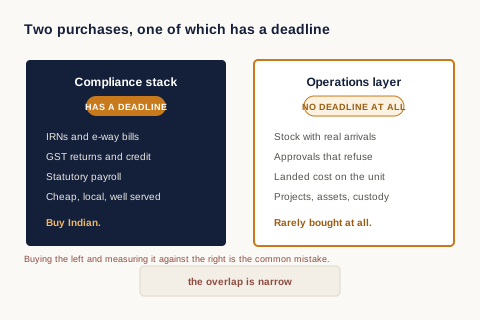
The most expensive mistake in this market is not choosing the wrong vendor. It is conflating two different products, buying the one with the deadline attached, and then being disappointed that it did not solve the other problem.
Purchase one — the compliance stack
- Invoice registration, IRNs, e-way bills, GST returns.
- Reconciliation of inbound documents and input credit.
- Statutory payroll — provident fund, ESI, professional tax, TDS.
- Bought from an Indian vendor, cheaply, with a local implementer.
- Nobody should be talking you out of this.
Purchase two — the operations layer
- Stock across locations, with transfers that have arrivals.
- Procurement with approvals that actually refuse.
- Landed cost reaching the unit cost you price against.
- Projects, assets, maintenance, custody.
- Nobody has a deadline that makes you buy this.
Some products do both, more or less. Most do one well and the other adequately. The failure pattern is consistent: a business buys against the compliance deadline because that is the thing with a date on it, discovers eighteen months later that stock, purchasing and project cost are still in spreadsheets, and concludes that the software was a disappointment. It was not. It was the right answer to a different question.
The questions that separate vendors, in this market specifically
General buying advice is available everywhere. These are the ones that behave differently in India than elsewhere.
Six questions, and what a vague answer tells you
How do you handle stock transfers between states?
The answer you often get
Transfers are fully supported.
What to press for instead
Ask specifically whether a transfer has a confirmed arrival — whether the receiving location records what it actually got, against the dispatch. "Supported" often means the stock leaves one location and appears in another with no document in between, which is the exact gap that produces late invoices and unexplained shortages.
What happens to input credit across our registrations?
The answer you often get
The system is GST compliant.
What to press for instead
Compliance is not the question. Ask whether anybody can show you, per registration, whether credit is accumulating faster than it is being used. Most systems cannot, most buyers never ask, and the answer is usually working capital sitting somewhere it cannot be spent.
How does landed cost work?
The answer you often get
You can add freight to a purchase.
What to press for instead
Ask what happens when the freight invoice arrives three weeks after the goods and covers four consignments. If the answer is that somebody journals it to an overhead account, landed cost is not reaching the unit cost, and every margin figure downstream is built on a purchase price rather than a real cost.
Can approvals actually block a purchase?
The answer you often get
Yes, there is an approval workflow.
What to press for instead
Ask what happens when somebody raises a purchase order above their limit and the approver is unavailable. If the answer is that it goes through with a notification, that is a warning rather than a control, and it will be routed around within a month of go-live.
Who implements this, and where are they?
The answer you often get
We have an excellent partner network.
What to press for instead
Ask for the name of the specific person or firm who would do your implementation, how many they did last year, and whether they can be on site. In India this is a genuine differentiator rather than a formality, and a vendor who cannot name anybody is offering remote onboarding whatever the brochure says.
What do you not do?
The answer you often get
A pause, then a roadmap item.
What to press for instead
The most informative question on this list. A vendor who cannot name three things they do not do either has not thought about their boundary or is not going to tell you where it is. Both are the same problem for you, and you will find it during implementation instead.
Scoring a shortlist without a spreadsheet full of ticks
Feature matrices reward vendors who say yes to everything. These criteria are chosen because they are hard to answer dishonestly.
Six criteria, weighted for an Indian multi-location business
Score each vendor out of five. The weight column is our view of what actually predicts satisfaction two years in; adjust it for your own business rather than treating it as received wisdom.
Compliance depth
Make them prove it: Ask them to show an IRN being generated and an e-way bill being raised, live, from a real document — not in a slide.
Transfers with arrivals
Make them prove it: Ask them to dispatch ten units and receive eight, and show you where the difference is recorded.
Landed cost
Make them prove it: A freight invoice arriving three weeks late, covering four consignments. Show me the unit cost afterwards.
Approvals that refuse
Make them prove it: Try to raise a purchase order above your limit while the approver is on leave.
Implementation proximity
Make them prove it: Name the person who would run our implementation and tell me how many they completed last year.
Stated boundary
Make them prove it: Name three things you do not do that a business like ours often needs.
A note on price, since this is India
You will see a very wide price range, and the cheap end is genuinely good rather than merely cheap — that is not true in most markets and it changes the calculation. The useful discipline is to price the whole thing: licence, implementation, the data migration, the person internally who will own it, and the cost of the year in which it is half-adopted. A cheaper product implemented properly beats an expensive one implemented remotely almost every time, and in this market you can have both cheap and properly implemented, which is a genuine luxury.
Where we fit, stated narrowly
We are an operations layer built in Nairobi for businesses running physical operations in difficult conditions. In India that makes us a purchase-two product only, and only for a specific kind of business.
Multi-location stock with real transfers
Every warehouse, depot and site store a distinct position, transfers that stay open until the receiving end confirms the quantity, in-transit stock owned and visible, blind counts with valued variance.
Procurement with approvals that refuse
Requisitions, thresholds that block rather than warn, RFQ comparison with the award reason recorded, three-way matching against what was ordered and received.
Landed cost on the consignment
Freight, duty, clearing and handling allocated to the receipt they belong to and carried into the unit cost you price against.
Projects, assets and custody
Budget and cost per project, plant and equipment under a named holder with maintenance history, on the same basis across locations.
Approval limits, working week and holidays
Configured per organization rather than assumed, including delegation and the states your locations sit in.
Deciding your registration and valuation position
Which locations are separately registered, how transfers are valued, and what your credit position should look like. This is your chartered accountant's work and it should stay there.
IRP registration, IRN generation and e-way bills
No portal connection, no invoice reference numbers, no movement documents, no thirty-day clock tracking. Buy this from an Indian provider.
GST returns and input credit reconciliation
No GSTR-1, no GSTR-3B, no 2B matching, no Invoice Management System actions on inbound documents.
Indian statutory payroll
No provident fund, ESI, professional tax or salary TDS. Our maintained payroll engine covers Kenya only.
A local implementation partner
Onboarding is remote from Nairobi. Against a market where somebody can be in your office tomorrow, this is a real disadvantage rather than a footnote.
Read that list as a filter rather than as a feature comparison. Four "not built" entries, one of which is the entire category most Indian buyers are shopping for, is not a roadmap. It is the boundary, and it means the honest answer for most readers is that we are not the right purchase.
You are a single-state business
Buy the cheapest thing that files correctly
The argument that makes us interesting in India — that internal movements across state lines are taxable supplies with documents attached — does not apply to you at all. Nothing else we offer justifies the price difference against a competent local product. This is not modesty; it is the correct answer.
Your problem is compliance
Buy an Indian compliance product for that layer
IRNs, e-way bills, returns, credit reconciliation and statutory payroll are a solved problem here, solved cheaply, by vendors with an implementer in your city. We would not try to beat that on price and we will say so. Where the conversation stays open is the layer above it — if your operations are the mess and compliance is already handled, that is the half we would compete for, and an IRP or e-way-bill seam onto our records is a build we will scope rather than a claim we make.
You run operations in several states and your compliance is already handled
There is a conversation worth having
Specifically if nobody can tell you what stock is where at what cost, transfers have no documented arrivals, landed cost sits in an overhead line, and project cost is reconstructed quarterly. That is a different product category from what you already own, and it is the one we build.
You are not sure which of the two you need
Run the four-transfers test first
Take four interstate transfers from last month and look for the documented arrival at the far end. If they are all there, your operational layer is working and your problem is elsewhere. If three of four are assumptions, you now know which purchase you are making, and you found out for the price of an afternoon.
What AWRA OpsHub does today
- Multi-location stock with governed transfers and confirmed arrivals
- In-transit stock as an owned, dated position
- Procurement approvals that refuse, with RFQ comparison and three-way matching
- Landed cost allocated to the consignment
- Project cost, asset custody and a full audit trail
- The rupee as a base currency preset
More we can add to your workspace
- IRP connection, IRN generation and e-way bills
- GST returns, 2B reconciliation and Invoice Management System actions
- Provident fund, ESI, professional tax and salary TDS
- An Indian-language interface — English only, documents included
- A local implementation partner; onboarding is remote from Nairobi
What we can build for India on top of the standard product
Everything listed above as something we can add describes what ships in the standard product today — it is a starting point for India, not a limit on what AWRA OpsHub can do there. Kenya's eTIMS integration and its maintained payroll engine are in the product because Kenyan clients needed them and commissioned them; neither appeared by itself. The same door is open here. If an IRP connection, e-way bills, an Indian payroll engine, a bank or mobile money feed, a statutory return format, a rule specific to how your operation runs, or a link to a system you already have is what stands between you and a decision, tell us and we will scope it as a build — written spec, timeline and price — before you commit to anything.
IRP registration, IRNs and e-way bills
Invoice registration against the IRP with the IRN and signed QR returned onto the document, e-way bill generation and cancellation for goods in movement, and the thirty-day reporting clock watched rather than discovered. Read the honest version first: this is the single most crowded build on this list. Tally, Zoho, Busy and a dozen others already do it, at a price we cannot approach, with a chartered accountant who already knows your ledger. We would build it to sit under an operations layer you had already chosen us for, not to win a GST comparison.
UPI, NEFT and bank feeds
UPI collection with automatic settlement against the invoice, NEFT and RTGS payment files, and bank statement feeds wired into the Payments Register so money in and out reconciles without re-keying.
The operational work, which is what most commissions actually are
An extra approval stage in a chain that does not match the standard one, a custom field set on employees or assets that only your sector needs, an expiry that has to block an order rather than send an email, a report your board asks for in a shape nothing produces, or a scanner or weighbridge feeding the goods-in door. These are the commissions we are asked for most often and the smallest ones we quote — and unlike a revenue-authority pipeline, none of them waits on a regulator.
Payroll and statutory returns
Provident fund, ESI, professional tax by state and TDS on salary, computed on live records and produced in the return layouts each body expects. This is a serious statutory build with per-state variation, and it is a genuine reason to keep an Indian payroll provider rather than move payroll to us.
Systems you already run
The accounting package, CRM, online store or custom database you intend to keep — connected through our API so a fact is entered once and appears everywhere it is needed.
How it works: you describe the requirement, we return a written scope, timeline and cost, and once agreed it is built into your environment and maintained as part of the product. No roadmap slide, and no pretending in a demo that something exists when it does not.
Tell us what you need integratedOur take
Decide which of the two purchases you are making before you look at a single product, because the shortlists barely overlap and the deadline only attaches to one of them. If it is compliance, buy Indian, buy cheap, and buy from somebody who can be in your office — that market is genuinely excellent and we do not compete in it. If it is operations across several states, and your compliance is already sorted, then you are in a much smaller market with much less competition, and it is worth a conversation with two or three people including us. We would rather be on a shortlist of three for the right reason than on a shortlist of ten for the wrong one.
If you are making purchase two
Multi-state stock with real arrivals, procurement that refuses, [landed cost](/glossary/landed-cost) on the consignment, and projects with true cost. Not compliance — the layer underneath it.
Talk to us about IndiaFrequently asked questions
Why would we consider a Nairobi vendor at all?
For most Indian businesses, you would not, and the honest version of that answer is in the decision block above. The narrow case is a business running physical operations across more than one state, whose compliance stack works and is not being replaced, and whose actual cost is that stock, procurement, projects and assets live in separate spreadsheets that only agree at year end. We are built for operations in conditions where connectivity is patchy, goods are imported with real landed cost, and assets move between sites — which is a different qualification from being a good Indian ERP.
Is Tally really good enough?
For an enormous number of Indian businesses, yes — and pretending otherwise would damage our credibility rather than yours. It is inexpensive, it is connected to the portal, and there is an implementer and an accountant in every city who knows it. Where businesses outgrow it is generally not in accounting but in physical operations at multiple sites: stock in six locations, procurement approvals that need to hold, project cost, asset custody. That is a category question rather than a quality question, and it is the one worth asking.
What does a realistic total cost look like?
Price the whole thing rather than the licence: software, implementation, data migration, the internal person who will own it, and the productivity cost of the period during which the business is running two ways of working. In India the licence is often the smallest line, which is exactly why a cheap product implemented well beats an expensive one implemented remotely. Whoever you buy from, ask for the implementation to be quoted separately and specifically, with a named implementer.
How should we handle data migration?
Migrate balances and master data; do not migrate history. The instinct is to bring five years of transactions across and it is almost always a mistake — it multiplies the project, imports every inconsistency you were hoping to leave behind, and delays go-live past the point where anybody remembers why you started. Open balances, current stock, current customer and supplier records with clean identifiers, open orders. Keep the old system readable for history.
Do you have Indian customers or references?
Not in the way a buyer in this market is entitled to expect, and this is the fair objection. Our operating history is East and Southern Africa, and while the operating conditions transfer well, the reference story does not. If a local reference in your industry is a requirement — and in India it reasonably might be — that is a real reason to choose somebody else, and we would rather agree with you on the first call than spend three months on a process that ends the same way.
What is the single most useful thing to do before shortlisting?
Decide which of the two purchases you are making, and write it down in a sentence. Almost every disappointing implementation we hear about in this market traces back to that sentence never being written — the business bought against the deadline, which attaches to compliance, and then measured the result against a set of operational problems that were never in scope. Twenty minutes of writing, and it filters your shortlist faster than any demonstration will.
