
Buying Operations Software in Malaysia: A Straight Guide
Everybody is selling you a countdown. Here is how to buy while the market is in the middle of a compliance rush, without paying for urgency you may not be subject to.
Buying software during a compliance rush is a specific and slightly unpleasant experience. Urgency is doing a lot of the selling, every vendor has repositioned around the same three letters, and the natural question — "what do we actually need?" — gets replaced by "what will make the deadline?"
Those are different questions and they produce different shortlists. This guide is about keeping them apart.
One disclosure before anything else, because it shapes what follows: we have no MyInvois connection. We do not submit documents and we are not going to pretend the argument for us is a compliance argument. If submission is what you need, the useful part of this guide is the first half, and the honest recommendation is to buy from a Malaysian provider.
Step one, before any shortlist: establish whether you are in scope
This sounds like an odd first step for a buying guide and it is the step most likely to save you money. Scope has three tests and only the first is about your own revenue.
- Your turnover, against the current exemption floor — which was raised, cancelling a planned phase, and moved a number of businesses out of scope after they had already begun preparing.
- Your group. A business under the floor that is a subsidiary or related company of one above it is generally brought back in. Decided by ownership, not by trading.
- Your customers. Counterparties in scope need correct identifying data about you regardless of your own position, which reaches you as a receivables problem rather than a tax one.
Check the renewal before you check the shortlist
If you bought a compliance tool against the earlier exemption floor, there is a real possibility you are now outside the mandate. Nobody writes to tell you that your obligation has gone away. Establish your current position with LHDN or your tax adviser before you renew anything, and before you extend a project that may no longer have a driver.
Step two: separate the two layers you are buying
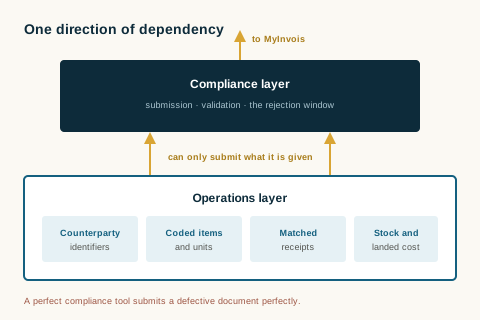
Almost every disappointing implementation we hear about in markets going through a mandate traces back to buying one layer and measuring it against the other.
The compliance layer
- Submission to MyInvois and the validated document coming back.
- The rejection and cancellation window, tracked.
- Consolidated and self-billed documents where they apply.
- SST determination and returns.
- Statutory payroll — EPF, SOCSO, EIS, monthly deductions.
The operations layer
- Counterparty records complete enough for a document to validate.
- Items coded and classified consistently, not typed per transaction.
- Receipts matched against orders before an invoice is approved.
- Stock across warehouses, branches and sites with real transfers.
- Landed cost reaching the unit cost you price against.
The connection between them is one-directional and it is the reason the second layer matters right now. Whatever submits your documents can only submit what it is given. If the counterparty record is stale, the item is uncoded and the quantity was never matched against a receipt, then a perfect compliance tool submits a defective document perfectly.
Step three: the questions that actually separate vendors
Six questions, and what a vague answer tells you
Are you connected to MyInvois?
The answer you often get
We are MyInvois ready.
What to press for instead
"Ready" is not "connected". Ask them to submit a document live in the meeting and show you the validated response coming back. If that requires scheduling a separate session with a technical person, you have your answer about the maturity of the integration.
How do you handle the rejection window?
The answer you often get
Cancellations are supported.
What to press for instead
Ask what happens on day four — after the window has closed. If the answer is not a credit note, they have not implemented the window. Ask also who gets told when a rejection arrives, because a rejection nobody sees is a receivable nobody is chasing.
Where does counterparty data live?
The answer you often get
On the customer record.
What to press for instead
Ask to see a report of which customer records are missing which identifier. If no such report exists, the data lives on the record in the sense that there is a field for it — which is not the same as knowing whether it is populated and current.
Do you handle sales tax and service tax separately?
The answer you often get
SST is supported.
What to press for instead
They are two taxes with separate registrations, and service tax has two live rate bands. Ask to see both represented. A single "SST" field is a modelling error that will not surface until somebody reconciles a year of it.
What happens to a rate change mid-year?
The answer you often get
You can update the rate.
What to press for instead
Ask what happens to documents dated before the change. If the system applies the current rate to historic documents, your figures will silently diverge from your filed returns, and nothing will error.
What do you not do?
The answer you often get
A pause, then a roadmap item.
What to press for instead
The most diagnostic question here. A vendor who cannot name three real gaps either has not defined their boundary or will not show it to you. You will find it anyway, during implementation, at a worse moment.
Scoring the shortlist
Six criteria for a Malaysian buyer, this year specifically
Score each out of five. Weight the first criterion at zero if all three scope tests came back clear — that is the whole point of running them first.
Live MyInvois submission
Make them prove it: Submit a document in the meeting and show me the validated response.
Counterparty data completeness
Make them prove it: Show me a report of which customer records are missing which identifier.
Two taxes, two rate bands
Make them prove it: Show me a six per cent service and an eight per cent service, alongside a sales tax item.
Historic rate integrity
Make them prove it: Change a rate, then open a document dated before the change.
Matching before approval
Make them prove it: Receive eight of ten units and then try to approve an invoice for ten.
Stated boundary
Make them prove it: Name three things you do not do that a business like ours often needs.
Where we fit
One record per counterparty, with completeness reporting
Identifiers, registration numbers and addresses on the party rather than copied onto documents, and a report of which records are missing which field.
Coded items and units of measure
Classification held on the product so the same item is described the same way on every document regardless of who raised it.
Three-way matching before approval
Order, receipt and invoice compared, with the variance surfaced at the goods-in door rather than after a document exists.
Multi-location stock, procurement and landed cost
Every warehouse and branch a distinct position, approvals that refuse, and freight and duty reaching the unit cost.
Item-level tax treatment and historic rates
Treatment held on the item rather than as one organization-wide rate, with documents retaining the rate that applied on their date.
Establishing your scope position
Which of the three tests apply to you, and what your registrations should be. Your tax adviser, not a vendor.
MyInvois submission
No connection, no submission, no validated document returned, no rejection-window tracking, no consolidated or self-billed generation.
SST determination and filing
We do not decide whether a supply is taxable, which tax applies, or which band — and we do not file.
Malaysian statutory payroll
No EPF, SOCSO, EIS or monthly tax deduction. Our maintained payroll engine covers Kenya only.
Bahasa Malaysia interface and a local implementer
English only, and onboarding is remote from Nairobi with a five-hour time difference. Both are real objections in this market.
You are in scope and have no submission capability
Buy that first, from a Malaysian provider
It is the thing with a date attached and it is well served locally. Do not let anybody — including us — talk you into sequencing a broader operations project ahead of it.
You have submission and documents keep getting rejected
The problem is upstream and you already own the fix
Rejections are usually counterparty data, item classification or quantity disagreements. Audit those before buying anything further; a second compliance tool will not help and you may find the answer is a fortnight of data cleaning.
All three scope tests came back clear
Slow down, and buy on the merits
You are in the rare position of buying without a deadline, which means you can evaluate against what actually costs you money — stock accuracy, purchase control, landed cost, margin visibility. Do not pay a compliance premium for a mandate you are outside.
Your operations are in several locations and your compliance is handled
That is the conversation we are useful in
Counterparty records, coded items, matched receipts, stock across branches, landed cost on the consignment. A different purchase from the one the market is currently making, and the one that decides the quality of what your compliance tool submits.
What AWRA OpsHub does today
- One counterparty record with identifiers and completeness reporting
- Coded items and units of measure held on the product
- Three-way matching between order, receipt and invoice
- Multi-location stock with governed transfers and blind counts
- Landed cost on the consignment and procurement approvals that refuse
- The ringgit as a base currency preset
More we can add to your workspace
- MyInvois submission of any kind
- SST determination, banding or filing
- EPF, SOCSO, EIS and monthly tax deduction
- A Bahasa Malaysia interface — English only, documents included
- A local implementation partner; onboarding is remote from Nairobi
What we can build for Malaysia on top of the standard product
Everything listed above as something we can add describes what ships in the standard product today — it is a starting point for Malaysia, not a limit on what AWRA OpsHub can do there. Kenya's eTIMS integration and its maintained payroll engine are in the product because Kenyan clients needed them and commissioned them; neither appeared by itself. The same door is open here. If a MyInvois connection, an SST engine, a bank or mobile money feed, a statutory return format, a rule specific to how your operation runs, or a link to a system you already have is what stands between you and a decision, tell us and we will scope it as a build — written spec, timeline and price — before you commit to anything.
MyInvois submission and validation
Submission to the MyInvois portal or API with the validated document and its QR returned onto the invoice, the seventy-two-hour rejection and cancellation window tracked, consolidated invoices assembled where the relaxation period still allows them, and buyer TIN and identification captured at the point of sale rather than chased afterwards. Sales tax and service tax handled as the two different taxes they are, at the rate and band each service actually carries.
DuitNow, FPX and bank feeds
DuitNow and FPX collection matched to the invoice, bulk payment files in the format your bank accepts, and statement feeds wired into the Payments Register.
The operational work, which is what most commissions actually are
An extra approval stage in a chain that does not match the standard one, a custom field set on employees or assets that only your sector needs, an expiry that has to block an order rather than send an email, a report your board asks for in a shape nothing produces, or a scanner or weighbridge feeding the goods-in door. These are the commissions we are asked for most often and the smallest ones we quote — and unlike a revenue-authority pipeline, none of them waits on a regulator.
Payroll and statutory returns
EPF, SOCSO, EIS and monthly tax deduction computed on live records, with the contribution schedules and the annual forms produced in the layout each body expects rather than rebuilt in a spreadsheet each month.
Systems you already run
The accounting package, CRM, online store or custom database you intend to keep — connected through our API so a fact is entered once and appears everywhere it is needed.
How it works: you describe the requirement, we return a written scope, timeline and cost, and once agreed it is built into your environment and maintained as part of the product. No roadmap slide, and no pretending in a demo that something exists when it does not.
Tell us what you need integratedOur take
Run the three scope tests before you look at a single product, because the answer changes what you are buying and it may remove the deadline entirely. If you are in scope and have no submission capability, buy that locally and buy it now. If your documents are being rejected, the cause is almost certainly upstream and a second compliance tool will not touch it. And if you turn out to be outside the mandate, you have something rare in this market right now: the ability to buy on the merits, at your own pace, against problems you can actually name.
The layer underneath
Counterparty records, coded items, matched receipts, stock across branches and [landed cost](/glossary/landed-cost) on the consignment — the operational half that decides the quality of whatever you submit.
Talk to us about MalaysiaFrequently asked questions
Should we buy a compliance tool or a full system?
Establish scope first, because it may change the question. If you are in scope with no submission capability, buy the compliance tool — it has a date attached and it is well served locally. A full system is a much larger project and sequencing it ahead of a live obligation is a common and expensive mistake. If you are out of scope, you have the rare luxury of buying against operational problems rather than a deadline, and you should use it.
Our documents keep getting rejected. Do we need better compliance software?
Usually not. Rejections are typically caused by counterparty identifiers that are wrong or stale, item classifications that were free text, or quantities that never matched a receipt — all of which are upstream of submission. A second compliance tool submits the same defective data more reliably. The diagnostic is to categorise a month of rejections by cause; in our experience the great majority are data rather than transmission.
How long does an implementation take?
For a submission tool, weeks. For an operations layer across multiple locations, months, and most of the elapsed time is decisions rather than configuration — what a location is, what a cost centre is, who can approve what, how items are classified. Any vendor quoting a full operations implementation in weeks is either much simpler than they appear or is describing the software installation rather than the project.
What should we migrate?
Balances and master data. Not history. The instinct to bring several years of transactions across is understandable and almost always wrong — it multiplies the project, imports the inconsistencies you were hoping to leave behind, and pushes go-live past the point where the organization remembers why it started. This is a particularly good moment to migrate clean counterparty records, since you will be asked for those identifiers by somebody eventually.
Do you have Malaysian customers?
Not yet, and that is a fair objection in a market with a competent local bench and vendors who can be in your office. Our operating history is East and Southern Africa. The operating conditions we build for transfer reasonably well — multi-location stock, imported goods with real landed cost, procurement control — but a local reference story does not, and if that is a requirement for your board then it is a legitimate reason to choose somebody else.
What is the one thing to do this week?
Run the second scope test: one phone call to whoever holds the shareholder register, to establish whether anybody above you crosses the threshold. It is the test least likely to have been run, it is decided by ownership rather than revenue so nobody in the operating business thinks to check it, and it can invert the conclusion you reached from your own turnover. It costs nothing and it should happen before any vendor conversation.
