
Buying Operations Software in Mauritius: A Straight Guide
A market with capable local firms, a real fiscalisation obligation and a records problem nobody sells to. Mostly about buying three separate things from three appropriate places, in the right order.
Mauritius is an unusual market to write a buyer's guide for, because it is one of the few in this series where the honest advice is mostly to buy locally. The professional services sector here is deep, the accounting firms are good, the management companies know their obligations, and there are certified billing providers who do fiscalisation for a living.
So this guide is narrower than most. It is about separating three purchases that get bundled into one conversation, deciding which of them you actually have a problem with, and buying each from whoever is genuinely best at it — which for two of the three is not us.
Three purchases, routinely confused
| What it is | Where to buy it |
|---|---|
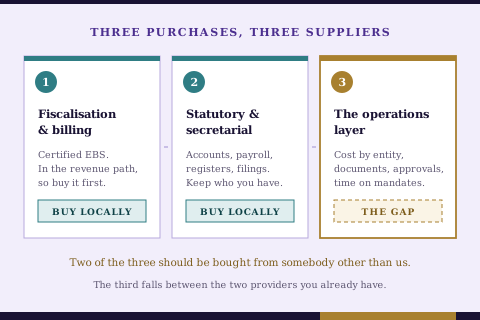
| Fiscalisation and billing. Invoices submitted to the Revenue Authority in real time through a certified Electronic Billing System, with the validation reference held against the transaction | A certified provider. This is an accreditation, not an integration — either a vendor holds it or they do not, and no amount of enthusiasm substitutes. We do not hold it. Buy this first, from someone who does |
| Statutory and secretarial. Accounts, returns, payroll calculation and filing, statutory registers, minute book, share register, the annual cycle | Your accountants and your management company. They are good here, they are licensed, and they are cheaper at it than any software you would buy to displace them. We do none of this and are not proposing to |
| The operations layer. Procurement with approvals that block, stock across sites, landed cost, projects and time against mandates, documents against transactions, cost attributed to an entity and a jurisdiction, one audit trail across all of it | This is the one that is often nobody's job. It is not accounting and it is not compliance, so it falls between the two providers you already have — and it is what we do |
Two of the three purchases above should be made from someone other than us, and one of them should be made first. A guide that did not say so would not be worth reading.
Why sequence matters more here than usual
Fiscalisation sits in the path of your revenue. If a submission fails, an invoice does not issue. Nothing else on the list has that property — you can adopt procurement controls, landed cost or project accounting next quarter without touching your billing.
That asymmetry gives you the order. Settle fiscalisation first, keep your statutory relationships where they are, and only then look at the operations layer. Do it the other way round and you can end up with a platform you like and a fiscalisation route bolted onto the side of it, in the one place where a bolt-on is expensive.
The question that tells you whether you have the third problem
One question, and you can ask it this afternoon without talking to any vendor.
What was the total expenditure incurred by the Mauritian entity, in Mauritius, last financial year — and how was that number produced?
The number is not the interesting part. How it was produced is. If it came back as a report you can see the working of, your records are in good shape and the third purchase is not urgent for you. If it came back after two days, a spreadsheet and a conversation with the one person who knows which cost centres belong to which entity, then you have the problem, it recurs every year, and it is currently held together by an individual rather than by a system.
Four things worth asking us, and the answers
Published in advance so a demonstration does not have to be spent on them.
-
Do you make us compliant with the substance requirements?
No. Substance is assessed on what your business actually does — people, premises, expenditure, where decisions are genuinely taken. Software changes none of that. What it changes is whether you can evidence it cheaply. If your arrangements are sufficient, good records make that demonstrable; if they are not, no system helps. Anyone offering you a "substance solution" should be asked which regulator has accepted it.
-
What is the minimum expenditure or headcount?
We will not tell you, and be suspicious of a software vendor who does. The tests are proportionate to your level of activity and assessed in the round, indicative guidance varies by activity type, and figures circulate secondhand. Your management company has the current position for your specific case and is licensed to give it. What we can say is that whatever the figure is, you will need to produce your actual number against it — and that part is a records problem.
-
Do you do Mauritian payroll?
No. No PAYE, no NPF or NSF contributions, no statutory returns. Our maintained payroll engine covers Kenya only and we do not plan to change that for a market this well served locally. We do attribute labour cost to entities, projects and cost centres, which is the half of the problem this guide is actually about — but the calculation and the filing belong to a local provider.
-
Why would you support a market this far from you?
A fair question to ask every vendor. Support is remote from Nairobi, in English, one hour behind you — effectively the same working day. There is no Port Louis office and no Mauritian implementation partner. Ask us, and ask everybody else, what happens when the person who implemented your system leaves. That question separates vendors more reliably than any feature list.
What is genuinely different about buying here
Two things, and both of them cut against the usual advice in this series.
The first is that the credibility discount runs the other way. In most markets we write about, a buyer is reasonably worried that a remote vendor will not know their local rules. Here, the local firms know the rules better than any software vendor will, so the right response is not to look for a vendor who claims to know them — it is to keep the local relationships and buy software that is honest about staying out of their way.
The second is that the problem worth solving is not visible in a feature list. Nobody sells "expenditure attributable to an entity and a jurisdiction" as a headline capability, because it is not exciting and it does not demonstrate well. It is nonetheless the thing that turns a fortnight in March into a report, and it is the reason this market has a page in this series at all.
Where the boundary sits
Cost, documents, approvals and time, attributed as they happen
Expenditure coded to entity, cost centre and jurisdiction at entry; documents held against the transactions they evidence; approvals recorded against what they authorised; time and cost booked to the mandate. The third purchase, and the one we would stand behind.
Multi-currency and multi-site operations
Original currency and the rate actually applied retained on the transaction, stock across locations including goods handled without being owned, landed cost on the consignment. Ordinary here, and genuinely multi-currency rather than one reporting currency with conversions bolted on.
Fiscalisation through a certified EBS
Not built and not certified. This is an accreditation rather than an integration. Buy it first, from a provider who holds it, and evaluate everything else afterwards. If that sequencing means you never get to us, the advice was still correct.
Payroll, statutory accounts, returns and company secretarial
Not built. Not payroll calculation, not filing, not statutory registers, not the minute book, not the share register. Your existing providers are better at all of it and cost less than displacing them would.
Any judgement about whether your arrangements are enough
Yours, your management company's and your adviser's. We can make records exist, be attributed and be retrievable. Deciding what is sufficient is regulated advice and we are not the people to give it.
The short version
Buy fiscalisation first, from a certified provider. Keep your accountants and your management company. Then ask one question internally — total expenditure incurred by the Mauritian entity, in Mauritius, last year, and how the number was produced. If the answer is a report, you are done. If the answer is a person, that is the conversation, and it is the only one we are claiming to be useful in.
Nothing above requires a demonstration to verify and most of it can be checked against your own records this week. That is deliberate: a market with advisers this good deserves a guide that can be audited by them.
What we can build for Mauritius on top of the standard product
Everything listed above as something we can add describes what ships in the standard product today — it is a starting point for Mauritius, not a limit on what AWRA OpsHub can do there. Kenya's eTIMS integration and its maintained payroll engine are in the product because Kenyan clients needed them and commissioned them; neither appeared by itself. The same door is open here. If a certified EBS fiscalisation connection, a Mauritian payroll engine, a bank or mobile money feed, a statutory return format, a rule specific to how your operation runs, or a link to a system you already have is what stands between you and a decision, tell us and we will scope it as a build — written spec, timeline and price — before you commit to anything.
Real-time fiscalisation, through certification we do not hold
Invoice fiscalisation against the Revenue Authority in real time — structured invoices, a validation response held on the transaction, retries, a failure queue and a daily report of invoices carrying no reference. Stated precisely, because precision is the whole value of saying it here: this requires becoming a certified Electronic Billing System, which is an accreditation rather than an integration. We are not certified and hold no connection today. If you are in scope, choose your EBS first and fit everything else around it.
Banks, cards and genuinely multi-currency settlement
Bank statement feeds and card acquirer settlement into the Payments Register, across the several currencies a Mauritian entity actually operates in rather than one reporting currency with conversions bolted on. There is no exchange control to work around here, which makes this the ordinary version of a problem that is difficult almost everywhere else on the continent.
The operational work, which is what most commissions actually are
An extra approval stage in a chain that does not match the standard one, a custom field set on employees or assets that only your sector needs, an expiry that has to block an order rather than send an email, a report your board asks for in a shape nothing produces, or a scanner or weighbridge feeding the goods-in door. These are the commissions we are asked for most often and the smallest ones we quote — and unlike a revenue-authority pipeline, none of them waits on a regulator.
Payroll and statutory returns
PAYE, National Pensions Fund and National Savings Fund contributions and the associated returns, computed on live records and produced in the layout each body expects. Not built today — our maintained engine covers Kenya only, and the local providers here are good.
Systems you already run
The accounting package, CRM, online store or custom database you intend to keep — connected through our API so a fact is entered once and appears everywhere it is needed.
How it works: you describe the requirement, we return a written scope, timeline and cost, and once agreed it is built into your environment and maintained as part of the product. No roadmap slide, and no pretending in a demo that something exists when it does not.
Tell us what you need integrated