
Buying Operations Software in Singapore: A Straight Guide
Written for the holding company rather than the local business — because if your warehouse is in Singapore, you have excellent local options and should use them.
Singapore has more vendor choice per business than almost anywhere. Every international product is here, the regional implementation bench is deep and genuinely good, and buyers evaluate software professionally rather than by instinct. It is a market where a weak pitch is identified quickly and correctly.
So this guide starts by splitting the audience, because for a good half of it the better buy is local and we would rather say which half than let you work it out over three calls.
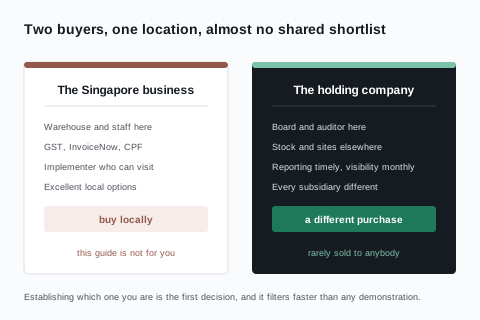
Which buyer are you?
The Singapore business
- Warehouse, staff and customers are here.
- You need GST, InvoiceNow, CPF and local statutory reporting.
- You need an implementer who can be in your office.
- Excellent local and regional options exist, several of them outstanding.
- This guide is not for you, and neither are we.
The holding company
- The board, the auditor and the bank are here.
- The stock, the sites, the plant and the people are not.
- Your reporting is timely; your operational visibility is monthly.
- Your subsidiaries each run something different.
- This is the shape the rest of this guide addresses.
That split is not a marketing device. The two buyers need different products, evaluate against different criteria, and share almost no shortlist. Conflating them is the most common reason a group buys something excellent and remains unable to answer the question it bought it to answer.
For the holding company: what you are actually buying
Three distinct purchases get bundled together in most group software conversations, and separating them makes the evaluation dramatically easier.
| The purchase | What it solves | Where to buy it |
|---|---|---|
| Singapore compliance | GST, InvoiceNow and Peppol, CPF, statutory filing | Locally. Well served, competitively priced, connected to the network |
| Group consolidation | Eliminations, minority interests, translation, statutory group accounts | A consolidation product or your accounting system. A real category with real specialists |
| Operational visibility | What stock is where at what cost, today, across entities that report monthly | Rarely bought at all, which is why the gap persists |
Almost every group has bought the first two. The third is usually assumed to be a by-product of the second, and it is not — consolidation aggregates what subsidiaries submit, and what they submit is a financial summary. The operational detail was never in it.
The questions worth asking
Six questions for a group evaluation
Can you show group stock at cost, right now?
The answer you often get
You can run a consolidated report.
What to press for instead
Ask them to show it, with two entities in different currencies and something in transit between them. The interesting question is whether goods on the water appear at all, because in many systems they are in neither entity's figure.
How do you handle intercompany transfers?
The answer you often get
Both entities post their side.
What to press for instead
That is two records of one event and it is the origin of every reconciliation difference. Ask whether a transfer can exist once, with a confirmation at each end, rather than twice with a hope that they agree.
What rate is retained on a transaction?
The answer you often get
We support multi-currency.
What to press for instead
Ask whether the original currency and the rate actually applied are kept on the transaction, or whether it is converted once and the source discarded. If the source is discarded, every subsequent difference lands in an exchange line with no explanation available.
How long to onboard an acquisition?
The answer you often get
It is a straightforward import.
What to press for instead
It is not, and a vendor saying so has not done one. The real work is definitional — what a location is, what a cost centre is, who approves what. Ask what that process looks like and how long it took for their last customer who did it.
How does it behave on a bad connection?
The answer you often get
It is cloud based.
What to press for instead
For a Singapore office that is fine. For a site in Mindanao, Zambia or eastern Indonesia it is the whole question. Ask specifically what happens with no connection, and get it demonstrated rather than described.
What do you not do?
The answer you often get
A pause, then a roadmap item.
What to press for instead
The most diagnostic question here, and in this market you are entitled to a fluent answer. A vendor selling to professional buyers who cannot state their boundary has either not defined it or has decided not to share it.
Scoring the shortlist
Six criteria for a holding company buying operational visibility
Score out of five. Note that the classic Singapore criteria — GST, InvoiceNow, CPF — are absent deliberately, because if you are buying this layer you should already own those and they should not be scored twice.
Group position, live
Make them prove it: Show me group stock at cost, two currencies, with something in transit.
One transaction, not two
Make them prove it: Transfer stock between entities and show me both sides.
Currency provenance
Make them prove it: Show me a purchase in a third currency and the rate that was actually applied.
Behaviour on a bad connection
Make them prove it: Aeroplane mode, record a receipt, reconnect.
Onboarding an entity
Make them prove it: Walk me through adding an acquired operating company.
Stated boundary
Make them prove it: Name three things you do not do that a group like ours often needs.
On the credibility discount, which we should name rather than work around
A Nairobi vendor selling into Singapore starts at a disadvantage and it is a rational one. No local office, no local implementation partner, a five-hour time difference and no Singapore reference story. If a board requires a local reference in your sector, that is a legitimate reason to choose somebody else and we will not argue with it. The counter-argument is narrow and specific: your operating entities are in markets we have built for, and support in your time zone matters less than support in theirs — which is where ours already is.
Where we fit
Multiple entities and locations on one basis
Each a distinct position with its own stock, approvals and numbers, reportable individually and together without waiting for a submission.
Transfers with confirmation at both ends
One movement rather than two entries, with in-transit stock owned and visible while it travels.
Currency provenance
Original currency and the rate actually applied retained on the transaction rather than converted once and discarded.
Procurement, landed cost, projects and assets
Approvals that refuse per entity, duty and freight reaching the unit cost, true project cost, and plant under named custody — on the same basis in every operating company.
Entity structure, delegation and definitions
What a location, cost centre and project mean across the group, and who can approve what in each entity. Configured, and the decisions are yours to make once.
Group policy — cut-off, rates, transfer pricing
Conventions, benchmarking and documentation belong with your finance function and advisers, and they matter more than any software choice here.
InvoiceNow, Peppol and IRAS transmission
No access point, no structured sending or receiving, no invoice data transmitted under the GST requirement.
Statutory consolidation
No eliminations, minority interests, translation reserve or group financial statements.
Singapore statutory payroll and GST
No CPF, Skills Development Levy, IR8A or IR21, and no GST return preparation.
Local office and implementation partner
Onboarding is remote from Nairobi. In this market that is a fair objection rather than a detail.
Your business is in Singapore
Buy locally, and stop here
You need GST, InvoiceNow, CPF and an implementer who can visit. The local and regional market serves that well and we would be a strange choice. This is the correct answer rather than a modest one.
You need consolidated statutory accounts
That is a consolidation product
Eliminations, minority interests and translation are a real specialism with real specialists. We do not do any of it and we would rather you bought the right category than stretched ours.
Your subsidiaries are in markets we know and you cannot see them between month ends
This is the conversation
Operating entities recording the same operational facts on the same basis, continuously, so a group question is answered by looking. It sits under your existing compliance and consolidation rather than replacing either.
You are not sure the gap is real
Ask for group stock at cost, today
Then time how long it takes to arrive. An hour means your visibility matches your reporting and you should spend the money elsewhere. A week and three phone calls is the finding, and it costs nothing to discover.
What AWRA OpsHub does today
- Multiple entities and locations on one operational basis
- Transfers with confirmation at both ends and in-transit stock owned throughout
- Original currency and applied rate retained on every transaction
- Per-entity procurement approvals that refuse, with delegation
- Landed cost, project cost and asset custody across markets
- Offline capture, which matters for the operating entities rather than for Singapore
More we can add to your workspace
- InvoiceNow, Peppol or IRAS transmission
- Statutory consolidation, eliminations or group financial statements
- CPF, Skills Development Levy, IR8A, IR21 or GST returns
- Transfer-pricing benchmarking, policy or documentation
- A Singapore office or local implementation partner
What we can build for Singapore on top of the standard product
Everything listed above as something we can add describes what ships in the standard product today — it is a starting point for Singapore, not a limit on what AWRA OpsHub can do there. Kenya's eTIMS integration and its maintained payroll engine are in the product because Kenyan clients needed them and commissioned them; neither appeared by itself. The same door is open here. If an InvoiceNow access point, a CPF engine, a bank or mobile money feed, a statutory return format, a rule specific to how your operation runs, or a link to a system you already have is what stands between you and a decision, tell us and we will scope it as a build — written spec, timeline and price — before you commit to anything.
InvoiceNow, Peppol and GST reporting
Sending and receiving structured invoices through a Peppol access point on the InvoiceNow network, invoice data transmitted to IRAS on the schedule your registration date puts you in, and GST returns assembled from the underlying documents rather than from a summary. Worth stating plainly: Peppol is a receiving network as much as a sending one, and the inbound half is the one most implementations leave until last.
PayNow, GIRO and multi-currency banking
PayNow collection matched to the invoice, GIRO files, and multi-currency bank feeds wired into the Payments Register — which is most of the point in a market where the bank account and the operation are usually in different countries.
The operational work, which is what most commissions actually are
An extra approval stage in a chain that does not match the standard one, a custom field set on employees or assets that only your sector needs, an expiry that has to block an order rather than send an email, a report your board asks for in a shape nothing produces, or a scanner or weighbridge feeding the goods-in door. These are the commissions we are asked for most often and the smallest ones we quote — and unlike a revenue-authority pipeline, none of them waits on a regulator.
Payroll and statutory returns
CPF contributions by age band and residency status, the Skills Development Levy, IR8A submission and IR21 tax clearance for departing foreign employees, computed on live records rather than assembled at year end.
Systems you already run
The accounting package, CRM, online store or custom database you intend to keep — connected through our API so a fact is entered once and appears everywhere it is needed.
How it works: you describe the requirement, we return a written scope, timeline and cost, and once agreed it is built into your environment and maintained as part of the product. No roadmap slide, and no pretending in a demo that something exists when it does not.
Tell us what you need integratedOur take
Decide which buyer you are in the first meeting, because the two shortlists barely overlap. If your operations are here, buy locally — that is the right answer and we would be a poor choice. If you are a holding company whose operations are elsewhere, separate the three purchases: compliance, consolidation, and operational visibility. You almost certainly own the first two. The third is the one nobody sells you, and the test for whether you need it takes an afternoon: ask for group stock at cost today and time the answer.
The purchase nobody offers you
Not compliance, not consolidation — operational visibility across entities that currently report monthly. It sits underneath both of the things you already own.
Talk to us about SingaporeFrequently asked questions
We are a Singapore business, not a holding company. Should we consider you?
Probably not, and we would say so on the first call. If your warehouse, staff and customers are here, you need GST, InvoiceNow, CPF and an implementer who can be in your office — and Singapore has an unusually good market for exactly that. We have none of those things. Choosing us would mean accepting real disadvantages in exchange for capability you can get locally, which is not a trade worth making.
Do you connect to InvoiceNow?
No. We are not a Peppol access point, we do not send or receive structured invoices on the network, and we do not transmit invoice data to IRAS. The GST InvoiceNow requirement is being phased in over several years by registration type and date, so your specific obligation depends on your position — confirm it with IRAS or your tax adviser. If you are in scope you need a connected provider, and there is no reason you cannot have that alongside an operational layer.
Can you replace our consolidation system?
No, and the distinction matters more than vendors usually admit. We do not produce statutory consolidated accounts: no eliminations, no minority interests, no translation reserve. What we do is hold operational records on one basis across entities so the inputs to a consolidation are consistent before anyone consolidates them. That reduces reconciliation work substantially and it is genuinely useful — it is simply a different thing from consolidation, and buying it as a replacement would disappoint you.
How would this work with subsidiaries on different systems?
It is the normal starting position and no group replaces four systems at once. The practical approach is to begin with one or two operating entities where the visibility gap costs the most, agree the operational definitions there, and extend from a working example. Value appears before a full rollout, and the definitional decisions — what a site is, what a cost centre is — get made once at small scale rather than in a group-wide negotiation nobody has time for.
What about the time difference and having no local office?
Both are real and we would rather price them in than argue them away. Nairobi is five hours behind Singapore, so your afternoon is our morning and your morning is not covered. There is no local office and no partner who can attend a site. The one thing genuinely in our favour is that for a holding company the support is usually needed by the operating entities rather than by the Singapore office — and if those are in Africa, they are in our time zone rather than yours.
Do you have Singapore references?
No, and in this market that is a serious objection rather than a soft one. Buyers here evaluate professionally and are right to want evidence. Our operating history is East and Southern Africa, which is relevant if that is where your subsidiaries are and irrelevant if it is not. If a local reference in your sector is a board requirement, take that seriously — it is a legitimate reason to choose somebody else, and we would rather agree with you early than spend a quarter arriving at it.
