
The Finance Function Is Here. The Operations Are Not
The consolidated accounts are accurate, the auditor signs, and nobody in the building can tell you what the group is holding today. Those are not contradictory statements, and the gap between them is where holding companies lose money.
There is a category of company that shows up in Singapore in large numbers and is almost never written about in software terms: the holding entity whose operations are somewhere else. A regional headquarters, a trading house, a resource or commodity group, a family office with operating subsidiaries scattered across Asia and Africa.
From a distance it looks like a well-run business, and usually it is. The financial reporting is timely and audited. The board pack arrives on schedule. The bank is comfortable. Nothing in the governance would trouble a reviewer.
And if you ask, on a Wednesday, how much stock the group is holding right now and what it cost to land, the honest answer is a number from last month end, produced by the people being reported on, in a template designed for accounts rather than for operations.
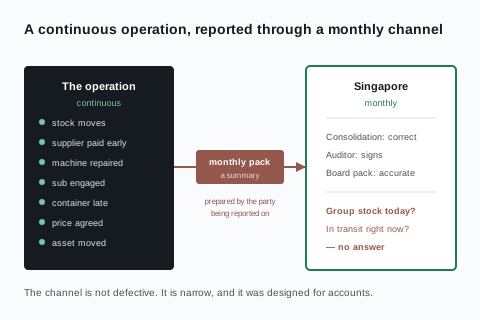
The gap, in three steps
Nobody does anything wrong in this sequence, which is why it persists in businesses full of competent people.
-
Decisions are made where the information is
A supplier is paid early because the site would otherwise stop. A machine is repaired rather than replaced. A subcontractor is engaged at short notice. Every one of those calls is made by somebody with far better local information than anybody in Singapore has, and most of them are correct.
-
A summary crosses the boundary once a month
A trial balance, a few schedules, a commentary. It is a summary, which means it is an interpretation, and the interpretation is prepared by the party being measured. Nothing in it is untrue. What is absent was not concealed — it was simply never requested, because the template was built for financial reporting.
-
The consolidation is correct and the picture is not
The numbers add up. The auditor signs. And the group cannot answer an operational question without a round of emails, because the operational detail never crossed the boundary in the first place.
Financial reporting and operational visibility are different things, and having the first in excellent order is exactly what makes it easy to believe you have the second.
Five questions that expose it in about a week
These are worth asking not because the answers are damning — usually they are not — but because how long they take to answer is the actual measurement.
- How much stock does the group hold right now, at cost, across every operating entity?
- Which subsidiary has the largest intercompany receivable, and has the other side confirmed the same figure?
- What is the group's total in-transit inventory, and which entity is carrying it?
- When a subsidiary commits to a material purchase, does anybody here know before the money is spent, or after?
- If we acquired an operating company next quarter, how long before we could see it on the same basis as the rest?
The last one is the most revealing and the answer is almost always measured in months. That is a fair reflection of reality — integrating a business is genuinely hard — but it is worth noticing that the difficulty is rarely technical. It is that nobody has ever agreed what a location, a cost centre or a project means across the group, so each acquisition renegotiates it.
What the gap actually costs
Four consequences, in roughly the order that groups discover them.
| Consequence | How it shows up |
|---|---|
| Capital allocated on stale information | The subsidiary that gets the investment is the one whose pack read best last quarter, which is not always the one where the money would work hardest |
| Working capital nobody can locate | Stock exists, is owned, and cannot be sold against because no one can say precisely where it is or what condition it is in |
| Subsidiaries funding each other invisibly | Through receivables that neither side has confirmed, which appear as balances rather than as a financing decision anybody took |
| Diligence that costs more than it should | An investor, lender or acquirer asks operational questions on a group basis. Assembling the answers takes weeks and the assembly itself signals something |
The credibility point, which is the one that lands with boards
When an operational number turns out to be wrong, the credibility that is spent belongs to the holding company rather than the subsidiary. The board asked, Singapore answered, and Singapore was wrong. It happens perhaps twice before the group stops asking operational questions in board meetings altogether — which is the worst possible resolution, because the questions were the right ones and the reporting was the problem.
What we are not saying
Two things, because this argument is easy to over-extend and the over-extended version is wrong.
Not: centralise the decisions
- Local autonomy usually produces better decisions than remote control.
- The person on site has information that cannot be transmitted in a pack.
- Groups that centralise operational decisions get slower without getting better.
- The problem is not who decides. It is that nobody here knows.
- Visibility and control are different things, and only one of them is wanted.
Not: buy a bigger consolidation tool
- Consolidation operates on what the subsidiaries submit.
- A better tool consolidates the same summary faster.
- The missing data was never in the submission to begin with.
- This is a collection problem, not an aggregation one.
- More reporting on the same inputs produces more confident wrong answers.
What does help is unglamorous: the operating entities recording the same operational facts on the same basis, continuously, so that a question can be answered by looking rather than by asking. Not a new reporting layer — a shared operational one underneath the reporting that already works.
Four questions to ask your own group
What is group stock at cost today?
The answer you often get
As at last month end, it was...
What to press for instead
Ask for today, and time it. The delay is the measurement, not the number. A week and three phone calls is a very different business from an hour, and both would describe their reporting as good.
Do subsidiaries use the same definitions?
The answer you often get
Broadly, yes.
What to press for instead
Ask what a "site" is in each one, and whether a cost centre means the same thing in two of them. "Broadly" is where every consolidation difficulty originates, and it is usually discovered during an acquisition rather than before one.
How do you know a subsidiary is holding old stock?
The answer you often get
It would show in the provision.
What to press for instead
A provision is a judgement made by the entity holding the stock, about its own stock, and reported to you. Ask whether anybody here can see ageing by item and location without requesting it. Usually not, and that is the same gap in another costume.
What happens between month ends?
The answer you often get
We would hear if there were a problem.
What to press for instead
Ask who would tell you and why. Subsidiaries report exceptions upward when they are already resolved or already unavoidable. The four weeks in which something could still have been changed are the four weeks you have no view of.
What AWRA OpsHub does today
- Multiple entities and locations on one basis, each a distinct position
- Transfers between entities that stay open until the receiving end confirms
- Multi-currency held at the rate actually applied, with the original currency retained
- Procurement approvals per entity that refuse rather than warn
- Landed cost on the consignment in every operating company
- Project cost, asset custody and a full audit trail across markets
More we can add to your workspace
- Statutory consolidation — eliminations, minority interests or translation reserve
- Group financial statements of any kind
- InvoiceNow, Peppol or IRAS transmission
- CPF, Skills Development Levy, IR8A or IR21
- Transfer-pricing benchmarking, policy or documentation
What we can build for Singapore on top of the standard product
Everything listed above as something we can add describes what ships in the standard product today — it is a starting point for Singapore, not a limit on what AWRA OpsHub can do there. Kenya's eTIMS integration and its maintained payroll engine are in the product because Kenyan clients needed them and commissioned them; neither appeared by itself. The same door is open here. If an InvoiceNow access point, a CPF engine, a bank or mobile money feed, a statutory return format, a rule specific to how your operation runs, or a link to a system you already have is what stands between you and a decision, tell us and we will scope it as a build — written spec, timeline and price — before you commit to anything.
InvoiceNow, Peppol and GST reporting
Sending and receiving structured invoices through a Peppol access point on the InvoiceNow network, invoice data transmitted to IRAS on the schedule your registration date puts you in, and GST returns assembled from the underlying documents rather than from a summary. Worth stating plainly: Peppol is a receiving network as much as a sending one, and the inbound half is the one most implementations leave until last.
PayNow, GIRO and multi-currency banking
PayNow collection matched to the invoice, GIRO files, and multi-currency bank feeds wired into the Payments Register — which is most of the point in a market where the bank account and the operation are usually in different countries.
The operational work, which is what most commissions actually are
An extra approval stage in a chain that does not match the standard one, a custom field set on employees or assets that only your sector needs, an expiry that has to block an order rather than send an email, a report your board asks for in a shape nothing produces, or a scanner or weighbridge feeding the goods-in door. These are the commissions we are asked for most often and the smallest ones we quote — and unlike a revenue-authority pipeline, none of them waits on a regulator.
Payroll and statutory returns
CPF contributions by age band and residency status, the Skills Development Levy, IR8A submission and IR21 tax clearance for departing foreign employees, computed on live records rather than assembled at year end.
Systems you already run
The accounting package, CRM, online store or custom database you intend to keep — connected through our API so a fact is entered once and appears everywhere it is needed.
How it works: you describe the requirement, we return a written scope, timeline and cost, and once agreed it is built into your environment and maintained as part of the product. No roadmap slide, and no pretending in a demo that something exists when it does not.
Tell us what you need integratedOur take
Ask for the group stock position today, at cost, across every entity — and time how long it takes to arrive. That single exercise separates groups whose operational visibility matches their financial reporting from the much larger number where the two have quietly diverged. If it comes back in an hour, this article is not about you. If it takes a week, then every capital allocation decision made between month ends this year was taken on a picture that was several weeks old and prepared by the party being measured. That is not a reporting failure. It is a collection one, and it is fixed underneath the reporting rather than inside it.
The layer underneath the pack
Operating entities recording the same operational facts on the same basis, continuously — so the answer to a group question is a report rather than a round of emails.
Talk to us about SingaporeFrequently asked questions
Is this not just a consolidation problem?
No, and the distinction is the point of the article. Consolidation aggregates what the subsidiaries submit. If the submission is a trial balance and some schedules, then a better consolidation tool produces a faster, prettier version of the same limited picture. The operational detail — what stock is where, in what condition, at what landed cost, against which project — was never in the submission. That is a collection problem and it is solved in the operating entities, not in the holding company.
Should we centralise decision-making?
Generally not, and groups that respond to this problem by centralising usually make it worse. Local managers have information that cannot be transmitted in a monthly pack and they are frequently right for reasons that are hard to articulate at a distance. The objective is visibility rather than control: knowing what is happening, when it happens, without needing to approve it. Those are separable, and conflating them is how a group ends up slower and no better informed.
Do you produce consolidated accounts?
No — no eliminations, no minority interests, no translation reserve, no group statutory financial statements. That is your accounting system and your auditor. What we hold is operational records on one basis across multiple entities, so the numbers that feed a consolidation are consistent before anyone starts consolidating. That reduces the reconciliation work substantially. It does not replace the consolidation and we would rather be precise about that than let the distinction blur in a demonstration.
What about entities that already have their own systems?
That is the normal situation rather than the exception, and it is worth being realistic: no group replaces four operating systems at once, and any vendor suggesting otherwise has not done it. The practical approach is to start with one or two entities where the visibility gap costs the most, get the operational basis agreed there, and extend. The value shows up earlier than a full rollout, and the definitional decisions — what a site is, what a cost centre is — get made once on a small scale rather than in a large negotiation.
How long does an acquisition take to bring onto the same basis?
Realistically a fortnight of decisions and then some configuration, and the decisions are the expensive part — what a location means, how projects are structured, who approves what, how items are classified. Any vendor describing this as an import is talking about the data rather than the project. The useful preparation is to have made those decisions once, for the group, so the next acquisition inherits them instead of renegotiating them.
Why would a Singapore group buy from a Nairobi vendor?
For the operating entities rather than for Singapore. Where your subsidiaries are in markets we have built for — much of East and Southern Africa, increasingly parts of Southeast Asia — the operating conditions are the ones we designed around: intermittent connectivity, imported goods with real landed cost, cash purchasing, mobile assets. That is a different qualification from being a good Singapore ERP, and it is the only one we are claiming. For your Singapore compliance and consolidation, buy locally.
