When Your VAT Return Is A Claim, Not A Bill
Accounting systems are built around the assumption that tax flows outward. For exporters and zero-rated suppliers it flows back, and the number the whole return turns on is the one most systems never record.
Every VAT system has two kinds of registered business in it. One charges tax on its sales, pays tax on its purchases, and hands over the difference. The other charges little or no tax on its sales — because it exports, or because what it sells is zero-rated — pays tax on nearly everything it buys, and claims the difference back. Same rate, same rules, same forms. Completely different relationship with the tax authority, and completely different requirements of an accounting system.
Software is overwhelmingly built for the first kind. Output tax gets careful treatment: rates on lines, tax on documents, totals on reports. Input tax is often not recorded as tax at all — it goes into the cost of what was purchased, which is exactly right if you can never reclaim it and exactly wrong if reclaiming it is your entire relationship with the revenue authority.
Two businesses, one rate
| Standard-rated domestic trader | Exporter or zero-rated supplier | |
|---|---|---|
| Charges on sales | The standard rate | Nothing, or almost nothing |
| Pays on purchases | The standard rate | The standard rate |
| The return is | A payment | A claim |
| The critical number is | Output tax — what you charged | Input tax — what you were charged |
| What most systems hold | Exactly that | Not that |
| Where the balance sits | A liability, and it is visible | A receivable, and it is usually in a spreadsheet |
Why "we do reports" is not an answer
When a vendor is asked how their system handles input tax, a common reply is that the reporting is flexible. It is worth being precise about why that does not follow. A report cannot total a figure that was never captured. If the tax you paid a supplier went into the cost of the goods at the moment of receipt, there is no field anywhere holding it as tax, and no amount of report configuration will separate it out afterwards. The information is not hidden; it is gone.
Landed costing makes this sharper, because it is a genuinely good feature doing precisely the wrong thing here. Its purpose is to fold freight, duty and tax into the unit cost of goods so that margins are honest. A reclaim needs the opposite: tax held out of cost, identified as tax, attributable to a supplier and a period. Both cannot be true of the same figure, and a system that does landed costing well may be actively harder to reclaim from.
Landed cost puts the tax into the cost of goods on purpose. A claim needs it kept out. The better a system is at the first, the less help it is with the second.
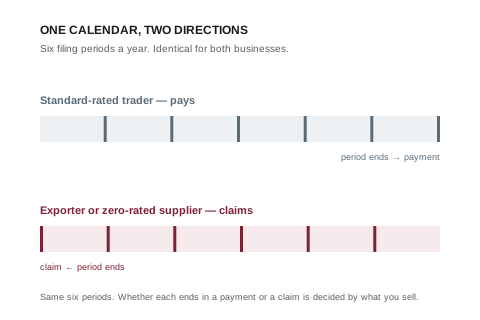
The cadence matters more than people expect
Filing frequency is usually treated as an administrative detail. For a business in a credit position it is a working capital variable. Trinidad and Tobago files every two months — six returns a year, each due at the end of the month following the period. That means the input tax paid at the start of a period waits the whole period plus a month before it is even claimed, and only then begins whatever the settlement process takes.
The structural point, and we will not go past it: a business in a standing credit position is financing its own input tax from the moment it pays a supplier until the moment its claim is settled. How long that is, and why, varies by jurisdiction and is not a software question. What is a software question is whether the evidence behind the claim is assembled continuously or in a scramble six times a year.
What ours does, since we are the ones raising it
We hold no tax on the purchase side — no rate, no amount, no flag, on any purchase document. A tax rate appears in exactly three tables in our schema and all three are sales-side. So we cannot total your input tax, cannot show your credit position, and cannot produce a return; the claim has to be assembled from supplier invoices outside the system. What we do carry is the discipline underneath it: matched orders, receipts and supplier invoices with documents attached, which is the evidence a claim rests on even when the arithmetic happens elsewhere. Published on our Trinidad and Tobago page. It is the same missing column our Liberia page describes — there the absence is defensible today and stops being so in January; here it has been wrong for years.
What a buyer can actually check
Four questions for anyone selling you a system
Show me, on a purchase document, the field that holds the tax I was charged.
What you will hear
A field, a report, or a redirection to landed cost.
How to read it
Only the field counts. This single question resolves most of the evaluation and takes ten seconds.
What is my input tax total for the last period, and where does that number come from?
What you will hear
A screen, or an export.
How to read it
If the provenance is an export plus a formula, the system is storing cost and a person is deriving tax.
How do you apportion input tax between zero-rated and standard-rated activity?
What you will hear
A method, or an admission.
How to read it
Relevant the moment a domestic trader wins an export contract, which is exactly when a manual method stops scaling.
If a supplier invoice arrives three weeks late, which period does its input tax fall into?
What you will hear
A rule about document dates.
How to read it
Late supplier invoices are the normal case, not the exception. A system with no answer here will produce claims that quietly disagree with your ledger.
One thing that is not a software problem
Whether a particular supply is zero-rated, exempt or standard-rated is a question for your adviser and the published schedules, and the consequences of getting it wrong land on you rather than on your vendor. Any software supplier offering a confident view on the classification of your supplies is offering you a liability. What software can honestly do is record the classification you were advised to apply, apply it consistently, and make the evidence retrievable — which is a smaller claim than the market usually makes and a more useful one.
The short version
If your last VAT return produced a claim rather than a payment, you are buying software against a different requirement from the one it was probably built for. The whole evaluation turns on one question — where, on a purchase, is the tax recorded — and it is answerable in a sentence by anyone who knows their own product. Ask it first. Everything else on a feature list is downstream of it.