
When The Rate Goes Up And The Tax Goes Down
A rate change is arithmetic. A change of mechanism is a change in which side of your ledger the tax lands on — and the second is much easier to miss, because the headline number moves in the wrong direction.
On 1 January 2027 Liberia replaces its 13% Goods and Services Tax with an 18% Value Added Tax. Almost every summary of that reports five percentage points, and five percentage points is the least important thing about it. The GST is single-stage and cannot be deducted; the VAT can be. What changes is not how much tax there is. It is who ends up carrying it.
This distinction is worth understanding even if you never trade in West Africa, because it is the clearest available illustration of something that applies everywhere: the name of a tax tells you very little, and the rate tells you less than you think. Two taxes with the same name and the same percentage can behave completely differently depending on one question — may a business deduct the tax it was charged on its inputs?
Why a cascading tax costs more than its rate
If a business cannot deduct the tax on its purchases, that tax becomes part of what the purchase cost. The business then sells the goods on, and tax is charged again — on a price that already contains the first lot of tax. Do that three times down a supply chain and the tax compounds. The technical term is cascading; the practical term is that a 13% tax is not a 13% tax.
| Stage | Value added | GST 13%, not deductible | VAT 18%, deductible |
|---|---|---|---|
| Importer | 100.00 | Taxed on 100.00 → charges 13.00 → sells at 113.00 | Charges 18.00 → hands over 18.00 |
| Wholesaler | 100.00 | Taxed on 213.00 → charges 27.69 → sells at 240.69 | Charges 36.00, deducts 18.00 → hands over 18.00 |
| Retailer | 100.00 | Taxed on 340.69 → charges 44.29 → sells at 384.98 | Charges 54.00, deducts 36.00 → hands over 18.00 |
| Total tax collected | 300.00 added | 84.98 — which is 28.33% of the value added | 54.00 — which is 18.00% of the value added |
| What the last buyer pays | — | 384.98 | 354.00 |
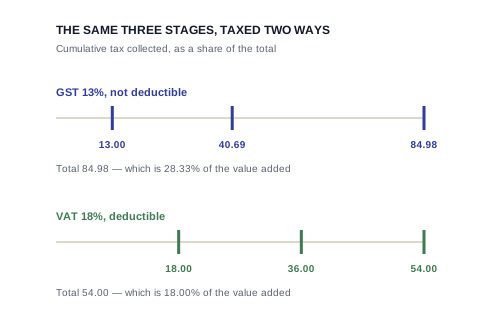
The rate went up by five points and the tax fell by ten. Nothing was avoided; the 30.98 difference is entirely tax that was being charged on tax.
What this does to an accounting system
Here is the part that matters when you are choosing software. Under a cascading tax, the tax you pay a supplier is genuinely part of the cost of what you bought. It belongs in the cost of goods, it is not recoverable, and a system that folds it into landed cost is doing the right thing. Under a credit-invoice tax, the same money is a receivable. It is not cost, it is an asset, and it needs to be recorded as tax — separately identified, attributable to a supplier and a period, and totalable.
That is not a configuration difference. It is a different shape of record. Most systems built for markets with a deductible tax hold tax on the purchase side as a matter of course. Systems built elsewhere frequently do not, because there was nothing to hold.
What ours does, since we are the ones raising it
We hold no tax on the purchase side at all. Across the whole product a tax rate is held in exactly three kinds of document — customer invoices, quotations and point-of-sale receipts — and all three are sales. A purchase order carries no tax rate, no tax amount and no tax flag. For a single-stage tax that is defensible, and we would defend it. For a deductible one it is not, and it is the single largest gap on our Liberia page. It is also the same gap our Trinidad and Tobago page describes from the other end, where broad zero-rating means many businesses are reclaiming rather than paying. One missing capability, two markets, two different reasons to care.
The transition question nobody enjoys
When a jurisdiction switches mechanism, businesses are left holding stock bought under the old rules and sold under the new ones. Whether any relief attaches to that stock, and on what evidence, is a matter for the transitional rules and for a tax adviser. It is worth flagging here only because it is the question a software vendor is most likely to be asked and least qualified to answer. The right answer from a vendor is that the system will record whatever treatment you are advised to take, and produce the purchase history the advice will be based on.
What a buyer can actually check
Four questions, and the first one settles most of it
Show me the field on a purchase order that holds the tax I was charged.
What you will hear
Either a field appears on screen, or you are shown a report, or the conversation moves to landed cost.
How to read it
Only the first is a yes. A report cannot total a figure that was never captured, and landed cost deliberately folds tax into unit cost — which is the opposite of what a deduction needs.
How do you total input tax for a period?
What you will hear
A named report, or a description of an export into a spreadsheet.
How to read it
If the answer involves exporting and adding up, the system is not holding the number; a person is.
What happens to an invoice raised in December and credited in January, across a rate change?
What you will hear
Ideally: the credit follows the rate of the supply it reverses, and here is where that is recorded.
How to read it
Many systems have nowhere on a credit note to record a rate at all. Ask to see the field rather than the intention.
Can I store next year's rate now, with a start date?
What you will hear
Often "yes, there is a date field".
How to read it
A date field is not a scheduled change. Ask what reads it. We have those columns and nothing reads them, which we say on the Liberia page with the column names.
The short version
When a tax changes mechanism, the rate is the headline and the deduction right is the story. A tax you cannot reclaim belongs in cost; a tax you can reclaim belongs in a receivable, and no amount of reporting will move it from one to the other after the fact. If you operate anywhere that is switching — or anywhere with broad zero-rating, which produces the same requirement for the opposite reason — the question to put to every vendor is not whether they support VAT. It is where, on a purchase, the tax is recorded.
