
Four Documents Decide Whether Your Supplier Gets Paid
In the CEMAC zone, paying a foreign supplier is a case you have to prove rather than an instruction you give. Four documents have to agree, they are created by four different parties at four different times, and nobody owns the fact that they must match.
Ask a finance director in Douala why a supplier has not been paid and you will very rarely be told about cash. You will be told about a file — that the bank has come back on something, that a declaration does not match, that somebody is looking for a document from March.
This is not a banking relationship problem and it is not evidence of a badly run business. Since March 2019 the CEMAC exchange regulation has treated a transfer out of the zone as a case to be evidenced rather than an instruction to be executed, and your bank has its own reporting obligation to the central bank and its own exposure if the case is incomplete. It is not being difficult. It is being audited.
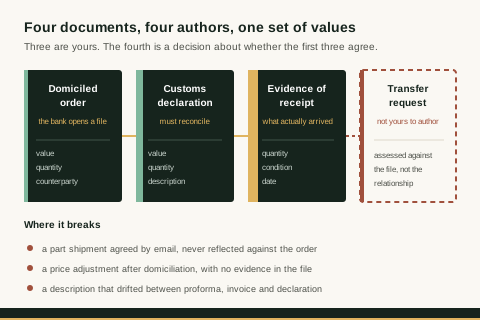
The operational consequence is specific and it is the subject of this piece: four documents, created by four parties at four different moments, have to agree with each other — and in most businesses no single system, and no single person, is responsible for the fact that they must.
The four documents
Every business importing into the zone knows this sequence. What is unusual is how rarely it is written down as a sequence, which is why it survives in the head of whichever person has done it before.
-
The domiciled order
Above a threshold, the contract or order is registered with a bank inside the zone before the transaction proceeds, and the bank opens a file against it with a reference number. From that point the commercial relationship has a second identity, and everything downstream has to agree with it. The threshold is deliberately not stated here — it differs by transaction type and published figures vary, so confirm yours with your own bank rather than with anybody's website.
-
The customs declaration
Values, quantities, description and counterparty, filed at the border. A declaration that does not reconcile with the domiciled order is not a customs problem you resolve at customs. It is a payment problem that surfaces months later, when the bank compares the two.
-
The evidence of receipt
Proof that what was declared is what actually arrived. This is the point where exchange-control compliance and ordinary warehouse discipline become the same activity — a short delivery nobody recorded is now a stock error, a credit note, and a discrepancy between your customs record and your payment file.
-
The transfer request
Assessed against the file rather than against your standing with the bank. This is the only one of the four your business does not author, and it is the one everybody waits on.
Three of the four documents are produced by your own business. The fourth is a decision about whether the first three agree.
What actually goes wrong
Almost never a refusal. Almost always a delay, produced by something small that happened months earlier and was reasonable at the time.
| What happened | When it surfaces |
|---|---|
| A part shipment, agreed with the supplier by email and never reflected against the order | At the bank, when the declared quantity and the domiciled quantity do not match |
| A price adjustment after the order was domiciled — a discount, a corrected line, a freight change | At the bank, as a value discrepancy nobody can immediately explain |
| A description that drifted between the proforma, the final invoice and the declaration | At the bank, and it takes longer than a value difference because it needs a narrative |
| A receipt recorded late or in a spreadsheet and never attached to anything | At the bank, and then internally, when nobody can find evidence the goods arrived |
Notice what these have in common. Every one of them is an ordinary commercial event handled sensibly by somebody in the business. None of them is an error. They become a problem only because the record of the change lives somewhere the file is not assembled from.
The penalty is not shaped like a fine
This is the part that head offices outside the zone consistently misjudge, and it is worth stating plainly because it explains behaviour that otherwise looks like excessive caution.
A stop, not a cost
Sanctions under the regulation include a fine set as a proportion of the amount involved, which is the part that sounds like every other compliance penalty. The one that changes behaviour is the other one: suspension of the offender's right to transfer money through the CEMAC banking system, for a period measured in months. A business that cannot make international transfers cannot import. That is not an expense to be budgeted, it is an operational stop, and it is why the person guarding the file in Douala is not being bureaucratic.
Why this is a systems problem and not a discipline problem
The instinct, particularly from outside, is to conclude that the business needs a better checklist. It usually already has one. The checklist is not the constraint.
What a checklist fixes
- Whether somebody remembered to collect a document at all.
- Whether the steps happen in the right order.
- Whether a new member of staff knows what the steps are.
- Real value, and most businesses here have already captured it.
What it cannot fix
- That the four documents are created in four systems by four parties.
- That a change to one of them does not notify the others.
- That "do these values still agree?" is a question nobody is asked until the bank asks it.
- That the answer lives in one person's memory, and that person takes leave.
The shape of the fix is familiar to anyone who has implemented three-way matching. Order, receipt and invoice compared, with the mismatch surfaced rather than tolerated, and the supporting documents held against the transaction they evidence rather than in a shared folder. What is different here is that there is a fourth document, and a fourth party, and the party is a bank with a statutory obligation of its own.
Note also what the matching treats as a single instant. Order and receipt are two ends of a journey that, from Douala inland, is measured in weeks — and for a consignment moving between two of your own locations rather than in from a supplier, the system tracks that journey considerably less well than it tracks this one. Stock that is neither here nor there covers the internal leg, which is the longer one in this region.
A test worth running this week
Pick one import from last quarter and rebuild its complete file: domiciled order, declaration, transport documents, evidence of receipt, payment. Time it. Count the systems and the people involved.
- How long did it take, and how much of that was searching rather than reading?
- How many separate systems, inboxes or folders were involved?
- Could anybody other than the person who did it originally have done it?
- Was there a change to the order after domiciliation, and is the evidence of that change in the file?
- If the bank queried a value today, who would answer, and from what?
Almost every business that runs this exercise is surprised by the answer, and the number it produces is a far better basis for a software decision than any demonstration. It is also free, and it does not require talking to a vendor.
Who owns each part of it
Worth grading honestly, because the four documents are not equally within reach of any software product and a vendor conversation goes better when both sides know which is which.
The order and the receipt
Ordinary procurement records, matched against each other, with the documents held on the transaction they evidence and a revision history that survives a change. This is the part any competent operations system should already do.
The domiciliation reference on the record
A field on the order rather than a note in an email, with a report of orders that are missing one. Configuration rather than development, and the single highest-value change most businesses here could make this month.
The declaration and the bank relationship
Filing the declaration, domiciling the contract, corresponding with the bank, and everything to do with the central bank. Yours, permanently, and no vendor should offer to take it.
Real-time transmission to the tax administration
Cameroon's 2026 Finance Law creates a real-time issuance obligation through an approved platform. We do not transmit, we are not accredited, and the specification was unpublished when this was written — so there is no e-invoicing capability here to describe.
What software does not do here
Nothing in an operations system domiciles a contract, corresponds with your bank, submits anything to the central bank, or makes a transfer approved sooner. Anybody suggesting otherwise is selling something they cannot deliver. What changes is narrower and genuinely useful: assembling the file becomes a retrieval rather than a reconstruction, and a change to an order after domiciliation becomes something the system knows about rather than something somebody remembers.
That is a smaller claim than the problem deserves. It is also, as far as we can tell, the honest one.
What we can build for Cameroon on top of the standard product
Everything listed above as something we can add describes what ships in the standard product today — it is a starting point for Cameroon, not a limit on what AWRA OpsHub can do there. Kenya's eTIMS integration and its maintained payroll engine are in the product because Kenyan clients needed them and commissioned them; neither appeared by itself. The same door is open here. If a DGI e-invoicing connection, a French interface, a bank or mobile money feed, a statutory return format, a rule specific to how your operation runs, or a link to a system you already have is what stands between you and a decision, tell us and we will scope it as a build — written spec, timeline and price — before you commit to anything.
The DGI platform, once there is something to build against
Real-time issuance through the tax administration's e-Facturation platform or an accredited provider, with the retries, the failure queue and the daily report of invoices carrying no reference. Stated honestly, because it is the whole position today: the 2026 Finance Law creates the obligation, the technical specification and the accreditation route have not been published, and nobody — us included — can build against a specification that does not exist yet. Any vendor claiming Cameroon e-invoicing readiness right now is describing an intention.
MTN MoMo, Orange Money, banks and the transfer file
Mobile money settlement and bank statement feeds into the Payments Register, and — the one that actually matters here — the currency-control file assembled from the purchase record: the domiciliation reference, the customs declaration and the proof of receipt held against the payment instruction rather than in a folder somebody has to rebuild. We would not become your bank's counterparty; we would stop the file being reconstructed by hand every time.
The operational work, which is what most commissions actually are
An extra approval stage in a chain that does not match the standard one, a custom field set on employees or assets that only your sector needs, an expiry that has to block an order rather than send an email, a report your board asks for in a shape nothing produces, or a scanner or weighbridge feeding the goods-in door. These are the commissions we are asked for most often and the smallest ones we quote — and unlike a revenue-authority pipeline, none of them waits on a regulator.
Payroll and statutory returns
Income tax, CNPS contributions and the associated schedules produced in the layout each body expects, generated from live payroll records rather than rebuilt in a spreadsheet each month.
Systems you already run
The accounting package, CRM, online store or custom database you intend to keep — connected through our API so a fact is entered once and appears everywhere it is needed.
How it works: you describe the requirement, we return a written scope, timeline and cost, and once agreed it is built into your environment and maintained as part of the product. No roadmap slide, and no pretending in a demo that something exists when it does not.
Tell us what you need integrated