
Credit Notes vs Debit Notes: Correcting Invoices the Right Way
When an invoice is wrong, you do not edit it — you issue a credit note or a debit note. Which one, and who issues it, trips up almost everyone. Here is the plain distinction and why editing the original is the mistake to avoid.
Invoices are supposed to be permanent records, so when one turns out to be wrong — goods returned, a price corrected, a quantity over-billed — you cannot simply edit or delete it. You issue a separate document that adjusts it: a credit note or a debit note. The two are mirror images of each other, and the endless confusion between them comes down to a single question most people never pause to ask: whose books are being corrected, and in which direction? Answer that, and the choice is obvious every time.
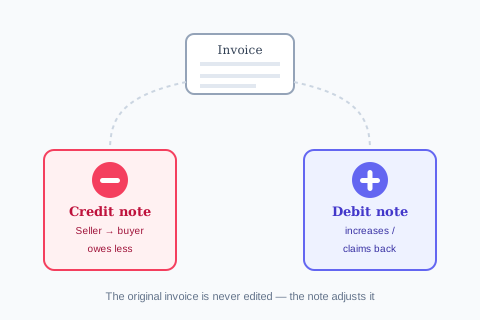
The credit note: reducing what is owed
A credit note is issued by a seller to a buyer to reduce the amount the buyer owes. It says, in effect, "you owe us less than the invoice stated." The typical triggers are goods returned, an overcharge, a post-sale discount, or damaged items. If a customer was invoiced for 100 units but returned 10, the seller issues a credit note for the 10 — the original invoice stays untouched as a record of what was billed, and the credit note stands beside it as the record of the correction.
The debit note: increasing what is owed (or claiming back)
A debit note moves in the opposite direction — it increases an amount owed or formally claims money back. It is issued in two common situations. A seller issues one to a buyer when the invoice undercharged (a price too low, a quantity understated), saying "you owe us more." A buyer issues one to a supplier when returning goods or disputing a charge, saying "we are debiting our account with you for this." Debit notes are, in practice, less frequent than credit notes, which is part of why they cause more confusion.
| Document | Issued by | Effect | Common trigger |
|---|---|---|---|
| Credit note | Seller → buyer | Reduces what the buyer owes | Returns, overcharge, discount |
| Debit note (seller) | Seller → buyer | Increases what the buyer owes | Undercharge on the original invoice |
| Debit note (buyer) | Buyer → supplier | Claims back / reduces payable | Returning goods, disputing a charge |
Why you never just edit the invoice
The instinct — especially in a spreadsheet or an informal system — is to open the wrong invoice and change the number. This is exactly the habit that destroys an audit trail. The invoice is a legal and tax document; once issued, it must remain as it was, and the correction must be a separate, traceable event. Editing the original leaves no record that a correction happened, breaks the link to any tax already reported, and is precisely the kind of silent change that turns a clean audit into a difficult one. Credit and debit notes exist so that corrections are visible, dated, and attributable rather than hidden.
The eTIMS dimension in Kenya
Under Kenya's eTIMS regime this is not merely good practice — it is how the system works. Once an invoice is transmitted, corrections flow through credit and debit notes that reference the original, so KRA sees both the original document and its adjustment. Editing or deleting a transmitted invoice is not an option, which is exactly why understanding these notes matters for any VAT-registered business.
Credit and debit notes are a small piece of accounting hygiene with outsized consequences, because they protect the integrity of the invoice record that everything downstream depends on. A system that handles them properly — adjusting notes that reference the original, feed cleanly into accrual receivables and payables, and preserve the full trail — is what lets you correct mistakes honestly without ever compromising the books or the tax record.
What AWRA OpsHub does today
- Credit notes as a first-class record: a credit note number, the customer, the original invoice it references, amount, reason, status, issued and applied dates.
- Applying a credit note to an invoice, which reduces the balance due, increases amount paid and moves the invoice to a credited or partially-credited status.
- Cancelling a credit note, so an issued-in-error note is closed rather than deleted.
- The same flow available to the mobile app, so a field correction is not stuck waiting for a desk.
- Applied credit notes transmitted to eTIMS, as a refund receipt that names the original invoice, retried until KRA accepts it. A credit note carries an amount rather than items, so it reverses as one line.
- Applied credit notes posted to the ledger: receivables credited, revenue reversed off the accounts the invoice credited in its own proportions, and the tax share reversed — once, however often the request is retried.
More we can add to your workspace
- A debit note entity. A debit note record of its own. Where this article describes issuing one, today you raise a fresh invoice or an adjustment instead — and you should decide which, deliberately, rather than improvising per case.
- An automatic stock return. Crediting an invoice does not put goods back into stock — that is a separate adjustment with its own reason.
A credit note that reduces output VAT generally needs to reach KRA the same way the original invoice did, which is why an applied credit note files as a reversal against it. Treatment and timing are still a question for KRA or your tax adviser; nothing here is tax advice.
Anything above that you need, we can build for you
Everything listed above as something we can add describes what ships in the standard product today — it is a starting point, not a limit on what AWRA OpsHub can do for your organisation. Kenya's eTIMS integration and its maintained payroll engine are both in the product because clients needed them and commissioned them; neither appeared by itself, and the same door is open for whatever you just read about. One qualification so this is worth what it claims: a small number of things on this blog we deliberately leave to a specialist rather than build — a statutory ledger we will not sign our name to, a rule that would decide a tax question for you, a clinical or member-funds record that belongs in a regulated system — and where that is true the post says so in those words. Everything else is a scope, a timeline and a price.
The operational work, which is what most commissions actually are
An extra approval stage in a chain that does not match the standard one, a custom field set on employees or assets that only your sector needs, an expiry that has to block an order rather than send an email, a report your board asks for in a shape nothing produces, or a scanner or weighbridge feeding the goods-in door. These are the commissions we are asked for most often and the smallest ones we quote — and unlike a revenue-authority pipeline, none of them waits on a regulator.
The module-shaped additions, which are the ones readers ask for most often
A price list with real discount authority, a customer-facing quotation that expires, a bill of materials or recipe costing, a staff advance that is issued, acquitted and chased, a member or unit ledger, a matching rule that holds a payment. Each of these is a build rather than a setting, and each has been quoted before — a bigger piece of work than a custom field, with a written spec and a date instead of a roadmap slide.
The report, document or pack nothing currently produces
The board pack in the shape your board actually asks for, a donor or funder layout, an invoice or receipt template carrying what your regulator or your customer expects, a dataset the report builder cannot reach yet. Usually the fastest thing on this list to deliver, because the data is already in the system.
Systems, rails and hardware you already run
The accounting package, CRM, online store, core banking or custom database you intend to keep — connected through our API so a fact is entered once and appears everywhere it is needed. Plus the physical edge: a scanner, a scale, a weighbridge or a till peripheral feeding the door it belongs to.
How it works: you describe the requirement, we return a written scope, timeline and cost, and once agreed it is built into your environment and maintained as part of the product. Nothing here waits on a regulator or a published specification, which is why operational builds are the ones we quote fastest. Tell us the requirement that would otherwise rule us out — that is a better first conversation than a demo.
Tell us what your operation needsCorrect invoices without breaking the record
Credit notes that reference the original invoice, apply cleanly against the balance due, and keep the correction attributable.
Explore invoicing & billingFrequently asked questions
What is the difference between a credit note and a debit note?
A credit note is issued by a seller to reduce what a buyer owes — typically for returns, overcharges, or discounts. A debit note increases an amount owed (when a seller undercharged) or is issued by a buyer to claim money back from a supplier. They are mirror images; which one you use depends on whose account is being corrected and in which direction.
Why can't I just edit or delete a wrong invoice?
Because an invoice is a legal and tax document that must remain as issued. Editing it destroys the audit trail, breaks the link to any tax already reported, and hides that a correction occurred. Credit and debit notes make the correction a separate, dated, traceable event — which is what keeps the books and tax records defensible.
Who issues a debit note — the buyer or the seller?
Either can, depending on the situation. A seller issues a debit note when the original invoice undercharged the buyer. A buyer issues one to a supplier when returning goods or disputing a charge. This dual usage is why debit notes cause more confusion than credit notes, which flow only from seller to buyer.
How do credit and debit notes work under eTIMS in Kenya?
Once an invoice is transmitted to KRA through eTIMS, it cannot be edited or deleted — corrections must be made through credit or debit notes that reference the original document, so both are visible to KRA. For VAT-registered businesses this makes proper use of these notes a compliance requirement, not just good bookkeeping.
