
Buying Operations Software in Cameroon: A Straight Guide
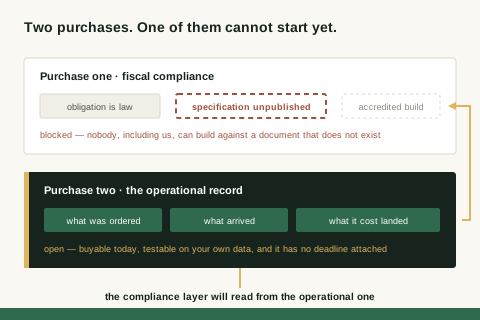
Two purchases are being confused in this market right now. One of them has no specification to build against yet, and the other one you could start on this month.
Cameroon has an electronic invoicing obligation and no published technical specification for it. Both halves of that sentence matter, and a buyer who holds only the first half is about to make an expensive scheduling mistake.
This guide is written by a vendor, which you should factor in. It is also written to be useful if you buy nothing from us, and the two sections that would most obviously cost us a sale are both still in it.
Start by separating the two purchases
Almost every confused software conversation in this market right now is one purchase being priced as though it were the other.
Purchase one: fiscal compliance
- Real-time issuance through the tax administration's platform or an accredited provider.
- Cannot be honestly quoted today, because the specification and accreditation route are not published.
- Will be bought from somebody who is accredited, once there is something to be accredited against.
- Has a deadline attached, which is why it is getting all the attention.
Purchase two: the operational record
- What was ordered, what arrived, what it cost landed, which documents exist.
- Buyable today, from several vendors, and testable on your own data.
- Has no deadline, which is exactly why it keeps being deferred.
- Is also the layer purchase one will eventually have to read from.
Businesses that conflate these tend to wait for the first, neglect the second, and then do both badly in a hurry when a date is finally announced. It is the most predictable failure pattern in the market and it is entirely avoidable.
A vendor claiming Cameroon e-invoicing readiness today is describing an intention. Ask which specification version their product is built against and see whether a version number comes back.
The questions that actually separate vendors here
Feature lists in this market converge quickly and tell you very little. These do not.
Five questions, and what the answers mean
Which version of the e-invoicing specification is your product built against?
What a good answer sounds like
"There isn't a published one yet, so nobody is built against it, including us. Here is what we would need from you when there is."
What a bad answer tells you
A confident yes, with no version, no document reference and no accreditation status. That is a sales answer to a technical question.
Can I see the exchange-control file for a purchase order in your system?
What a good answer sounds like
A demonstration of documents held on the transaction, with the domiciliation reference as a field rather than a note, and a way to see which orders are missing something.
What a bad answer tells you
A file attachment area with no relationship to the order, or a shrug. This is the part of the job that actually consumes your team's week.
What happens when an order changes after it has been domiciled?
What a good answer sounds like
A specific answer about revisions being recorded against the original with the reason retained, so the change is evidence rather than an overwrite.
What a bad answer tells you
"You just edit it." That is how a value discrepancy becomes something nobody can explain four months later.
Is the interface available in French, today, not on a roadmap?
What a good answer sounds like
A yes with a demonstration, or a clear no. Either is fine; only the evasion is not.
What a bad answer tells you
A partial answer about document templates being translatable, offered as though it answered the question about the application.
Who answers on a Tuesday afternoon when a receipt will not post, and where are they?
What a good answer sounds like
A named channel, a location, a time zone and an honest statement about language.
What a bad answer tells you
A reseller two countries away, or a support address with no stated hours. In a market this size that is the risk that actually bites.
Where we do not fit
Stated here rather than in a footnote, because two of these eliminate us outright for some readers and finding that out on the first call is better for everybody.
What we do here today
- Matching that will not close on a missing document, with the supporting files held against the transaction they evidence.
- Landed cost in XAF on the consignment, so clearing, freight, duty and demurrage reach unit cost rather than a general expense line.
- Multi-site stock with confirmed transfers, so in-transit goods belong to somebody and a short delivery surfaces against the dispatch.
- XAF and XOF stored as the two distinct currencies they are, with the rate actually applied retained.
- Approvals that block above a threshold, per site, with a complete audit trail.
- Mobile capture for sites with poor connectivity, so a receipt upcountry is recorded when it happens.
More we can add — the first two decide it for some readers
- An e-invoicing connection and an accreditation, once there is a published specification to build against. We will not describe an unpublished one as nearly built.
- A French interface. The application is English-only. For a finance function working in French this is not a detail, and for some organisations it ends the conversation.
- A SYSCOHADA ledger. A numbered OHADA chart of accounts. Producing statutory accounts from it stays with your expert-comptable, in any member state, deliberately.
- A part in your exchange-control process. Domiciling contracts, speaking to your bank and submitting to the central bank are things we decline; what a system can do is make the wait visible, attributable and countable.
- Cameroonian payroll: income tax bands, CNPS contributions and statutory schedules.
- A local office or implementation partner. Support is remote from Nairobi, in English, two hours ahead of you.
What we can build for Cameroon on top of the standard product
Everything listed above as something we can add describes what ships in the standard product today — it is a starting point for Cameroon, not a limit on what AWRA OpsHub can do there. Kenya's eTIMS integration and its maintained payroll engine are in the product because Kenyan clients needed them and commissioned them; neither appeared by itself. The same door is open here. If a DGI e-invoicing connection, a French interface, a bank or mobile money feed, a statutory return format, a rule specific to how your operation runs, or a link to a system you already have is what stands between you and a decision, tell us and we will scope it as a build — written spec, timeline and price — before you commit to anything.
The DGI platform, once there is something to build against
Real-time issuance through the tax administration's e-Facturation platform or an accredited provider, with the retries, the failure queue and the daily report of invoices carrying no reference. Stated honestly, because it is the whole position today: the 2026 Finance Law creates the obligation, the technical specification and the accreditation route have not been published, and nobody — us included — can build against a specification that does not exist yet. Any vendor claiming Cameroon e-invoicing readiness right now is describing an intention.
MTN MoMo, Orange Money, banks and the transfer file
Mobile money settlement and bank statement feeds into the Payments Register, and — the one that actually matters here — the currency-control file assembled from the purchase record: the domiciliation reference, the customs declaration and the proof of receipt held against the payment instruction rather than in a folder somebody has to rebuild. We would not become your bank's counterparty; we would stop the file being reconstructed by hand every time.
The operational work, which is what most commissions actually are
An extra approval stage in a chain that does not match the standard one, a custom field set on employees or assets that only your sector needs, an expiry that has to block an order rather than send an email, a report your board asks for in a shape nothing produces, or a scanner or weighbridge feeding the goods-in door. These are the commissions we are asked for most often and the smallest ones we quote — and unlike a revenue-authority pipeline, none of them waits on a regulator.
Payroll and statutory returns
Income tax, CNPS contributions and the associated schedules produced in the layout each body expects, generated from live payroll records rather than rebuilt in a spreadsheet each month.
Systems you already run
The accounting package, CRM, online store or custom database you intend to keep — connected through our API so a fact is entered once and appears everywhere it is needed.
How it works: you describe the requirement, we return a written scope, timeline and cost, and once agreed it is built into your environment and maintained as part of the product. No roadmap slide, and no pretending in a demo that something exists when it does not.
Tell us what you need integratedA scorecard you can use on anybody
Weighted for this market specifically. If you are scoring vendors on a generic ERP checklist you will pick the wrong one, because the generic checklist has no row for the thing that actually delays your payments.
Five criteria, weighted for Cameroon
Score each vendor out of the weight shown, using evidence rather than claims.
Document trail on the transaction
Make them prove it: Ask to see an order with its declaration and receipt evidence attached, and a report of orders missing one.
Support answer
Make them prove it: Ask who, where, in what language, and what happens when your implementer leaves.
Landed cost discipline
Make them prove it: Ask for the true landed cost of one consignment including demurrage.
Honesty about e-invoicing
Make them prove it: Ask for a specification version number.
Currency correctness
Make them prove it: Ask whether XAF and XOF are stored separately.
The one thing to do before you talk to anybody
Take one import from last quarter and rebuild its complete file — domiciled order, declaration, transport documents, receipt, payment. Time it, and count the systems and people involved. That number is the honest size of your problem, it costs you an afternoon, and it will make every subsequent vendor conversation shorter and better. Most businesses that run it are surprised, and the surprise is usually the point at which the software question stops being abstract.
If the answer comes back in twenty minutes from one system, you do not have this problem and you should spend your budget elsewhere. That is a real possible outcome of the exercise and we would rather you found it out for free.
