
Buying Operations Software in South Sudan: A Straight Guide
One question separates vendors here faster than any feature list, and it takes five seconds to ask. We failed it ourselves until August 2026, which is exactly why it works.
This guide is for two readers: an importer or distributor working out of Juba, and a grant-funded organisation running programmes from it. They buy different things, answer to different auditors, and share one difficulty in the middle. It opens with the test question, because it is the most useful paragraph here and burying it would be a waste of your afternoon.
The question
"Which consumption tax instrument does South Sudan levy, and is the tax we pay on purchases creditable?"
The correct answer is that it is a sales tax — 18% standard under Schedule 1 of the Financial Act, on produced goods, imported goods and specified services — with no input credit mechanism, so tax paid on a purchase is part of what the purchase cost. A vendor who says "VAT at 18%" has a country list rather than a market.
Why we can recommend that question with a straight face
Because we got it wrong. Our own reference data described South Sudan's tax as "Value Added Tax" at 18% until August 2026. The rate was right, which is precisely how it survived: every review anybody runs asks whether a figure has changed, and this figure had not changed. A wrong instrument carrying a right number passes every check of that kind. We corrected the data, corrected the published copy that had inherited the error, and are telling you rather than editing quietly — partly because it is the honest thing and partly because a vendor who has never been caught by this has never been asked.
Treat the answer as a proxy rather than as a gotcha. It tells you whether anybody at the vendor has read anything specific about this market, and that predicts a great deal about the implementation you are about to buy.
Three purchases, routinely confused
| What it is | Where to buy it |
|---|---|
| Tax advice and the filing itself. Whether a charge is creditable, what your registration or agreement exempts you from, what goes on the return, and lodging it through eTax | A local tax adviser, and the National Revenue Authority's own platform. We do neither and are not proposing to. Any vendor willing to tell you in a sales meeting whether a cost is recoverable is selling you a tax opinion with a licence wrapped around it |
| Payroll calculation and statutory contributions. Personal income tax, contributions, and the schedules each body expects | A local payroll provider. We do not run South Sudanese payroll — our maintained engine covers Kenya only, and we would rather say so than sell a module whose rules we do not maintain. We do attribute labour cost to a project, grant, location and cost centre, which is the reporting half |
| The operations layer. Where a cost lands, whether it can still land there after the goods arrive, what document sits behind it, and which grant or consignment carries it | This is the one nobody sells. It is not tax advice and it is not filing, so it falls between the two providers you already have — and it is what we do |
Two of the three purchases above should be made from somebody other than us. A guide that did not say so would not be worth reading.
The two things that are genuinely different about buying here
Most of what makes a market distinctive is either a fiscalisation obligation or a language. Here it is neither, and that is worth saying plainly because it changes what you should be evaluating.
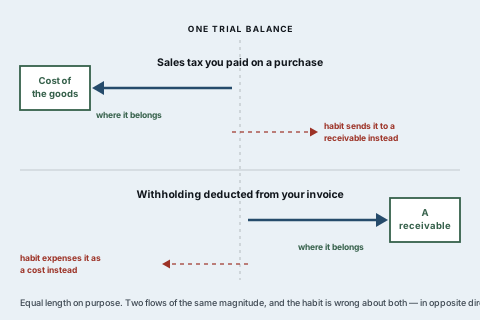
The first is the direction of two taxes. Sales tax paid on purchases is a cost, not a credit. Withholding deducted from your invoices is an advance under the Financial Act 2023/2024, so it is a receivable rather than an expense. Both are the opposite of the habit a VAT jurisdiction trains, and a system arriving from Kampala or Nairobi with correct instincts will be wrong twice. Ask a vendor to show you where each of those two amounts lands in their chart of accounts, and whether either is a setting you control.
The second is that language is not the obstacle it is elsewhere in this series. English is South Sudan's official language. Almost every other market page we write carries a paragraph explaining that our English-only interface is a real cost to a team that files in French or Arabic; here that paragraph does not apply. It is still an English-only product and that is still worth confirming with your own team, but it is not the negotiation it is in Dakar or Casablanca.
Filing: what exists, and the thing Kenyan readers get wrong
The National Revenue Authority runs eTax at etax.nra.gov.ss. Taxpayer registration and TIN issuance are done there, and filing and payment go through it. Every organisation formally present needs a TIN, including NGOs — individuals, businesses and organisations all register on the same platform.
That is e-filing. It is not the same thing as an obligation to have each invoice validated before it is legally valid, which is what eTIMS requires in Kenya and what the certified-machine route requires in Benin. The distinction matters when you are evaluating software, because an invoice-clearance obligation constrains how you may issue documents at all, while a filing obligation constrains what you submit afterwards. A reader arriving from Nairobi tends to assume the first and then evaluate for the wrong thing.
We hold no connection to eTax, submit nothing and prepare no returns. What we hold is the detail a return is built from, and we are not going to predict what the platform will require next.
Five things worth asking us, and the answers
Published in advance so a demonstration does not have to be spent on them.
-
Will you tell us whether a particular cost is recoverable?
No, and treat a yes from anybody as a warning rather than a service. The instrument here has no input credit, but whether a specific charge is creditable, and what your registration or agreement exempts you from, depends on documents we have not read. What the product does is let the amount land where your adviser says it belongs, and hold the evidence behind it. Ask every vendor this and notice which ones are eager.
-
Do you file with the National Revenue Authority?
No. No connection to eTax, no return preparation, no submission. eTax is where registration, filing and payment happen and it is the NRA's platform, not an integration point we hold. Where we are useful is that the detail a return is assembled from is in one place, coded, with documents attached — which makes the filing an extraction rather than an excavation.
-
Do you run South Sudanese payroll?
No. No income tax bands, no statutory contributions, no filing. Our maintained statutory payroll engine covers Kenya only and we are not going to sell you coverage of rules we do not maintain. We attribute labour cost to projects, grants, locations and cost centres, which is the half of the problem this guide is about. Use a local provider for the calculation; they will be cheaper and correct.
-
How do you handle the currency?
By recording the amount and the rate actually applied on the transaction, and holding no opinion about what the rate should have been. We are deliberately not printing a rate anywhere on this site: the pound has moved by orders of magnitude and any figure would be wrong within weeks. The structural point is the one that matters for software — a purchase committed at one rate and settled at another leaves a difference that belongs to the order which caused it, and if the applied rate is not on the transaction that difference surfaces as a lump at year end with nothing to attribute it to.
-
Why would a Nairobi company support us properly?
A fair question to ask everybody. Support is remote from Nairobi, in English, in the same working day, and there is no office and no implementation partner in South Sudan — we are not going to imply otherwise. Ask us, and ask everybody else, what happens when the person who implemented your system leaves. That question separates vendors more reliably than any feature list, and it is the one nobody prepares an answer for.
If you are grant-funded, read this order instead
The sequence is different because your binding constraint is different. Your income is restricted by budget line, your auditor is your donor, and your reporting calendar is theirs rather than the country's.
- First, establish whether your largest grants were budgeted gross or net of consumption tax. If they were net, the line is short by the tax and you want to know that before the report rather than in it.
- Second, get the exemption question answered against the document rather than from recollection — by your adviser, in writing, per activity.
- Third, check that tax is identified separately on transactions rather than absorbed into supplier totals, because a claim or an explanation needs the figure and its evidence.
- Fourth, check that cost is coded to grant, line, project and location at entry, and that approvals refuse above a line's ceiling rather than warning.
- Only then evaluate systems. And accept that no vendor has your donor's report template built — including us. Anybody claiming otherwise is describing an export, not a template.
The one question that tells you whether you have the operations problem
Answerable this afternoon, with no vendor involved.
What is the balance of your recoverable or input tax account, and when was any of it last actually recovered?
If the answer to the second half is a date, you are in good order and none of this is urgent. If the answer is "never", then the first figure is not an asset — it is accumulated cost sitting in the wrong place, it belongs to identifiable consignments and periods, and the price you have been setting was calculated from a base that was too low by the tax. That is the conversation, and it is the only one we are claiming to be useful in.
The short version
Ask every vendor which instrument this country levies and whether input tax is creditable; the answer predicts the implementation. Buy tax advice and filing locally, buy payroll locally, and evaluate us only for where a number lands and what evidence sits behind it. Then pull one balance and one date from your own trial balance. If the date is "never", you have measured the problem without spending anything, which is the right order.
Nothing above needs a demonstration to verify and most of it can be checked against records you already hold this week. That is deliberate: a guide that can only be evaluated in a sales meeting is not a guide.
What we can build for South Sudan on top of the standard product
Everything listed above as something we can add describes what ships in the standard product today — it is a starting point for South Sudan, not a limit on what AWRA OpsHub can do there. Kenya's eTIMS integration and its maintained payroll engine are in the product because Kenyan clients needed them and commissioned them; neither appeared by itself. The same door is open here. If an eTax filing connection, a South Sudanese payroll engine, a bank or mobile money feed, a statutory return format, a rule specific to how your operation runs, or a link to a system you already have is what stands between you and a decision, tell us and we will scope it as a build — written spec, timeline and price — before you commit to anything.
Filing output to eTax, and no opinion about what is recoverable
Return output against the National Revenue Authority's eTax platform, produced from live records with a reconciliation report rather than a black box. Worth being precise about what this is and is not: eTax is registration, filing and payment, not a requirement that each invoice be validated before it can be issued, so this is a filing pipeline rather than a fiscalisation one and the two are often confused. What we will not build at any price is a rule that decides whether a particular charge is creditable. The 18% here is a single-stage sales tax with no input credit, where the amount belongs is your adviser's call, and software that made that call for you would be selling a tax opinion.
Mobile money, bank feeds and multi-currency at the applied rate
Mobile money settlement files and bank statement feeds pulled into the Payments Register so collections match invoices without re-keying, alongside genuine multi-currency where the original amount and the rate actually applied stay on the transaction. That second half matters more here than the first: a purchase committed at one rate and settled at another leaves a difference that belongs to the order which caused it.
The operational work, which is what most commissions actually are
An extra approval stage in a chain that does not match the standard one, a custom field set on employees or assets that only your sector needs, an expiry that has to block an order rather than send an email, a report your board asks for in a shape nothing produces, or a scanner or weighbridge feeding the goods-in door. These are the commissions we are asked for most often and the smallest ones we quote — and unlike a revenue-authority pipeline, none of them waits on a regulator.
Payroll and statutory returns
Personal income tax and statutory contribution schedules produced in the layout each filing body expects, generated from live payroll records. Not built today — our maintained engine covers Kenya only, and a local payroll provider will be cheaper and correct.
Systems you already run
The accounting package, CRM, online store or custom database you intend to keep — connected through our API so a fact is entered once and appears everywhere it is needed.
How it works: you describe the requirement, we return a written scope, timeline and cost, and once agreed it is built into your environment and maintained as part of the product. No roadmap slide, and no pretending in a demo that something exists when it does not.
Tell us what you need integrated