The Holding Company Is Here. The Business Is in Five Other Countries.
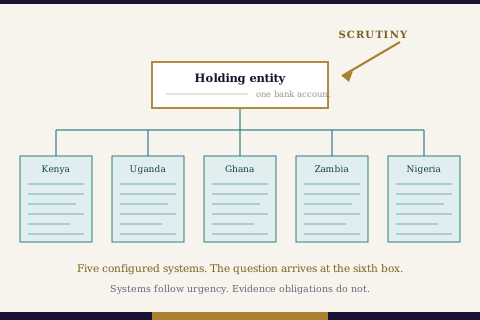
Systems get configured for the subsidiaries, because that is where the stock, the customers and the invoices are. Then the group discovers annually that the entity nobody configured is the one with the evidence obligation.
A group with a holding company in one country and operations in five others makes a reasonable sequence of decisions and arrives somewhere unreasonable. This piece is about that sequence, because recognising it is most of the fix, and because almost nobody arrives here through incompetence.
It applies wherever the structure sits — Mauritius, Malta, the Netherlands, Singapore, the Gulf free zones. The jurisdiction changes the rules. It does not change the shape of the problem.
How groups get here
Four steps, each of them locally correct.
-
The operating companies get the system
They have stock to count, customers to invoice, staff to pay and a tax authority to satisfy. They also have the urgency: an operating company that cannot invoice stops earning this week. The holding entity has none of that pressure and is not, at this point, being neglected — it is being correctly deprioritised.
-
The holding entity gets an accountant and a bank account
Which is genuinely adequate for what it does. A handful of transactions a month, a few intercompany balances, an audit once a year, dividends up and capital down. Nobody would specify an operations system for that, and nobody should have.
-
The group consolidates in a spreadsheet
Because consolidation is a monthly exercise performed by one competent person, and a spreadsheet is the right tool for a monthly exercise performed by one competent person. This step is where the group's knowledge starts to live outside its systems, and it is invisible while the person is there.
-
Somebody outside asks a question
An administrator, an auditor, a regulator, a bank doing diligence, a buyer in a transaction. The question is about the holding entity, and it is a question about evidence rather than about numbers. This is where the sequence stops being reasonable — and note that nothing went wrong in steps one to three. The structure simply grew an obligation that the systems were never asked to serve.
The entity with the thinnest chart of accounts is the entity with the most demanding evidence obligation. That inversion is the whole problem and it is nobody's decision — it is what happens when systems follow urgency.
The four questions that turn out to be hard
None of these is difficult in principle. All of them are difficult in the fourth week of a diligence exercise.
| The question | Why it is hard |
|---|---|
| Which entity incurred this cost, and in which country? | The group ledger knows what was spent and on what. Whether the holding entity incurred it, in its own jurisdiction, is a judgement somebody makes annually — and a judgement that is correct but unrecorded is not evidence of anything |
| Which entity employs this person? | Groups keep one staff list because they operate as one business. The employing entity is then inferred from whichever payroll a person appears on, which breaks for anybody seconded, shared, or engaged through a services agreement |
| Where is the document for this? | It exists. It is accurate. It is in a folder, a mailbox or a drive, filed by the person who received it, in a structure that made sense to them and to nobody since |
| When was this decided, and by whom? | The decision was genuinely made by the people who should have made it. What cannot be shown is the sequence — that the authority existed before the commitment rather than being papered afterwards |
Why "we will fix it at consolidation" does not work
It is the natural response and it fails for one specific reason, worth stating precisely: consolidation is a summarising operation, and evidence questions are detail questions. Consolidation takes many transactions and produces fewer numbers. Every evidence request runs the other way — it takes one number and asks for the transactions underneath it, with their documents, dates and authorisations.
So the consolidation layer, however good, is the wrong place to look. And a group that only ever needed the summary has usually never tested whether the detail can be retrieved. It usually can, by a person, slowly. That is a different capability from being able to produce it, and it lives in a different place — in someone's head rather than in the group's records.
The distinction that matters
Nothing here is an argument that your accounts are wrong. In almost every case they are right, and the extraction that produces the entity-level number is sound. The argument is that the reasoning behind the extraction is undocumented and unrepeatable, and that this is invisible until either the person leaves or somebody wants to see the working.
The fix, in the order it pays for itself
-
Make entity and jurisdiction properties of the transaction
Not of the report. Coded at entry, on everything, so any total by entity for any period is a filter rather than an extraction. This is the change that removes the whole category, and it costs almost nothing at the point of entry — it is only expensive retrospectively, which is why the retrofit is the version most groups eventually pay for.
-
Give the holding entity a real chart of accounts
It has few transactions and they are the most examined transactions in the group. Few and important is an argument for structure, not against it. Most holding entities are running a chart designed for a dormant company because that is what they resembled at incorporation.
-
Attach documents to transactions rather than to folders
The lease against the payments it governs. The services agreement against the recharges under it. The mandate against the work booked to it. Retrieval by transaction is the only retrieval that survives a change of staff, because a folder structure encodes one person's mental model.
-
Record authority against what it authorised
An approval that had to happen before the commitment could, held on the commitment. This is the only one of the four that produces something a reconstruction genuinely cannot: sequence. Everything else can be rebuilt slowly from documents. Sequence cannot be rebuilt at all.
The intercompany trap
One specific thing worth separating out, because it causes more trouble than its size suggests. Where a holding entity provides services to its subsidiaries — management, treasury, group functions — the recharge is usually calculated periodically and posted as a single figure.
That single figure is simultaneously the holding entity's revenue, the subsidiary's cost, and the only evidence that the service was provided at all. It is doing three jobs and it carries the detail for none of them. When somebody asks what the recharge was for, the answer is a calculation in a spreadsheet, and the calculation was correct, and there is nothing underneath it.
Booking the underlying work — time, cost, to the entity it was performed for — makes the recharge an output rather than an assertion. Same number, and a completely different thing to be asked about. This is the least glamorous recommendation in this piece and probably the highest-value one.
Who owns which part
Entity and jurisdiction on the transaction
Cost, revenue and commitments coded to entity, cost centre and site at entry, with reporting by any of them across any period. The one change that removes the category rather than easing it.
Documents against transactions
Attached to the record they evidence rather than filed alongside it, retrievable by date, entity or counterparty, previewable without downloading.
Work booked to the entity it was performed for
Time and cost against a project, mandate or engagement, which turns an intercompany recharge from an assertion into an output.
Your group structure and transfer pricing policy
What should be recharged, on what basis, at what margin, and how it is documented for tax purposes. Yours, your tax adviser's, and genuinely outside what we do. We hold the detail; the policy is not ours to have an opinion about.
Consolidation and group statutory accounts
Not built. No consolidation engine, no elimination logic, no group reporting pack, no statutory accounts in any jurisdiction. That stays with your accountants and the tools they use, and we are not proposing to replace either.
Company secretarial and statutory filing
Not built. No statutory registers, no minute book, no share register, no returns filed with anybody. Minutes can be stored as documents against a period; that is retrieval, not company secretarial software.
The test
Pick the holding entity. Ask for total expenditure it incurred, in its own jurisdiction, for the last financial year. Then ask how the number was produced.
If the answer is a report, you are in the minority and you can stop reading. If the answer involves a person, a spreadsheet and a judgement about which ledger lines belong where, then that person is currently load-bearing for something they were never told they were load-bearing for. That is the finding, and it is worth more than the number.
What we can build for the Indian Ocean islands on top of the standard product
Everything listed above as something we can add describes what ships in the standard product today — it is a starting point for the Indian Ocean islands, not a limit on what AWRA OpsHub can do there. Kenya's eTIMS integration and its maintained payroll engine are in the product because Kenyan clients needed them and commissioned them; neither appeared by itself. The same door is open here. If a national tax pipeline, a local payroll engine, a bank or mobile money feed, a statutory return format, a rule specific to how your operation runs, or a link to a system you already have is what stands between you and a decision, tell us and we will scope it as a build — written spec, timeline and price — before you commit to anything.
Tax pipelines, one country at a time
Electronic invoicing or fiscalisation against your authority's published interface, with retries, a failure queue and a daily report of invoices carrying no reference. Said carefully, because this region has no shared framework to hide behind: Mauritius runs real-time fiscalisation through certified providers, and the other three are unrelated regimes on unrelated timetables. That makes each of these a country build, and in Mauritius specifically an accreditation rather than an integration — which is a different kind of commitment and priced as one.
Bank feeds and genuinely multi-currency operations
Bank statement and card settlement feeds into the Payments Register, across the several currencies an island business actually transacts in. This is the shared condition of the region: almost everything is imported, the freight and the goods are frequently invoiced in different currencies, and the reporting currency is nobody's only working currency.
The operational work, which is what most commissions actually are
An extra approval stage in a chain that does not match the standard one, a custom field set on employees or assets that only your sector needs, an expiry that has to block an order rather than send an email, a report your board asks for in a shape nothing produces, or a scanner or weighbridge feeding the goods-in door. These are the commissions we are asked for most often and the smallest ones we quote — and unlike a revenue-authority pipeline, none of them waits on a regulator.
Payroll and statutory returns
Statutory payroll and social contribution schedules per country, computed on live records and produced in the layout each filing body expects. Four countries here means four engines rather than one, and none of them is built today.
Systems you already run
The accounting package, CRM, online store or custom database you intend to keep — connected through our API so a fact is entered once and appears everywhere it is needed.
How it works: you describe the requirement, we return a written scope, timeline and cost, and once agreed it is built into your environment and maintained as part of the product. No roadmap slide, and no pretending in a demo that something exists when it does not.
Tell us what you need integrated