One Currency, One Chart of Accounts, Six Tax Authorities
The monetary union really does give you one currency and one prescribed chart of accounts. It does not give you one tax rate, one invoicing obligation or one trade framework — and since January 2025 the last of those has been the interesting one.
A group operating across the West African monetary union gets one genuine simplification and one genuine trap, and they are easy to confuse because they look like the same fact. The simplification is that the currency and the accounting framework are shared. The trap is assuming that anything else is.
This piece separates the two, because a system configured on the assumption that the union is one jurisdiction will be right about the ledger and wrong about everything downstream of it.
What is genuinely shared
| Shared across the union | What it actually means for you |
|---|---|
| The XOF, pegged to the euro at a fixed rate | No FX risk against Europe, and none at all between member states. Also, and this is the part that gets missed: no protection whatever against the dollar or the yuan, which is what most imports are actually priced in |
| SYSCOHADA | The chart of accounts is prescribed by OHADA law with fixed account classes. Not a template you adapt — a numbering your accountant is required to present in. Software that expects you to invent your own will produce statements an auditor cannot read |
| A customs union | An intra-union movement is a different thing from an import, with different paperwork and different duty treatment |
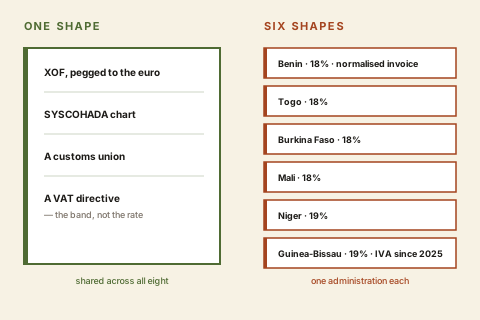
| A VAT directive | It sets the band that member states' rates sit inside. Note carefully: it harmonises the band, not the rate |
One currency and one chart of accounts is a real simplification, and it is the reason people over-generalise. Everything shared here is upstream of the ledger. Everything not shared is downstream of it.
What is not shared, in order of how often it bites
-
The rate inside the band
The directive sets a range and member states sit at different points in it. Most of the union is at 18%; Niger and Guinea-Bissau are at 19%. A single tax rate configured once for "the region" is therefore wrong for two countries out of eight, and wrong in the direction that under-charges — which is the direction nobody notices until an audit.
-
The invoicing obligation
This is the big one and it is not regional at all. Benin has required normalised invoices since 1 July 2021, issued through a certified electronic invoicing machine or the e-MECeF platform, with the tax authority validating each invoice and returning a unique number and a QR code before it is legally valid. That is Benin's rule. It does not follow from union membership and it does not transfer to a neighbour, and a vendor who describes it as "regional e-invoicing" has not read it.
-
The authority, the portal and the calendar
Six administrations, six portals, six filing calendars, six sets of correspondence. Nearly all of them are called the DGI, which is a genuine source of confusion rather than a joke — the abbreviation is shared and nothing behind it is.
-
Which trade framework a movement falls under
The newest of the four and the one with the least settled practice. Mali, Burkina Faso and Niger withdrew from ECOWAS on 29 January 2025, and remain members of UEMOA and the CFA franc. So the monetary and accounting union still covers all eight while the wider trade bloc no longer does.
The last one, carefully
It is worth being precise here, because this is a subject where imprecision turns quickly into commentary. Two facts, both verifiable, and nothing else is claimed: the three states left ECOWAS on 29 January 2025, and they remain in UEMOA and the CFA franc.
We have no view to offer on the politics, no forecast about the currency and nothing to say about the status of any particular border — restrictions in this region have opened and closed repeatedly and anything printed about a specific crossing would be out of date before it was read.
What follows operationally is narrow and durable. "Under which framework did this consignment move, and what document proves it" is now a question with a filing consequence rather than something that could be safely assumed from a map. The sensible response is not to have an opinion about it. It is to record it per consignment and keep the paperwork attached.
The distinction worth holding on to
Your expert-comptable's world and your transport manager's world used to be the same eight countries. They are not any more. Nothing about your ledger changed — the XOF, SYSCOHADA and the union's VAT framework are unaffected — but the assumption that a movement between neighbours is governed by one obvious rulebook no longer holds, and the cheapest place to absorb that is in the record rather than in a conversation.
What to configure differently
Four things, and none of them are large. They are just easy to get wrong once and then live with.
- A tax rate per country, not one for the region. Two of eight are at 19% and the difference does not announce itself.
- Invoicing configured per country of issue, with Benin treated as its own case rather than as an instance of a regional pattern.
- A field on the consignment for the framework the movement was made under, and the document that evidences it, kept with the shipment.
- The original currency and applied rate retained on every foreign-currency purchase. The peg covers the euro and nothing else, and the rate that was used is what a margin has to be explained from months later.
- Cost coded to country as well as cost centre at entry, so a per-country total is a filter rather than a reconstruction.
Where the boundary sits
Per-country tax rates and cost attribution
A rate per jurisdiction rather than one regional default, with cost and revenue coded to country, site and cost centre at entry so a per-country view is a filter.
Genuine multi-currency
Original amount and applied rate retained on the transaction alongside XOF, rather than one reporting currency with conversions bolted on.
Documents against transactions
The transit paperwork, the receipts and the proof of discharge held against the consignment rather than in a folder, retrievable by shipment.
Benin's certified invoicing route
Not built and not certified. Issuing a valid invoice in Benin requires going through a certified machine or the e-MECeF platform, with the authority validating each one — an accreditation rather than an integration. Buy it from a provider who holds it and evaluate everything else afterwards.
SYSCOHADA statutory accounts and any filing
Not built, in any member state, at any price. We post to a chart your accountant defines and hold the detail statements are built from. The presentation, the statements and the returns stay with your expert-comptable, and that refusal is a design decision rather than a gap.
The French interface
Not built today, and the most-asked-for thing in these markets. The product is English-only. For a finance team that files in French that is a real cost, we raise it in the first conversation, and we are not going to promise a date we cannot commit to.
The summary is short enough to act on. Configure for one currency and one chart of accounts, because those really are shared. Configure everything with a tax authority in it per country, because none of that is. And write down which rulebook each consignment moved under, because that used to be inferable and no longer is.
What we can build for the UEMOA member states on top of the standard product
Everything listed above as something we can add describes what ships in the standard product today — it is a starting point for the UEMOA member states, not a limit on what AWRA OpsHub can do there. Kenya's eTIMS integration and its maintained payroll engine are in the product because Kenyan clients needed them and commissioned them; neither appeared by itself. The same door is open here. If a French interface, Benin's certified invoicing connection, a bank or mobile money feed, a statutory return format, a rule specific to how your operation runs, or a link to a system you already have is what stands between you and a decision, tell us and we will scope it as a build — written spec, timeline and price — before you commit to anything.
Benin's normalised invoice, and a clean handoff everywhere else
In Benin, invoices issued through the certified electronic invoicing route with the tax authority validating each one and returning its unique number and QR code before the invoice is valid — held on the transaction, with retries, a failure queue and a daily report of sales carrying no reference. Stated precisely because the precision is the point: that is an accreditation rather than an integration, we do not hold it, and it is specific to Benin rather than to the union. Everywhere else this is a defined export mapped to your expert-comptable's chart of accounts. The statutory ledger stays with them by design; what we build is the pipe to it.
Mobile money, bank feeds and a French interface
Orange Money and other mobile money settlement files plus bank statement feeds pulled into the Payments Register, so collections reconcile against invoices without re-keying a statement. And French interface text and document templates — the single most-asked-for thing in these six markets, and the honest answer today is that it does not exist.
The operational work, which is what most commissions actually are
An extra approval stage in a chain that does not match the standard one, a custom field set on employees or assets that only your sector needs, an expiry that has to block an order rather than send an email, a report your board asks for in a shape nothing produces, or a scanner or weighbridge feeding the goods-in door. These are the commissions we are asked for most often and the smallest ones we quote — and unlike a revenue-authority pipeline, none of them waits on a regulator.
Payroll and statutory returns
National income tax and social security schedules per country, produced in the layout each filing body expects and generated from live payroll records. Six countries is six builds and we will say so rather than sell one as covering all of them.
Systems you already run
The accounting package, CRM, online store or custom database you intend to keep — connected through our API so a fact is entered once and appears everywhere it is needed.
How it works: you describe the requirement, we return a written scope, timeline and cost, and once agreed it is built into your environment and maintained as part of the product. No roadmap slide, and no pretending in a demo that something exists when it does not.
Tell us what you need integrated