
Your Turnover Says You Are Exempt. Your Shareholder Register May Disagree
Most businesses run one test, get an answer, and stop. There are three, only the first is about your own revenue, and the two nobody runs are the ones that produce the surprises.
Every vendor selling into Malaysia at the moment is running a countdown. Days until the deadline, phases on a timeline, a call to action with urgency attached. It is effective marketing and it answers a question most businesses have already answered for themselves.
The question nobody is helping with is the harder one, and it is not "when". It is "whether" — and whether turns out to have three separate tests with three separate answers.
Before anything else: positions and thresholds in this area have moved more than once, including a change that cancelled an entire planned phase. Nothing in this article is advice, no date appears in it that you should plan against, and the current position for your specific business should come from LHDN or your tax adviser. What does not change when a date moves is the shape of the three tests, which is what this piece is about.
Test one: your own turnover, which moved twice
This is the test everybody runs and it is the one that behaves most like people expect. The rollout has been phased by annual turnover, largest businesses first, working down.
What makes it interesting is that the floor underneath those phases was subsequently raised, which had two effects at once. It moved a substantial number of businesses out of scope, and it cancelled a phase that had been planned for the smallest of them.
The consequence nobody mentions
A business that prepared responsibly against the earlier floor — evaluated vendors, bought a compliance tool, put a project in motion — may now be outside the mandate entirely. That is a subscription worth checking before it renews. It is an unusual situation: most compliance changes create work, and this one relieved it for a set of businesses who had already done the work and may not have noticed the relief.
Test two: your group, which is not a revenue question at all
Here is the one that catches people, and it catches them because it is decided by a document most operating managers have never read.
A business below the exemption floor which is a subsidiary or related company of a business above it does not keep the exemption. The determining fact is ownership, not trading. Your revenue can be a fraction of the threshold and you can still be in scope because of who owns you.
| Situation | Test one says | Test two says |
|---|---|---|
| A standalone business under the floor | Out of scope | Out of scope — no group above it |
| A small subsidiary of a large group | Out of scope | In scope, because of the parent |
| One of several small companies under a common holding company | Out of scope individually | Depends on the group's position — and somebody has to actually look |
| A joint venture with a large partner | Out of scope | Worth establishing precisely, and worth doing it early |
The person running the small entity has no particular reason to be watching the large entity's turnover. That is exactly why this test gets skipped.
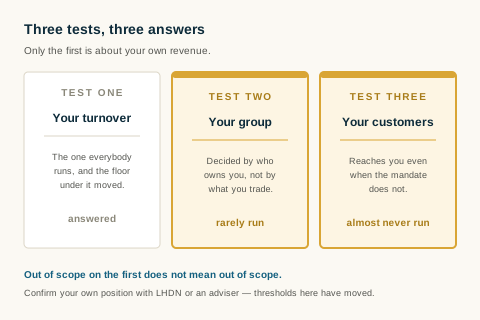
Test three: your customers, regardless of your own position
The third test is the one that reaches businesses who are genuinely, unambiguously outside the mandate — and it reaches them as an accounts-receivable problem rather than a tax one.
A counterparty in scope has to produce a validated document that identifies you correctly. In certain transaction types they may raise a document on your behalf. Either way, your identifiers, your registration details and your addresses have to be right in their system before they can transact with you cleanly.
-
Your large customer went into scope first
The phasing ran largest to smallest, so the biggest buyers were validating strictly long before their smaller suppliers had any obligation of their own. That asymmetry is not an accident of design, but it does have a predictable consequence.
-
Their accounts payable team asks you for data
Tax identification number, business registration number, sometimes an indirect-tax registration and a classification code. Reasonable requests, and in a great many businesses the answer requires somebody to go and find out rather than look up.
-
The data you give them is a snapshot
It is right on the day it is sent. Then an address changes, or a registration is updated, and nobody tells them, because there is no process that tells anybody anything about master data.
-
A document is rejected
Not because of anything on the invoice — because of an identifier attached to you. The rejection is discovered by their finance team, communicated to yours, and in the meantime a payment is not moving.
-
It becomes a receivables problem
Which is the point. A business with no compliance obligation whatsoever now has a working capital consequence, arising from a mandate it is not subject to, caused by a data field it never had a reason to maintain.
What to actually do, in about an afternoon
Five checks, in order of how often they turn something up
- Run test two. One phone call to whoever holds the shareholder register. Most businesses have never asked and the answer takes minutes.
- Confirm your test one position against the current floor rather than the one you checked eighteen months ago — it moved.
- If you bought a compliance tool against the old floor, check whether you are still in scope before it renews.
- Take your twenty largest customers and confirm one person can produce a complete, current set of your identifiers in five minutes. Not that the data exists somewhere.
- Ask whether any customer has rejected or queried a document of yours on identifier grounds in the last six months. If so, test three has already reached you.
A note on who owns this
In most businesses of moderate size, none of the three tests has an owner. Test one belongs to finance, sort of. Test two belongs to whoever deals with the holding company, which is often a director rather than a function. Test three belongs to nobody at all, which is why it is discovered by a customer. Assigning a name to each of the three is a genuinely useful hour of work and it costs nothing.
What AWRA OpsHub does today
- One record per customer and supplier, with identifiers held on the party rather than copied onto documents
- Completeness reporting, so you can see which counterparty records are missing which field
- Coded items and units of measure held on the product
- Three-way matching between order, receipt and invoice
- Multi-location stock, procurement approvals and landed cost
More we can add to your workspace
- A MyInvois connection — submission, validated document returned or rejection-window tracking
- Consolidated document assembly or self-billed document generation
- SST determination, banding or filing
- EPF, SOCSO, EIS or monthly tax deduction
- Scope assessment stays your adviser's work, and this article stops short of it
What we can build for Malaysia on top of the standard product
Everything listed above as something we can add describes what ships in the standard product today — it is a starting point for Malaysia, not a limit on what AWRA OpsHub can do there. Kenya's eTIMS integration and its maintained payroll engine are in the product because Kenyan clients needed them and commissioned them; neither appeared by itself. The same door is open here. If a MyInvois connection, an SST engine, a bank or mobile money feed, a statutory return format, a rule specific to how your operation runs, or a link to a system you already have is what stands between you and a decision, tell us and we will scope it as a build — written spec, timeline and price — before you commit to anything.
MyInvois submission and validation
Submission to the MyInvois portal or API with the validated document and its QR returned onto the invoice, the seventy-two-hour rejection and cancellation window tracked, consolidated invoices assembled where the relaxation period still allows them, and buyer TIN and identification captured at the point of sale rather than chased afterwards. Sales tax and service tax handled as the two different taxes they are, at the rate and band each service actually carries.
DuitNow, FPX and bank feeds
DuitNow and FPX collection matched to the invoice, bulk payment files in the format your bank accepts, and statement feeds wired into the Payments Register.
The operational work, which is what most commissions actually are
An extra approval stage in a chain that does not match the standard one, a custom field set on employees or assets that only your sector needs, an expiry that has to block an order rather than send an email, a report your board asks for in a shape nothing produces, or a scanner or weighbridge feeding the goods-in door. These are the commissions we are asked for most often and the smallest ones we quote — and unlike a revenue-authority pipeline, none of them waits on a regulator.
Payroll and statutory returns
EPF, SOCSO, EIS and monthly tax deduction computed on live records, with the contribution schedules and the annual forms produced in the layout each body expects rather than rebuilt in a spreadsheet each month.
Systems you already run
The accounting package, CRM, online store or custom database you intend to keep — connected through our API so a fact is entered once and appears everywhere it is needed.
How it works: you describe the requirement, we return a written scope, timeline and cost, and once agreed it is built into your environment and maintained as part of the product. No roadmap slide, and no pretending in a demo that something exists when it does not.
Tell us what you need integratedOur take
Run the second test. That is the whole recommendation and it costs one phone call. In our experience it is the test least likely to have been run and most likely to change the answer, because it is decided by ownership rather than by trading and the person who would notice is rarely the person who would care. Then run the third one, which is not really a compliance question at all — it is a question about whether your counterparty records are good enough for somebody else's system to accept a document about you. That one has consequences whether or not the mandate ever reaches you.
The records underneath the mandate
We do not submit to MyInvois — buy that from somebody who does. What we build is the counterparty data, the coded items and the matched receipts that decide whether what gets submitted is right.
Talk to us about MalaysiaFrequently asked questions
What are the current thresholds and dates?
This article deliberately does not print them, and that is not evasion. The thresholds have changed more than once — including a change to the exemption floor that cancelled an entire planned phase — and a date in vendor copy is exactly the kind of thing a reader plans against and later discovers was stale. Get the current position, and your own classification within it, from LHDN or your tax adviser. What is stable is the structure of the three tests, which is why the article is built on those rather than on a timeline.
We are below the exemption floor. Are we finished?
Only if all three tests come back clear. Below the floor, a business that is a subsidiary or related company of one above it is generally brought back into scope, decided by ownership rather than revenue. And separately from the mandate entirely, counterparties who are in scope need correct identifying data about you in order to issue valid documents naming you, which reaches you whether or not you have any obligation of your own. Confirm your specific position with an adviser.
What happens if a customer rejects a document because our details are wrong?
Practically, a payment stops moving while two finance teams sort out a data field. There is usually a limited window in which a validated document can be rejected or cancelled, after which the correction becomes a credit note rather than an undo — so a disagreement discovered late is more work than one discovered early. The commercially important point is that this can happen to a business with no compliance obligation at all, and it presents as a receivables problem rather than a tax one.
Should we cancel the compliance tool we bought if we are now out of scope?
Check first, decide second, and check with an adviser rather than with a vendor — including us. What is worth knowing is that this situation exists at all: a business that prepared responsibly against the earlier floor may now be outside the mandate, and nobody sends a letter telling you that your obligation went away. Most compliance changes create work. This one relieved it for a group of businesses who had already done it.
Does AWRA submit to MyInvois?
No. No portal or API connection, no submission, no validated document or QR returned, no tracking of the rejection window, no consolidated documents and no self-billed generation. Given that submission is what most of this market is currently buying, we would rather put that plainly than let a feature list imply otherwise. Buy it from a Malaysian provider or use the accounting system you already file from. What we build is the operational and counterparty record that decides the quality of whatever gets submitted.
Which of the three tests should we run first?
The second one, because it is the cheapest and the most likely to be unanswered. One phone call to whoever holds the shareholder register tells you whether anybody above you crosses the threshold, and that single fact can invert the conclusion you reached from your own revenue. Then the third, which is less a test than an audit: can one person produce a complete, current set of your identifiers in five minutes? That one has consequences regardless of what the first two say.
