
SST Is Two Taxes: Sales and Service, Handled Separately
Sales tax and service tax share an abbreviation and almost nothing else. They have different bases, different rates, different registration positions, and one of them has been quietly expanding into industries that had never registered for anything.
A single field labelled "SST" appears in a great many systems, spreadsheets and pricing models in Malaysia. It is one of the most reliably wrong pieces of data modelling in this market, and it is wrong in a way that is invisible until somebody reconciles a year of it.
SST is not one tax. It is two, administered under separate legislation, applying to different things, at different rates, with separate registration positions. A business can be registered for one and not the other. Many are.
This is a summary written for people who model costs and prices rather than for people who file returns. Scope, rates and registration thresholds are set in legislation, have changed recently and materially, and belong with a Malaysian tax adviser. Nothing here is advice.
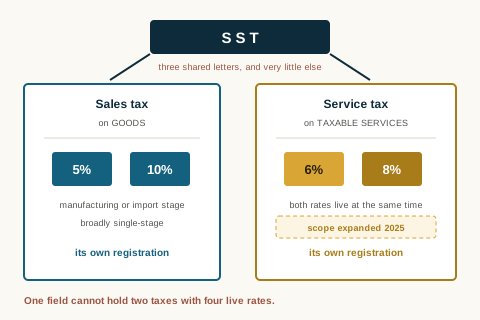
Two taxes, side by side
Sales tax
- Applies to goods, generally at the manufacturing or import stage.
- Charged at rates that vary with the goods — commonly five or ten per cent.
- Broadly a single-stage tax rather than one collected along a chain.
- Exemption mechanisms exist for manufacturers buying inputs.
- Your obligation depends on what you make or import.
Service tax
- Applies to taxable services, provided by prescribed persons.
- Standard rate rose from six to eight per cent on 1 March 2024.
- A named list of services stayed at six, so both rates are live.
- Scope expanded substantially in 2025 into new service categories.
- Your obligation depends on what you do and whether it is on the list.
One field cannot hold a tax that has two rates in force simultaneously, applied to two different bases, under two different registrations.
The rate change that a lot of records never caught up with
On 1 March 2024 the standard service tax rate went from six per cent to eight. A specific list of services remained at six — food and beverage, telecommunications, logistics, parking and others, with further adjustments since, including a reduction for industrial leasing from the start of 2026.
That means both rates are correct, at the same time, depending on the service. Any system holding a single rate is wrong for some portion of what it touches, and the direction of the error depends on which number somebody happened to enter.
Where we found this ourselves
Worth admitting because it is the same mistake: our own country profile carried Malaysia at six per cent until we wrote the market page for it, well after the rate had changed. Nobody using the product noticed, because it is a default rather than a per-item rate — it was found by having to state the number in public. That is a genuinely useful discipline and it is now a step in how we approach any new market: write the rate down where someone can see it, and see whether you still believe it.
The expansion, and who it caught
The more consequential change is scope rather than rate. Service tax reached into areas including leasing and rental, construction, financial services and private healthcare and education, with enforcement following after a settling-in period.
The businesses most affected by a scope expansion are not the ones who were already registered and had to add a category. They are the ones who had never registered for anything and had no reason to think of themselves as being in an indirect-tax regime at all.
-
A business has never been in scope for anything
It provides a service that was not on the list. There is no registration, no return, and nobody in the business whose job includes watching indirect tax legislation, because there has never been a reason for one.
-
The list changes
The category is now taxable. The change is published, professionally advised on, and widely covered — in the places that people who already deal with indirect tax read.
-
Pricing does not change
Contracts are quoted, agreements renewed, and rate cards issued, all on the previous basis. Whether the tax can be passed on depends on what the contract says, and a contract written before the category existed usually does not say.
-
The registration obligation is discovered late
Frequently through a customer asking, or an adviser during a year-end conversation. By then there is a period to reconcile and a question about whether the amounts can be recovered from customers after the fact.
-
And the answer is often no
Which is what turns a compliance question into a margin question. Not an enormous one per transaction, applied across a year of contracts priced without it.
What this means for how you hold the data
None of the above is a software problem. But there is a modelling consequence worth being deliberate about, because it is cheap to get right at the start and expensive to unpick later.
Five modelling decisions
- Hold the tax treatment on the item or service, not as a single organization-wide rate. If one number covers everything you sell, that number is wrong for part of it.
- Keep sales tax and service tax distinguishable in your records. They are separate registrations and separate returns; a merged field cannot be unmerged later.
- Record which rate band applies to each taxable service, since both six and eight per cent are live simultaneously.
- Make sure a rate change is a change to a rate, not a re-entry of every item. If updating a rate means touching a thousand records, it will be done partially.
- Keep history. When a rate changes mid-year, documents before and after must each carry the rate that applied on their date, not the current one.
The last of those is the one that produces the most painful reconciliations. A system that stores the current rate and applies it retrospectively to old documents will produce a set of figures that no return agrees with, and the discrepancy is silent.
Four questions for your own records
What SST rate do you use?
The answer you often get
Six per cent. Or eight.
What to press for instead
Either single answer is the finding. Ask which tax, on which supplies, and whether both rate bands are represented in the records. A business that can name only one number is modelling two taxes with one field.
Are you registered for sales tax, service tax, or both?
The answer you often get
We are SST registered.
What to press for instead
Ask for the specific registrations. They are separate positions with separate obligations, and "SST registered" is not a status — it is a shorthand that hides which of the two applies.
Did the 2025 scope expansion affect you?
The answer you often get
We would have heard.
What to press for instead
Ask who would have heard, and from whom. A business that has never been in an indirect-tax regime has nobody whose job is to notice, which is exactly the profile of a business the expansion reached.
What rate is on an invoice from eighteen months ago?
The answer you often get
Whatever the system shows.
What to press for instead
Ask whether that is the rate that applied on the date of the document or the rate configured today. If the system applies the current rate to historic documents, your figures and your filed returns will diverge silently.
What AWRA OpsHub does today
- Tax treatment held on the item rather than as a single organization-wide rate
- Historic rates retained on the document, at the rate that applied on its date
- Coded items and units of measure held on the product
- One record per counterparty, with identifiers on the party
- Multi-location stock, procurement approvals, three-way matching and landed cost
More we can add to your workspace
- Determining whether a supply is taxable, and under which of the two taxes, stays your adviser's work
- Sales tax exemption handling for manufacturers
- SST return preparation or filing of any kind
- MyInvois submission — connection or validated document returned
- EPF, SOCSO, EIS or monthly tax deduction
What we can build for Malaysia on top of the standard product
Everything listed above as something we can add describes what ships in the standard product today — it is a starting point for Malaysia, not a limit on what AWRA OpsHub can do there. Kenya's eTIMS integration and its maintained payroll engine are in the product because Kenyan clients needed them and commissioned them; neither appeared by itself. The same door is open here. If a MyInvois connection, an SST engine, a bank or mobile money feed, a statutory return format, a rule specific to how your operation runs, or a link to a system you already have is what stands between you and a decision, tell us and we will scope it as a build — written spec, timeline and price — before you commit to anything.
MyInvois submission and validation
Submission to the MyInvois portal or API with the validated document and its QR returned onto the invoice, the seventy-two-hour rejection and cancellation window tracked, consolidated invoices assembled where the relaxation period still allows them, and buyer TIN and identification captured at the point of sale rather than chased afterwards. Sales tax and service tax handled as the two different taxes they are, at the rate and band each service actually carries.
DuitNow, FPX and bank feeds
DuitNow and FPX collection matched to the invoice, bulk payment files in the format your bank accepts, and statement feeds wired into the Payments Register.
The operational work, which is what most commissions actually are
An extra approval stage in a chain that does not match the standard one, a custom field set on employees or assets that only your sector needs, an expiry that has to block an order rather than send an email, a report your board asks for in a shape nothing produces, or a scanner or weighbridge feeding the goods-in door. These are the commissions we are asked for most often and the smallest ones we quote — and unlike a revenue-authority pipeline, none of them waits on a regulator.
Payroll and statutory returns
EPF, SOCSO, EIS and monthly tax deduction computed on live records, with the contribution schedules and the annual forms produced in the layout each body expects rather than rebuilt in a spreadsheet each month.
Systems you already run
The accounting package, CRM, online store or custom database you intend to keep — connected through our API so a fact is entered once and appears everywhere it is needed.
How it works: you describe the requirement, we return a written scope, timeline and cost, and once agreed it is built into your environment and maintained as part of the product. No roadmap slide, and no pretending in a demo that something exists when it does not.
Tell us what you need integratedOur take
Stop writing "SST" as though it names one thing. It names two taxes with different bases, different rates, separate registrations and — for one of them — a scope that has recently grown into industries with no history of indirect tax at all. The practical consequences are modelling consequences: hold the treatment on the item, keep the two taxes distinguishable, represent both live rate bands, and keep the rate that applied on the date rather than the rate that applies today. None of that is difficult. All of it is much cheaper to do now than to reconstruct.
Get the modelling right first
We do not determine your SST position or file anything — that is your adviser. What we hold is the item-level treatment, the historic rate on the document, and the counterparty data underneath it all.
Talk to us about MalaysiaFrequently asked questions
So what is "the" SST rate?
There is not one, and treating it as a single field is the error this article is about. Sales tax on goods is charged at rates that vary with the goods, commonly five or ten per cent. Service tax on taxable services rose from six to eight per cent on 1 March 2024, with a named list of services remaining at six — so both rates are correct simultaneously depending on the service. Our own country profile now carries eight per cent as the standard service tax rate, and that is a default for provisioning rather than a statement about any particular supply.
Can a business be registered for one and not the other?
Yes, and it is common. They are separate registrations under separate legislation with separate thresholds and separate returns. A manufacturer may be registered for sales tax and have no service tax position; a services firm may be the reverse; a business doing both may hold both. The shorthand "SST registered" obscures which applies, which matters when somebody is trying to work out what you should be charging them.
What changed in the 2025 expansion?
The scope of service tax was broadened to reach additional categories including areas such as leasing and rental, construction, financial services and private healthcare and education, with enforcement following after a settling-in period. The specifics, the thresholds and any exclusions are set in the legislation and orders and should come from a Malaysian adviser. The reason it matters operationally is that scope expansions catch businesses with no history of indirect-tax compliance, and therefore nobody internally whose job is to notice.
If we were caught late, can we recover the tax from customers?
That depends on what your contracts say, and a contract written before a category became taxable usually says nothing useful about it. This is a legal and commercial question rather than a software one and it is worth taking properly. The reason it belongs in an article about data modelling is the consequence: where it cannot be recovered, an indirect tax becomes a margin reduction across every contract priced without it, which is a much larger number than the compliance cost of registering.
Does AWRA calculate or file SST?
No to both. We do not determine whether a supply is taxable, which of the two taxes applies, which rate band it falls in, or how sales tax exemptions for manufacturers should be handled — and we do not prepare or file a return. That is a Malaysian adviser's work. What we do is hold the treatment at item level rather than as one organization-wide rate, and retain the rate that applied on a document's date rather than overwriting history when a rate changes.
Why does keeping historic rates matter so much?
Because a system that stores only the current rate and applies it to old documents will silently disagree with every return you have already filed. Nothing errors, no reconciliation fails at the time, and the figures simply drift — which makes it one of the more unpleasant problems to discover, because there is no moment at which it announces itself. The correct behaviour is that a document carries the rate that applied on its date, permanently, and a rate change affects documents from that date forward.
