
The Supplier Who Is Foreign and Domestic at Once
No customs duty, overnight road delivery, a currency at par and an invoice with no VAT on it. Everything about a South African supplier says domestic, and two things that cost money say otherwise.
A customs union is designed to make a border stop feeling like a border, and within the Southern African Customs Union it works. Goods move between South Africa, Namibia, Botswana, Lesotho and Eswatini without internal customs duty, on a common external tariff, by road, usually overnight.
The union does not remove the tax jurisdictions. So a South African supplier selling into Namibia — or into Botswana, Lesotho or Eswatini — is simultaneously the most domestic-feeling supplier you have and a foreign one for the two purposes that cost you money. That contradiction has to be resolved somewhere, and if your system does not resolve it, a person does, differently each time.
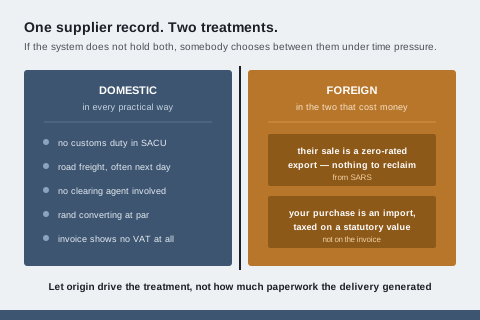
The two halves of the same supplier
Domestic in every practical way
- No customs duty within the union.
- Road freight, frequently next-day, with no clearing agent involved.
- Prices in rand, converting at par in the CMA states.
- Same language, similar commercial terms, often the same banking group.
- Which is why they get managed exactly like a local supplier.
Foreign in the two that bite
- Their sale is an export, zero-rated — so their invoice shows no VAT and there is nothing to reclaim from SARS.
- Your purchase is an import, and import VAT is charged on a statutory valuation rather than on the invoice value.
- Both of those are invisible on the paperwork you receive.
- And both are permanent features rather than transitional ones.
The paperwork you receive is complete, accurate and silent about the two things that matter. Nothing is being withheld — the supplier simply has no reason to tell you about your own import treatment.
How systems get this wrong
Almost always by making the sensible-looking simplification. Four versions of it, in roughly the order they cause trouble.
| The simplification | What it costs later |
|---|---|
| Recording the supplier as local, because everything about the relationship is | The purchase is not treated as an import, so there is nowhere for import VAT, freight or handling to land — and landed cost quietly becomes purchase price |
| Storing the currency as the local one, because the rate is one | The record no longer says what currency the transaction was actually in, which matters the first time there is a dispute, a credit note at a different date, or an audit question about a cross-border supply |
| Reading the supplier's zero-rated invoice as "no VAT" | The VAT does exist. It arrives separately, at import, on a different value, from a different authority, sometimes through an agent's account — and it is easy for it never to reach the consignment it belongs to |
| Treating "no duty" as "no import" | The whole import discipline is skipped: no checklist, no valuation, no landed-cost habit. This is the root cause of the other three |
The rule that resolves it
One decision, applied consistently, removes the whole category: let the treatment be driven by where the goods came from, not by how much paperwork the delivery generated.
That sounds obvious written down. It is not what most systems do, because most systems infer "this is a simple purchase" from the absence of customs documents, and inside a customs union the absence of customs documents means nothing at all.
Origin drives treatment
A purchase from outside the tax jurisdiction is an import, whether or not duty was payable and whether or not a clearing agent was involved.
Currency stored as issued
The original currency code retained on the transaction even when the rate is one, so the record describes what happened rather than what it converted to.
Import costs on the consignment
Import VAT, freight, handling and any clearing allocated to the receipt they belong to, so they reach unit cost rather than a general expense line.
The statutory valuation itself
The uplift or market-value test that determines the taxable amount. This stays yours: define it with your accountant, and verify it against a real import rather than against a vendor's description.
A link to customs or your clearing agent
Not built. There is no ASYCUDA connection and no data feed from an agent, so a customs event arrives as a document somebody attaches rather than a status that updates itself. Within SACU that is a smaller gap than it sounds; for imports from outside the union it is a real manual step and it should be priced in.
Where the pegged currency makes it worse rather than easier
In the Common Monetary Area — Namibia, Lesotho and Eswatini — the local currency is pegged one-for-one to the rand and the rand is legal tender. This removes the exchange-rate question from the room, and because it removes the question, several things that are not about the exchange rate stop being asked as well.
The most consequential is the record-keeping one. A system that has flattened the two currencies into one has also destroyed the information needed to answer "what is our rand exposure" — and it destroyed it years before anybody thought to ask. Keeping the two codes distinct costs nothing while the peg holds. It is the only reason you would be able to answer at all if it ever did not.
This is not a prediction about the peg
The peg has held for a long time and there is no argument here that it will not. The point is narrower: distinguishing two currencies is record-keeping hygiene rather than a forecast, and hygiene is cheap in advance and impossible retrospectively. The same reasoning applies to the two CFA francs on the other side of the continent, for the same reason and with the same fixed rate.
Five things to check in your own system
- Is a South African supplier recorded as foreign or local, and does anything downstream depend on that answer?
- Is the currency on their transactions stored as ZAR, or as the local currency because the rate is one?
- Does import VAT land on the consignment, or as a separate payment with no relationship to the goods?
- Can you produce a landed cost for one case of a fast-moving line, including everything that was paid to have it?
- If a clearing agent was involved for an overseas import, is their invoice allocated to the receipt or expensed?
None of these require software to answer, and answering them honestly is more useful than any vendor demonstration. Two of them will probably be uncomfortable, and the uncomfortable ones are the reason the exercise is worth doing.
What we can build for Southern Africa on top of the standard product
Everything listed above as something we can add describes what ships in the standard product today — it is a starting point for Southern Africa, not a limit on what AWRA OpsHub can do there. Kenya's eTIMS integration and its maintained payroll engine are in the product because Kenyan clients needed them and commissioned them; neither appeared by itself. The same door is open here. If a revenue authority pipeline, a bank or mobile money feed, a statutory return format, a rule specific to how your operation runs, or a link to a system you already have is what stands between you and a decision, tell us and we will scope it as a build — written spec, timeline and price — before you commit to anything.
Tax pipelines and return output
Return output in the shape your revenue authority expects and electronic invoicing against any prescribed interface, with retries, a failure queue and a reconciliation report.
Banks, EFT and card acquirers
Bank statement feeds, EFT and debit-order files and card acquirer settlements pulled into the Payments Register so receipts match invoices without re-keying.
The operational work, which is what most commissions actually are
An extra approval stage in a chain that does not match the standard one, a custom field set on employees or assets that only your sector needs, an expiry that has to block an order rather than send an email, a report your board asks for in a shape nothing produces, or a scanner or weighbridge feeding the goods-in door. These are the commissions we are asked for most often and the smallest ones we quote — and unlike a revenue-authority pipeline, none of them waits on a regulator.
Payroll and statutory returns
Payroll tax and social security schedules produced in the layout your filing body expects, generated from live payroll records rather than rebuilt each month.
Systems you already run
The accounting package, CRM, online store or custom database you intend to keep — connected through our API so a fact is entered once and appears everywhere it is needed.
How it works: you describe the requirement, we return a written scope, timeline and cost, and once agreed it is built into your environment and maintained as part of the product. No roadmap slide, and no pretending in a demo that something exists when it does not.
Tell us what you need integrated