
A Zero Rating Is a Document, Not a Fact
A zero-rated export is not a property of the goods. It is a treatment you claimed, conditional on evidence you must be able to produce — and on a distribution margin, the difference between having it and having it somewhere is the whole margin.
There is a quiet category error running through a great many export businesses, and it is embedded in the language everyone uses. People say a sale "is zero-rated", as though that were a fact about the transaction in the way that its weight is a fact about the pallet.
It is not. Zero-rating is a treatment you applied, and in every regime we have looked at it is conditional — usually on being able to demonstrate that the goods actually left. The tax was never in the price. If the conditions cannot be evidenced, the shortfall does not come out of a provision, because nobody provisioned for it. It comes out of the margin.
Nothing here is tax advice, and the specific conditions are your own authority's to set and to change. What follows is about record-keeping, which is the part that is reliably yours.
The arithmetic, because it is worse than people expect
Distribution margins are thin and the exposure is a percentage of revenue rather than of profit, which is a combination that catches people out. Worth doing once with real numbers.
One quarter of cross-border sales, priced at zero
Currency omitted deliberately, because the ratio is the point and it holds in any of them. Eighteen per cent of shipments missing evidence is not a badly run business — it is an ordinary one where the customs entries live with the clearing agent, the delivery notes live in a folder, and nobody ever tried to connect them to a specific invoice. And note what the exposure is a percentage of: revenue, not profit. That is why a single-digit failure rate produces a double-digit margin hit.
The tax was never in the price. That is the whole reason the recovery hurts.
Why the evidence goes missing, when nobody lost anything
This is the part worth understanding, because the usual explanations — carelessness, under-resourcing — are wrong and lead to the wrong fix. In almost every case we have looked at, every document existed. What was missing was the connection.
-
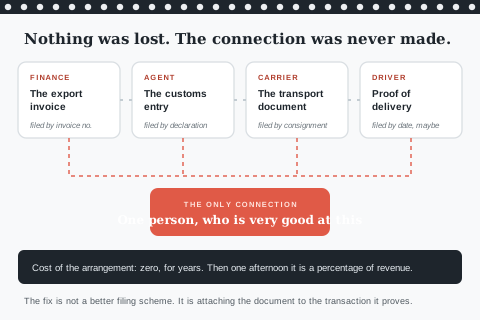
The documents are created by four different parties
The invoice by your finance system, the customs entry by your clearing agent, the transport document by the carrier, the delivery proof by the driver or the customer. Four originators, four systems, four filing conventions, and no shared reference between them.
-
Each is filed in the way that suits its owner
The agent files by declaration number. The carrier by consignment. Finance by invoice number and month. Everybody is being perfectly organised, and none of the organising schemes agree.
-
The connection lives in one person's head
There is usually somebody who can find anything. They know which agent handled which route in which month, and they are genuinely good at it. This works completely until they are on leave, or they leave.
-
Nothing goes wrong for years
And this is the dangerous part, because the absence of consequence reads as evidence that the arrangement is fine. The cost of a disconnected filing system is exactly zero until the specific afternoon on which it is not.
-
A query arrives about a period nobody remembers
Not necessarily an audit. A review, a routine question, a change of adviser. Three people spend a fortnight reassembling links that were never made, and the answer for some proportion of shipments is "we know it happened but we cannot show it".
The four documents and what each one is actually for
These vary by jurisdiction and your adviser will tell you which apply to you. The logic of them is remarkably consistent, though, and it is worth understanding what each is doing rather than treating the list as a ritual.
| Document | What it establishes | Created by |
|---|---|---|
| The export invoice | What was sold, to whom, and on what terms | You |
| The customs entry | That the goods physically left. This is the foundation and the first thing asked for | Your clearing agent |
| The transport document | Who carried it, when, and to where — the corroborating movement record | The carrier |
| Proof of delivery | That it arrived, rather than merely departed. Also settles shortage claims | The driver or customer |
| The counterparty's registration | That you sold to a registered business, valid at the date of supply | Them, and it expires |
The one that expires
The last row is different in kind from the others and gets missed for exactly that reason. A customs entry is true forever once it exists. A counterparty registration is a fact with a date on it, and a customer whose registration lapsed eleven months ago is a problem discovered by somebody else, in a review, with your invoice as the evidence. Registration validity is not a document to file — it is a date to watch, which means it belongs to a system rather than to a person.
The fix, which is structural rather than diligent
Everybody's first instinct is a process: a checklist, a monthly review, somebody assigned. Those help and they decay, because they depend on attention and attention is the resource under most pressure in a small finance function.
The durable version is to make the connection structural — the document attaches to the transaction, and the transaction cannot be treated as an export without it.
What structural looks like in practice
- Documents attach to the shipment or invoice, not to a folder organised by month.
- The export treatment is blocked until the required attachments exist, rather than flagged for follow-up.
- Counterparty registration is a field with an expiry date that the system watches, not a note in a comment box.
- Retrieval is one path — the same two clicks whether the person who filed it is here or not.
- Files are checksummed and access-logged, so the document produced in a review is provably the one that was filed.
- Somebody can run "show me every zero-rated supply this quarter with a missing attachment" as a report, on a Tuesday, in seconds.
That last one is the test of whether any of this actually happened. If the answer to it is a spreadsheet exercise, the discipline is still living in a person.
Four questions, and what a vague answer usually means
Can we attach documents to transactions?
The answer you often get
Yes, you can upload files.
What to press for instead
Uploading is not attaching. Ask whether a document is bound to a specific invoice or shipment, whether it can be made required before a treatment applies, and whether you can report on what is missing. A general file store is a shared drive with extra steps.
Do you track customer registration validity?
The answer you often get
You can record it on the customer.
What to press for instead
Recording is not watching. Ask whether it has an expiry date, what happens as that date approaches, and who is told. A field nobody is alerted about is a note.
Can we prove a document has not been altered?
The answer you often get
Everything is stored securely.
What to press for instead
Ask specifically about checksums and access logging. In a review, the useful property is not that the file was safe — it is that you can demonstrate the file produced today is the file stored then, and show who opened it in between.
How do we find every incomplete export from last quarter?
The answer you often get
You could export the data and check.
What to press for instead
That is a description of the problem. Ask to see the report. If it does not exist, the exception is invisible by default, and invisible-by-default is how eighteen per cent happens without anybody being careless.
What AWRA OpsHub does today
- Documents attached to the transaction they justify, not to a folder
- Checksums and access logging on stored files
- Expiry dates on customer and supplier registrations, watched by the system
- Landed cost carried onto the consignment at the rate actually paid
- Reporting on transactions with missing attachments
More we can add to your workspace
- Customs or single-window integration, in any market
- Issuing or applying for certificates of origin
- Interpreting whether a specific supply qualifies for zero-rating — that is your adviser's
- Filing anything with any revenue authority outside Kenya
Anything above that you need, we can build for you
Everything listed above as something we can add describes what ships in the standard product today — it is a starting point, not a limit on what AWRA OpsHub can do for your organisation. Kenya's eTIMS integration and its maintained payroll engine are both in the product because clients needed them and commissioned them; neither appeared by itself, and the same door is open for whatever you just read about. One qualification so this is worth what it claims: a small number of things on this blog we deliberately leave to a specialist rather than build — a statutory ledger we will not sign our name to, a rule that would decide a tax question for you, a clinical or member-funds record that belongs in a regulated system — and where that is true the post says so in those words. Everything else is a scope, a timeline and a price.
The operational work, which is what most commissions actually are
An extra approval stage in a chain that does not match the standard one, a custom field set on employees or assets that only your sector needs, an expiry that has to block an order rather than send an email, a report your board asks for in a shape nothing produces, or a scanner or weighbridge feeding the goods-in door. These are the commissions we are asked for most often and the smallest ones we quote — and unlike a revenue-authority pipeline, none of them waits on a regulator.
The module-shaped additions, which are the ones readers ask for most often
A price list with real discount authority, a customer-facing quotation that expires, a bill of materials or recipe costing, a staff advance that is issued, acquitted and chased, a member or unit ledger, a matching rule that holds a payment. Each of these is a build rather than a setting, and each has been quoted before — a bigger piece of work than a custom field, with a written spec and a date instead of a roadmap slide.
The report, document or pack nothing currently produces
The board pack in the shape your board actually asks for, a donor or funder layout, an invoice or receipt template carrying what your regulator or your customer expects, a dataset the report builder cannot reach yet. Usually the fastest thing on this list to deliver, because the data is already in the system.
Systems, rails and hardware you already run
The accounting package, CRM, online store, core banking or custom database you intend to keep — connected through our API so a fact is entered once and appears everywhere it is needed. Plus the physical edge: a scanner, a scale, a weighbridge or a till peripheral feeding the door it belongs to.
How it works: you describe the requirement, we return a written scope, timeline and cost, and once agreed it is built into your environment and maintained as part of the product. Nothing here waits on a regulator or a published specification, which is why operational builds are the ones we quote fastest. Tell us the requirement that would otherwise rule us out — that is a better first conversation than a demo.
Tell us what your operation needsOur take
Stop thinking of export evidence as filing and start thinking of it as the thing your margin is resting on. The failure is never that a document was lost — it is that four parties created four documents under four reference schemes and the only connection between them was somebody who is very good at their job. Make the attachment structural, watch the registration dates, and make sure "what is missing?" is a report rather than an exercise. That is a week of setup against a percentage of revenue.
Try the two-minute test
Take one zero-rated export from last quarter and try to produce its customs entry, transport document, delivery proof and the customer's registration as at that date. Two minutes, no asking anyone. Whatever happens is worth knowing.
Talk to us about export evidenceFrequently asked questions
What evidence does a zero-rated export actually require?
That is jurisdiction-specific and it is a question for your tax adviser or your revenue authority, not for a software vendor — the conditions differ, and they change. What is consistent across the regimes we have worked in is the logic: the authority wants to be satisfied that the goods left, and the documents that satisfy that are typically the customs entry, a transport document and evidence of delivery, supported by the counterparty's registration being valid at the date of supply. Get your specific list from your adviser and then build the discipline around it.
How long do we need to keep it?
Also jurisdiction-specific, and typically measured in years rather than months. The practical implication matters more than the exact number: whatever the period is, it will outlast at least one member of your finance team and possibly your current filing arrangement. That is the real argument for attaching documents to transactions rather than to a folder structure — retention periods are long enough that institutional memory cannot be the retrieval mechanism.
Is this really worth systematising for a small business?
It depends entirely on what proportion of your revenue is zero-rated. If it is five per cent, probably not — handle it manually and check it quarterly. If cross-border sales are a third of your turnover, the arithmetic in this piece is your arithmetic, and the exposure is a percentage of revenue rather than of profit. Work out your own number before deciding; it takes an afternoon and it is the only version of this argument that should persuade you.
Our clearing agent keeps all of this. Is that not enough?
It is usually fine and occasionally very much not. Two things to check. First, whether you can retrieve a specific document yourself, quickly, without their help — because the day you need it may be a day they are slow to respond, or a year after you changed agents. Second, whether their reference scheme can be mapped to your invoice numbers at all; most agents file by declaration, which means reconnecting the two is a manual exercise repeated for every query. Keeping your own copy attached to your own transaction costs seconds at the time.
Does AWRA connect to customs systems?
No, in any market. There is no integration with any customs authority, single window or port community system, and we do not issue or apply for certificates of origin. Customs events are recorded by a person rather than received as data. What we do is hold the documents against the transaction they belong to, checksummed and retrievable, watch the expiry dates on registrations, and carry clearance costs onto the landed unit cost.
