When the Workforce Turns Over, So Does Custody
In a workforce where people leave the country rather than move down the road, custody does not decay gradually. It ends on a visa date, and whatever was held informally goes with it.
Every operation runs on a layer of informal arrangement that nobody has written down. The supervisor who has the good torque wrenches in his vehicle. The storeman who knows which supplier will actually deliver on a Thursday. The foreman with the spare radio batteries in his locker. This is not disorder — it is how work gets done, and a business that eliminated all of it would grind to a halt.
The arrangement has one assumption baked into it: that the people are still going to be here next year, or at least that when they go, they go one at a time and hand things over at a sensible pace.
In a workforce that is largely expatriate and residency-bound, that assumption does not hold. Departures are terminal rather than local, they cluster around contract and project cycles, and they happen against a visa date rather than a convenient one.
What actually leaves
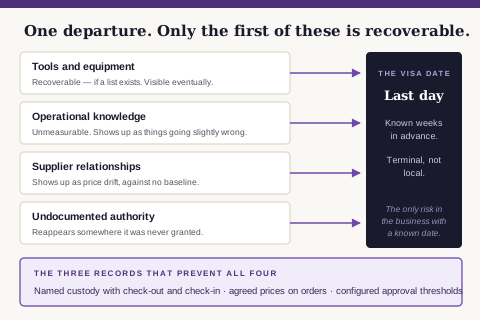
Four things, in ascending order of how much they cost and descending order of how visible they are.
| What leaves | Typical value | How visible is the loss? |
|---|---|---|
| Tools and equipment | Recoverable if there is a list | Visible eventually, when something is needed |
| Operational knowledge | Unmeasurable and large | Invisible — it shows up as things going slightly wrong |
| Supplier relationships | Shows up as price drift | Invisible without a price baseline to compare against |
| Undocumented authority | Shows up as a governance gap | Invisible until an audit, or until it is misused |
Only the first is what most people mean by an asset register problem. It is also the smallest of the four.
The tools are recoverable. The reason your best supplier gives you that price is not.
Why "we have a register" is usually not true
Almost every business we talk to has an asset register. Very few have a custody record, and the difference is the whole subject.
An asset register
- Answers: what do we own?
- Built for depreciation and insurance.
- Updated when something is bought or written off.
- Accurate at the moment it was compiled.
- Tells you a compactor exists.
A custody record
- Answers: who has it, right now?
- Built for the day somebody leaves.
- Updated on every check-out and check-in.
- Accurate continuously, or it is not a custody record.
- Tells you which site the compactor is on, and who signed for it.
The test is simple and slightly uncomfortable: pick an item and ask who has it. If the answer requires a phone call, you have a register. If it requires two phone calls, you have a spreadsheet that was accurate in March.
The offboarding moment, which is the only one that matters
Everything above resolves into a single practical question: on the day somebody's last day is confirmed, can the business produce a list of what they are holding?
Not an approximation. A list, generated, with items on it, that somebody can walk through with them. In a business with structural turnover this is not an occasional nicety — it is a recurring event with a known frequency, and it is entirely predictable.
-
The departure is known weeks in advance
Visa-bound departures are almost never sudden. There is notice, usually generous, and the handover window is real. This is the advantage a high-turnover expatriate workforce has over an ordinary one and almost nobody uses it.
-
A list either exists or it does not
If custody is recorded, generating the list takes seconds and the conversation is administrative. If it is not, the conversation is a negotiation between two people's recollections, and both are acting in good faith.
-
What comes back is checked in against the same record
The check-in matters as much as the check-out. A returned item with no condition note is how a broken tool becomes an argument six months later with the next holder.
-
What does not come back is a decision, not a discovery
Sometimes an item is genuinely gone, consumed, or was never really an asset. That is fine — what matters is that it is written off deliberately, on a date, by somebody, rather than quietly ceasing to exist in the records.
-
The knowledge handover has something to hang on
This is the underrated benefit. A generated list of what somebody holds is also a prompt for what they know. Going through eleven items produces eleven conversations that would not otherwise have happened.
The cheapest diagnostic in this article
Take the last four people who left. For each one, try to establish what they were holding on their final day. Not to apportion blame — several of them will have handed everything back perfectly. What you are measuring is whether the answer comes from a record or from somebody's memory. An afternoon, no software, and it settles the question of whether any of this applies to you.
The three records that do the work
- Named custody with check-out and check-in. Not a location field — a person, a date, and a condition note. The item is with somebody, not somewhere.
- Agreed prices on purchase orders. So that when the person who managed a supplier relationship leaves, price drift is detectable against a record rather than against nobody's memory.
- Configured approval thresholds and delegation. So that authority is a setting rather than an understanding, and a departure does not silently rewrite who can commit what.
Notice that only the first is about assets. The other two are about the invisible losses, and they are ordinary purchasing controls doing a second job.
Four questions, and what a vague answer usually means
Do you have an asset register?
The answer you often get
Yes, everything is on it.
What to press for instead
Ask who currently holds a specific item and when they took it. "It is assigned to the site" is a location. What you need is a person and a date, and the difference only becomes obvious on the day somebody leaves.
Can you produce a custody list for an employee?
The answer you often get
We could put one together.
What to press for instead
Could is doing the work in that sentence. Ask for it to be generated in front of you for a real person. If it is compiled rather than generated, offboarding depends on somebody having time in the week that somebody else leaves.
How do you know a supplier price has drifted?
The answer you often get
Purchasing would notice.
What to press for instead
Which purchasing — the person who just left, or the one who arrived last month with no baseline? Ask whether the agreed price lives on an order that an invoice is matched against, or in an email thread.
Who can approve a purchase of this size?
The answer you often get
That would go to the manager.
What to press for instead
Ask whether that is configured or understood, and what happens when the manager is unavailable. In a high-turnover business, an understood approval chain is rewritten by accident every couple of years, always upward in permissiveness.
What AWRA OpsHub does today
- Named custody with check-out, check-in and condition notes
- Maintenance history and depreciation held on the asset
- Agreed prices on purchase orders, matched against invoices
- Approval thresholds that refuse, and configured delegation
- Employee records with document expiry dates watched
- An audit trail recording who changed what and when
More we can add to your workspace
- Statutory payroll or end-of-service accrual outside Kenya
- Automated offboarding workflows tied to a visa or residency system
- Barcode or RFID hardware — custody is recorded, not sensed
- Geolocation tracking of assets or people
What we can build for Kuwait on top of the standard product
Everything listed above as something we can add describes what ships in the standard product today — it is a starting point for Kuwait, not a limit on what AWRA OpsHub can do there. Kenya's eTIMS integration and its maintained payroll engine are in the product because Kenyan clients needed them and commissioned them; neither appeared by itself. The same door is open here. If indemnity accrued on live records, an Arabic interface, a bank or mobile money feed, a statutory return format, a rule specific to how your operation runs, or a link to a system you already have is what stands between you and a decision, tell us and we will scope it as a build — written spec, timeline and price — before you commit to anything.
A VAT build if Kuwait legislates one
There is no value added tax in Kuwait and no electronic invoicing programme, so there is nothing to integrate with and we are not going to invent a roadmap item. If a law is enacted, this becomes an ordinary build against the published specification. It is listed here for completeness rather than because it is the thing you should be buying for.
Arabic interface, banks and acquirers
Arabic interface text with right-to-left layout and bilingual document templates, plus bank statement feeds and card acquirer settlements wired into the Payments Register.
The operational work, which is what most commissions actually are
An extra approval stage in a chain that does not match the standard one, a custom field set on employees or assets that only your sector needs, an expiry that has to block an order rather than send an email, a report your board asks for in a shape nothing produces, or a scanner or weighbridge feeding the goods-in door. These are the commissions we are asked for most often and the smallest ones we quote — and unlike a revenue-authority pipeline, none of them waits on a regulator.
Payroll and statutory returns
The build that actually matters here: end-of-service indemnity accrued month by month on live employee records under the Kuwaiti calculation — half a month per year for the first five and a full month per year after, on a twenty-six-day divisor, capped at eighteen months — held at both its termination and its resignation value, alongside Public Institution for Social Security contributions for the nationals they apply to and a Kuwaitisation position that is visible before a deadline.
Systems you already run
The accounting package, CRM, online store or custom database you intend to keep — connected through our API so a fact is entered once and appears everywhere it is needed.
How it works: you describe the requirement, we return a written scope, timeline and cost, and once agreed it is built into your environment and maintained as part of the product. No roadmap slide, and no pretending in a demo that something exists when it does not.
Tell us what you need integratedOur take
Structural turnover is not a human resources problem dressed up as an operations one. It is an operations problem with a known frequency and a known date, which makes it one of the few risks in a business you can prepare for precisely. The preparation is a custody record rather than an asset register, agreed prices on orders rather than in emails, and approval limits that are configured rather than understood. Three records, all of which most businesses believe they already have.
Run the four-leavers test
Take the last four people who left and try to establish what they were holding. It costs an afternoon, needs no software, and tells you whether custody in your business is a record or a recollection.
Talk to us about asset custodyFrequently asked questions
Is this only relevant to expatriate workforces?
The problem exists everywhere; the frequency and the shape are what differ. In a market with ordinary local turnover, departures are staggered, handovers are relaxed, and the person often remains reachable — which quietly repairs a lot of informal arrangements. Where turnover is residency-bound, departures cluster, handover windows are compressed against a fixed date, and the person becomes genuinely unreachable. Same underlying gap, much less forgiving conditions.
What is the difference between an asset register and a custody record?
An asset register answers "what do we own", is built for depreciation and insurance, and is updated at purchase and disposal. A custody record answers "who has this right now", is built for the day somebody leaves, and is updated on every check-out and check-in. Most businesses have the first and believe it does the job of the second. The test is to pick an item and ask who has it — if the answer needs a phone call, you have a register.
Do we need barcodes or scanners?
Usually not to start with, and treating it as a hardware project is a common way for this to never happen. The discipline is a named holder and a date, and that works perfectly well typed. Scanning helps at volume — a tool store issuing dozens of items a day — but a business losing equipment on departures is not losing it because scanning was too slow. It is losing it because nothing was recorded at all. We record custody rather than sensing it; there is no barcode or RFID hardware integration.
How do you handle items that were never really assets?
Deliberately, which is the whole point. Plenty of what people hold is consumable, low value, or genuinely used up — and pretending otherwise creates a register nobody maintains. The useful practice is to set a threshold for what goes under custody, keep it high enough that the record stays accurate, and write off what does not come back on a date, by a person, rather than letting it quietly disappear from the records.
Does this connect to an HR offboarding process?
Not automatically. There is no integration with a visa or residency system and no workflow that triggers on a leaving date. What exists is the record: employee details, documents with expiry dates the system watches, and the custody list you can generate for any holder. Connecting that to your offboarding checklist is a process step somebody owns, and we would rather describe it accurately than imply an automation that is not there.