Bank Reconciliation, Explained (Your Fraud Tripwire)
Bank reconciliation is the routine that proves your books and your bank agree — and the single most reliable way to catch errors, missed transactions, and fraud early. Here is what it is, why the two never quite match on their own, and how to do it without dread.
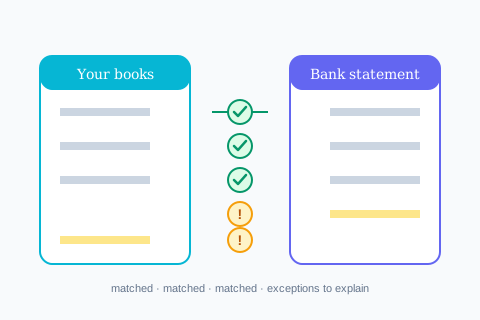
Bank reconciliation is the process of comparing the cash balance in your accounting records against the balance on your bank statement, and explaining every difference between them. Done regularly it is the most powerful control a small business has — it catches transactions you forgot to record, charges you did not know about, errors on either side, and, not infrequently, fraud. Done rarely or never, it is where a business slowly loses track of its own cash and discovers, months later, that the figure it has been trusting was fiction. The reconciliation is not bureaucracy; it is the moment your money story is checked against reality.
Why the two never match on their own
The books and the bank almost never show the same balance at a given moment, and that is normal, not alarming. The differences fall into predictable categories — timing gaps and things one side knows that the other does not yet:
- Outstanding payments — a cheque or transfer you recorded that has not yet cleared the bank.
- Deposits in transit — money you received and recorded but that the bank has not yet processed.
- Bank charges & interest — fees and interest the bank applied that you have not yet recorded.
- Direct debits & standing orders — automatic payments the bank made that never passed through your desk.
- Errors — a figure keyed wrong on your side, or, occasionally, the bank's.
Reconciliation is the act of accounting for each of these until the two balances are fully explained. What is left unexplained after that is exactly what you need to investigate.
The reconciliation, step by step
The routine
- Start from the bank statement closing balance and your book balance for the same date.
- Tick off every transaction that appears on both — these agree and need no action.
- List items on the bank statement not in your books (charges, direct debits) and record them.
- List items in your books not yet on the statement (uncleared payments, deposits in transit) — these are timing.
- After adjusting for both, the balances should agree. Anything left over is an error or an exception to chase.
Why frequency is everything
The single biggest determinant of how painful reconciliation is, and how much it protects you, is how often you do it. Reconcile weekly and each session handles a handful of transactions, discrepancies are fresh enough to explain, and fraud or error surfaces within days. Reconcile once a year and you face thousands of transactions, memories have faded, and a fraudulent payment made in February is discovered — if at all — the following January, long past the point of recovery. The reconciliation that protects you is the frequent, boring one.
Reconciliation is your fraud tripwire
Most cash fraud in small organizations is caught, if it is caught at all, by reconciliation — an unexplained payment, a charge to an unfamiliar account, a deposit that never arrived. A business that reconciles frequently makes fraud hard to sustain, because every unauthorized movement of money must survive a comparison against the books within days. A business that does not reconcile is, in effect, inviting anyone with access to try.
Bank reconciliation is what turns a balanced trial balance into genuinely trustworthy books: the trial balance proves the books are internally consistent, and reconciliation proves the cash they describe actually exists. In a connected system, much of the matching is automated — statement lines matched to recorded transactions, only the exceptions surfaced for a human — which turns a dreaded monthly ordeal into a short weekly review that keeps the most important number in the business, its cash, honest.
What AWRA OpsHub does today
- A reconciliation screen, behind its own reconciliation permission, that runs several internal integrity checks.
- Books integrity: total ledger debits against total ledger credits, so an imbalance surfaces as a number rather than a surprise at year end.
- Inventory ledger against physical stock value — the GL inventory account compared with the valuation of what is actually on hand.
- Payables against open purchase orders, so the AP balance can be tied to outstanding commitments.
- GL cash and bank against the Payments Register, including pending and failed payment transactions.
- A bank statement import — a statement uploaded as CSV or OFX against a bank account held in the ledger.
- Auto-matching of statement lines, with suggested matches for the rest and a line matched to one or several ledger entries — and an exception queue of lines still to be matched, entered as a new posting, or ignored.
- A bank reconciliation record for each statement date — the statement balance, the outstanding receipts and payments that explain the gap, who completed it and when — with every line it cleared locked.
More we can add to your workspace
- An open-banking or bank statement feed. M-Pesa and Paystack are the payment integrations today, and M-Pesa runs both ways — STK, QR and paybill collection in, B2C and B2B payouts out, with reversal. What a statement feed adds is different: a bank connection that hands you the lines to match.
So read this article as the discipline you should run, and run the statement side of it here: import the statement, let the matcher clear what it can, work the exceptions, and complete the reconciliation for the date. What we add on top is the layer most tools skip: whether your ledger agrees with your stock and your commitments, which is where the errors that survive a clean bank reconciliation usually hide.
Anything above that you need, we can build for you
Everything listed above as something we can add describes what ships in the standard product today — it is a starting point, not a limit on what AWRA OpsHub can do for your organisation. Kenya's eTIMS integration and its maintained payroll engine are both in the product because clients needed them and commissioned them; neither appeared by itself, and the same door is open for whatever you just read about. One qualification so this is worth what it claims: a small number of things on this blog we deliberately leave to a specialist rather than build — a statutory ledger we will not sign our name to, a rule that would decide a tax question for you, a clinical or member-funds record that belongs in a regulated system — and where that is true the post says so in those words. Everything else is a scope, a timeline and a price.
The operational work, which is what most commissions actually are
An extra approval stage in a chain that does not match the standard one, a custom field set on employees or assets that only your sector needs, an expiry that has to block an order rather than send an email, a report your board asks for in a shape nothing produces, or a scanner or weighbridge feeding the goods-in door. These are the commissions we are asked for most often and the smallest ones we quote — and unlike a revenue-authority pipeline, none of them waits on a regulator.
The module-shaped additions, which are the ones readers ask for most often
A price list with real discount authority, a customer-facing quotation that expires, a bill of materials or recipe costing, a staff advance that is issued, acquitted and chased, a member or unit ledger, a matching rule that holds a payment. Each of these is a build rather than a setting, and each has been quoted before — a bigger piece of work than a custom field, with a written spec and a date instead of a roadmap slide.
The report, document or pack nothing currently produces
The board pack in the shape your board actually asks for, a donor or funder layout, an invoice or receipt template carrying what your regulator or your customer expects, a dataset the report builder cannot reach yet. Usually the fastest thing on this list to deliver, because the data is already in the system.
Systems, rails and hardware you already run
The accounting package, CRM, online store, core banking or custom database you intend to keep — connected through our API so a fact is entered once and appears everywhere it is needed. Plus the physical edge: a scanner, a scale, a weighbridge or a till peripheral feeding the door it belongs to.
How it works: you describe the requirement, we return a written scope, timeline and cost, and once agreed it is built into your environment and maintained as part of the product. Nothing here waits on a regulator or a published specification, which is why operational builds are the ones we quote fastest. Tell us the requirement that would otherwise rule us out — that is a better first conversation than a demo.
Tell us what your operation needsCheck the books against the operation
Bank statements imported and matched line by line, each reconciliation recorded and locked — plus a reconciliation screen that ties the ledger to physical stock, open purchase orders and the payments register, and flags a debit/credit imbalance.
Explore accountingFrequently asked questions
What is bank reconciliation?
It is the process of comparing the cash balance in your accounting records against your bank statement and explaining every difference between them. It catches unrecorded transactions, bank charges, errors, and fraud, and it is the routine that proves the cash your books describe actually exists.
Why do my books and bank statement never match?
Because of timing and information gaps: payments you recorded that have not yet cleared, deposits in transit, bank charges and interest you have not recorded, automatic debits that never crossed your desk, and occasional errors. These differences are normal — reconciliation is the act of accounting for each until the two balances fully agree.
How often should I reconcile?
As often as practical — weekly for most active businesses. Frequent reconciliation keeps each session small, discrepancies fresh, and fraud or error caught within days. Reconciling rarely means facing thousands of transactions with faded memories and discovering problems long after they can be recovered.
How does reconciliation help detect fraud?
Most cash fraud in small organizations is caught by reconciliation — an unexplained payment, an unfamiliar charge, or a deposit that never arrived surfaces when the bank is compared against the books. Doing it frequently makes fraud hard to sustain, because every unauthorized movement must survive that comparison within days of occurring.