What Is a Trial Balance? (And What It Quietly Misses)
The trial balance is the checkpoint between your transactions and your financial statements — a single list that proves the books balance before anyone trusts a report built on them. Here is what it is, what it catches, and what it quietly misses.
The trial balance is one of accounting's oldest and most useful checkpoints: a list of every account in the chart of accounts with its balance, arranged in two columns — debits and credits — that must add up to the same total. Because double-entry bookkeeping records every transaction as an equal debit and credit, the sum of all debit balances must always equal the sum of all credit balances. When they match, the books are arithmetically consistent. When they do not, something is wrong, and you find it before building statements on a broken foundation.
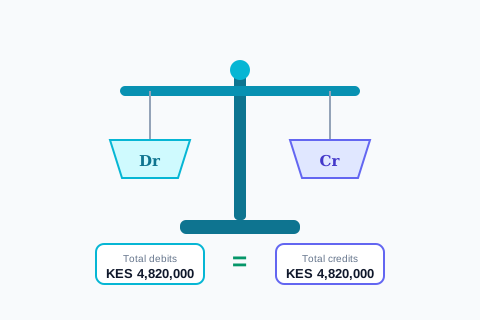
Why the two columns must match
Double-entry accounting rests on the principle that every transaction affects at least two accounts in equal and opposite amounts: receive cash for a sale, and cash (an asset) goes up while sales (income) goes up too, recorded as a debit and a credit of the same value. Repeat that across thousands of transactions and the total of all debits must equal the total of all credits — the books balance by construction. The trial balance simply totals both columns and checks. It is the arithmetic conscience of the whole system.
What a trial balance catches — and what it misses
A trial balance that does not balance is a guaranteed signal of error — a one-sided entry, a transposed figure, a posting to the wrong column. But a trial balance that does balance is not proof the books are correct, and this is the trap. Several serious errors leave the columns perfectly equal:
| Error | Does the trial balance catch it? |
|---|---|
| One-sided entry (debit without credit) | Yes — columns will not match |
| Transposed or wrong figure on one side | Yes — columns will not match |
| Transaction omitted entirely | No — both sides simply absent |
| Posted to the wrong account (right column) | No — still balances |
| Two errors that cancel out | No — they offset |
So the trial balance is necessary but not sufficient. It proves arithmetic consistency, not accuracy — which is why it is a checkpoint on the way to trustworthy books, not the destination.
From trial balance to financial statements
Once the trial balance balances, the financial statements assemble directly from it: the asset, liability, and equity accounts form the balance sheet, and the income and expense accounts form the profit-and-loss. This is why the trial balance sits exactly between raw bookkeeping and reporting — it is the last consistency check before the numbers become the statements that owners, lenders, and auditors rely on.
In a real system, it always balances
In a proper accounting system you never see an unbalanced trial balance, because the software will not let you post a one-sided entry in the first place — every transaction is balanced as it is recorded. That removes a whole class of arithmetic error, but it makes the remaining checks more important, not less: the errors a modern system cannot prevent are exactly the ones a trial balance never catches — omissions and postings to the wrong account.
Understanding the trial balance clarifies what balanced books do and do not guarantee. It is the reason bank reconciliation and account review still matter even when the trial balance is perfect: consistency is mechanical and easily automated, but accuracy — that each transaction is real, complete, and in the right place — still requires judgment. The trial balance clears the arithmetic so that judgment can focus on what actually matters.
What AWRA OpsHub does today
- A live trial balance in the accounting module, assembled from journal entries rather than compiled at period end.
- Paired entries by construction. Journal entries are generated in debit/credit pairs by a single service, so an unbalanced entry is not something a user can type.
- A books-integrity check on the reconciliation screen: total debits against total credits, with the imbalance shown as a figure.
- Statement grouping by system key, giving revenue, expense, asset and liability groupings.
- Manual journals for an accrual, a correction or an opening balance, each one a balanced set of lines, dated by the person posting it.
- Expenses posting to the ledger when they are recorded, and expense claims when they are approved.
- Equity accounts — share capital, opening balance equity and retained earnings — posted to by manual journal, so a complete balance sheet can be drawn.
- A period lock on posting: a closed month refuses a backdated entry, and an automatic posting dated in one rolls to the first open day.
More we can add to your workspace
- Year-end closing entries as a posting event, carrying the year’s result into retained earnings in the ledger itself rather than only on the statements.
The distinction that matters: what ships is an internally consistent ledger of operational movements, genuinely useful for checking that stock, sales and payments agree with each other. With manual journals, equity and a period lock it now carries the postings an accountant makes as well as the ones operations generate; whether it serves as your statutory book of account is a question for your auditor, and closing entries are the clearest piece still to come.
Anything above that you need, we can build for you
Everything listed above as something we can add describes what ships in the standard product today — it is a starting point, not a limit on what AWRA OpsHub can do for your organisation. Kenya's eTIMS integration and its maintained payroll engine are both in the product because clients needed them and commissioned them; neither appeared by itself, and the same door is open for whatever you just read about. One qualification so this is worth what it claims: a small number of things on this blog we deliberately leave to a specialist rather than build — a statutory ledger we will not sign our name to, a rule that would decide a tax question for you, a clinical or member-funds record that belongs in a regulated system — and where that is true the post says so in those words. Everything else is a scope, a timeline and a price.
The operational work, which is what most commissions actually are
An extra approval stage in a chain that does not match the standard one, a custom field set on employees or assets that only your sector needs, an expiry that has to block an order rather than send an email, a report your board asks for in a shape nothing produces, or a scanner or weighbridge feeding the goods-in door. These are the commissions we are asked for most often and the smallest ones we quote — and unlike a revenue-authority pipeline, none of them waits on a regulator.
The module-shaped additions, which are the ones readers ask for most often
A price list with real discount authority, a customer-facing quotation that expires, a bill of materials or recipe costing, a staff advance that is issued, acquitted and chased, a member or unit ledger, a matching rule that holds a payment. Each of these is a build rather than a setting, and each has been quoted before — a bigger piece of work than a custom field, with a written spec and a date instead of a roadmap slide.
The report, document or pack nothing currently produces
The board pack in the shape your board actually asks for, a donor or funder layout, an invoice or receipt template carrying what your regulator or your customer expects, a dataset the report builder cannot reach yet. Usually the fastest thing on this list to deliver, because the data is already in the system.
Systems, rails and hardware you already run
The accounting package, CRM, online store, core banking or custom database you intend to keep — connected through our API so a fact is entered once and appears everywhere it is needed. Plus the physical edge: a scanner, a scale, a weighbridge or a till peripheral feeding the door it belongs to.
How it works: you describe the requirement, we return a written scope, timeline and cost, and once agreed it is built into your environment and maintained as part of the product. Nothing here waits on a regulator or a published specification, which is why operational builds are the ones we quote fastest. Tell us the requirement that would otherwise rule us out — that is a better first conversation than a demo.
Tell us what your operation needsA ledger that ties to the operation
Double-entry generated automatically from stock, sales and payments, a live trial balance, and an integrity check that flags any imbalance.
Explore accountingFrequently asked questions
What is a trial balance?
It is a list of every account and its balance, split into debit and credit columns whose totals must be equal. Because double-entry bookkeeping records every transaction as equal debits and credits, the two columns balance when the books are arithmetically consistent — making the trial balance a checkpoint before financial statements are prepared.
What does it mean if a trial balance does not balance?
It means there is a definite error — a one-sided entry, a transposed figure, or a wrong amount on one side. An unbalanced trial balance is a guaranteed signal that something must be found and corrected before any statement built on the books can be trusted.
Can the books be wrong even if the trial balance balances?
Yes — this is the key limitation. A balanced trial balance proves consistency, not accuracy. It cannot detect a transaction omitted entirely, a posting to the wrong account within the correct column, or two errors that cancel each other out. That is why account review and reconciliation remain necessary even when the trial balance is perfect.
Do modern accounting systems still use a trial balance?
Yes, though you rarely see it fail to balance, because the software enforces balanced double-entry on every transaction and will not post a one-sided entry. The trial balance remains a standard report and checkpoint, but the errors that matter in a modern system are the ones it cannot catch — omissions and mis-postings — so review still matters.