Petty Cash Controls That Actually Work (The Imprest System)
Petty cash is small money and a large risk — the place where controls are weakest, receipts vaguest, and quiet leakage most common. Here is the simple system that keeps small cash honest without smothering it in bureaucracy.
Every organization keeps some cash on hand for the small, immediate things a formal payment process would strangle — a matatu fare, a bag of nails, airtime, a delivery tip. Petty cash exists precisely to move faster than approvals allow, and that speed is exactly why it is the softest target for leakage in the whole of finance. The amounts are individually trivial, so nobody watches closely; receipts are casual or missing; and "I paid for it, trust me" is the default record. Multiply that across a year and petty cash becomes a meaningful, entirely preventable loss. The good news is that controlling it well takes one simple system, not vigilance.
The imprest system: the one idea that works
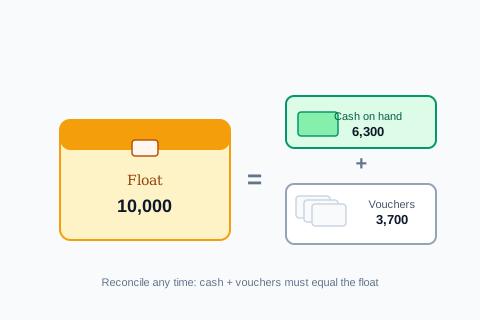
The proven method for petty cash is the imprest system, and its logic is elegant. You fix a float — say KES 10,000 — held by one custodian. Every disbursement is recorded with a voucher and, wherever possible, a receipt. At any moment, the cash remaining plus the vouchers spent must equal the fixed float. When the cash runs low, you reimburse exactly the total of the vouchers, restoring the float to its original amount. That single rule — cash on hand plus vouchers always equals the float — means the box can be reconciled in minutes and any shortfall is visible immediately, not at year-end.
The controls that make it hold
A petty cash system that stays honest
- A fixed float and a single named custodian responsible for it.
- A voucher for every disbursement — with date, amount, purpose, and recipient — plus a receipt where one exists.
- A per-transaction limit: anything above it goes through normal procurement, not petty cash.
- Cash plus vouchers reconciled to the float on a regular rhythm, and always before reimbursement.
- Reimbursement made only against the actual vouchers, so every top-up is backed by recorded spending.
- Vouchers coded to expense accounts, so petty cash spending appears in the books like any other cost.
The limit is the whole point
The most important and most ignored control is the per-transaction limit. Petty cash is for genuinely small, urgent items; the moment it becomes a way to buy meaningful things without approval, it has quietly become a hole in your procurement controls. A supplier payment split into several petty-cash disbursements to dodge an approval threshold is a classic red flag. Set a firm ceiling, and anything above it must go through a requisition — that one boundary keeps petty cash as the convenience it is meant to be rather than a bypass around every other control you have built.
Petty cash is a segregation-of-duties test in miniature
The same person should not hold the cash, approve the spending, and record it unchecked — that concentration is what makes leakage effortless. Even in a small organization, someone other than the custodian should periodically count the box against the vouchers. It takes minutes, and it is the single act that turns petty cash from a soft target into a controlled one. It is segregation of duties at its smallest and most practical scale.
Petty cash controls are humble, but they are a genuine test of whether an organization takes its money seriously, because they are where discipline is easiest to abandon. A business that runs a clean imprest system — floats fixed, vouchers complete, limits enforced, independently counted — almost always runs its larger finances well too. When petty-cash vouchers are captured in the same system as every other expense, coded and reconciled automatically, the smallest money gets the same honest treatment as the largest, which is exactly as it should be.
What AWRA OpsHub does today
- Petty cash floats — a box with a named custodian and a fixed imprest level, whose balance is its own ledger account, so the system holds “the box should contain KES 20,000”.
- Vouchers against the float, each posting the spend to the expense account it was coded to, and a top-up that shows exactly what brings the box back to its imprest level.
- Voucher approval by somebody other than its author, switchable, with vouchers awaiting approval counted against what the box can still pay out, so two vouchers cannot spend the same shilling.
- Staff advances issued to a person, from a bank account or straight from a float, retired against receipts with any balance returned or reimbursed.
- Expense records with a category, an expense account, a project, a payment method and a full audit trail — where a reimbursed spend belongs once it has left the box.
- A POS cash session with opening float, counted cash, expected cash, recorded cash drops and a variance — genuinely an imprest-style control, but it is for a till, not a petty cash box.
- Workflow rules on expenses, so a value threshold can notify someone or raise an approval task.
- Custom fields on expenses, if you want to carry a voucher number or a fund tag.
More we can add to your workspace
- A recorded box count against the float’s balance, so the independent count this page recommends is captured on the float rather than on a sheet beside it.
- An enforced per-voucher limit. A petty cash ceiling is a policy you police, not a rule the system applies.
- Approval that reaches money already spent outside the float. Petty cash vouchers can already wait for a second person, and whoever raised an expense can never approve it — but an expense recorded as already paid, outside a float, still goes straight to paid; gating that path too is being built.
The cheapest control on this whole page — one person requests, another releases — is a switch on the float: turn voucher approval on. Run the box as a float rather than as expenses recorded after the fact, so every shilling out is a voucher, every top-up restores the imprest level, and the per-voucher ceiling stays a policy your approver applies.
Anything above that you need, we can build for you
Everything listed above as something we can add describes what ships in the standard product today — it is a starting point, not a limit on what AWRA OpsHub can do for your organisation. Kenya's eTIMS integration and its maintained payroll engine are both in the product because clients needed them and commissioned them; neither appeared by itself, and the same door is open for whatever you just read about. One qualification so this is worth what it claims: a small number of things on this blog we deliberately leave to a specialist rather than build — a statutory ledger we will not sign our name to, a rule that would decide a tax question for you, a clinical or member-funds record that belongs in a regulated system — and where that is true the post says so in those words. Everything else is a scope, a timeline and a price.
The operational work, which is what most commissions actually are
An extra approval stage in a chain that does not match the standard one, a custom field set on employees or assets that only your sector needs, an expiry that has to block an order rather than send an email, a report your board asks for in a shape nothing produces, or a scanner or weighbridge feeding the goods-in door. These are the commissions we are asked for most often and the smallest ones we quote — and unlike a revenue-authority pipeline, none of them waits on a regulator.
The module-shaped additions, which are the ones readers ask for most often
A price list with real discount authority, a customer-facing quotation that expires, a bill of materials or recipe costing, a staff advance that is issued, acquitted and chased, a member or unit ledger, a matching rule that holds a payment. Each of these is a build rather than a setting, and each has been quoted before — a bigger piece of work than a custom field, with a written spec and a date instead of a roadmap slide.
The report, document or pack nothing currently produces
The board pack in the shape your board actually asks for, a donor or funder layout, an invoice or receipt template carrying what your regulator or your customer expects, a dataset the report builder cannot reach yet. Usually the fastest thing on this list to deliver, because the data is already in the system.
Systems, rails and hardware you already run
The accounting package, CRM, online store, core banking or custom database you intend to keep — connected through our API so a fact is entered once and appears everywhere it is needed. Plus the physical edge: a scanner, a scale, a weighbridge or a till peripheral feeding the door it belongs to.
How it works: you describe the requirement, we return a written scope, timeline and cost, and once agreed it is built into your environment and maintained as part of the product. Nothing here waits on a regulator or a published specification, which is why operational builds are the ones we quote fastest. Tell us the requirement that would otherwise rule us out — that is a better first conversation than a demo.
Tell us what your operation needsWhere the spend lands afterwards
Petty cash floats, vouchers with optional second-person approval, top-ups to the imprest level and staff advances — with every voucher posted to the books.
Explore financial governanceFrequently asked questions
What is the imprest system for petty cash?
It is a method where petty cash is held as a fixed float assigned to one custodian, every disbursement is recorded with a voucher, and at any moment the cash on hand plus the vouchers must equal the float. When cash runs low, you reimburse exactly the total of the vouchers to restore the original float — so the box reconciles in minutes and any shortfall is immediately visible.
What controls does petty cash need?
A fixed float and a single named custodian, a voucher (and receipt where possible) for every disbursement, a firm per-transaction limit, regular reconciliation of cash plus vouchers to the float, reimbursement only against actual vouchers, and vouchers coded to expense accounts. Crucially, someone other than the custodian should periodically count the box independently.
Why is a per-transaction limit on petty cash so important?
Because without it, petty cash becomes a way to buy meaningful items without approval — a hole in your procurement controls. A classic red flag is a larger payment split into several petty-cash disbursements to dodge an approval threshold. A firm ceiling forces anything above it through a requisition, keeping petty cash a convenience rather than a bypass.
How does petty cash relate to segregation of duties?
Petty cash is segregation of duties at its smallest scale: the same person should not hold the cash, approve spending, and record it unchecked, because that concentration makes leakage effortless. Having someone other than the custodian periodically count the box against the vouchers — a task of minutes — is what turns petty cash from a soft target into a controlled one.