
The E-Way Bill Is a Shipping Document Wearing a Tax Costume
It is filed with a tax authority, so it gets treated as a tax document. But its validity is measured in kilometres, it expires while the goods are still moving, and it goes wrong at a roadside rather than on a return.
Almost every document a business produces for a tax authority shares a set of properties. It is prepared after the fact, from records. It is checked by somebody in an office. If it is wrong, you find out weeks later, and the consequence is a correction, a penalty or an argument conducted entirely on paper.
The e-way bill has none of those properties, and treating it as though it does is how businesses end up with consignments detained on a highway at two in the morning.
It is prepared before the fact, from an intention. It is checked by somebody at the roadside. Its validity is calculated from distance rather than from a calendar. And if it is wrong, the consequence is physical: the goods stop moving.
Four properties no other compliance document has
| Property | Why it changes how you should handle it |
|---|---|
| It exists before the event | Every other document reports something that already happened. This one authorises something about to happen, which means it has to be produced by whoever is dispatching, at the moment of dispatch, not by finance at the end of the week |
| Its validity is a function of distance | You do not choose how long it lasts. The distance the consignment has to cover does. A long haul gets more time and a short one gets less, and neither is negotiable at the point somebody checks it |
| It can expire mid-journey | A breakdown, a closed road, a driver who stops for the night. The goods are still in transit and the document authorising the transit is no longer valid — a state no other tax document can enter |
| It is verified physically | By a person, at a checkpost, with the vehicle present. There is no correspondence, no clarification, and no next month |
It is filed with a tax authority and it behaves like a shipping document. Almost every failure comes from managing it as the first thing rather than the second.
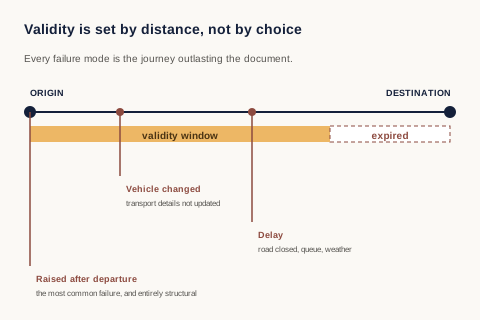
Where it actually goes wrong
In our experience the failures cluster into four patterns, and none of them is a misunderstanding of the rules. Everybody understands the rules. The rules are not the difficult part.
-
The goods left before the document existed
Not through carelessness — through sequencing. A customer needs it today, the truck is at the gate, the person who raises the documents is at lunch or in another branch or handling something else. The commercial pressure is immediate and the document is a step that happens afterwards. This is the single most common failure and it is entirely structural.
-
The vehicle changed and nobody updated it
Transhipment, a breakdown, a transporter who consolidates loads. The consignment is now on a different vehicle from the one named, which the person driving it may not know is a problem, and the person who does know is three hundred kilometres away.
-
The validity ran out while the goods were still moving
Weather, a strike, a closed road, a queue at a checkpost, or a distance estimate that was optimistic. The journey took longer than the window allowed. Nobody did anything wrong and the document is still invalid.
-
The details did not match the goods
Quantity, description, value, or a consignee address that changed after the order was taken. On paper these were minor discrepancies settled with a phone call. Against a document being verified against physical goods, they are a discrepancy on the spot.
The pattern underneath all four
Each one is a gap between a physical fact and a record of it. The goods left, and the record came later. The vehicle changed, and the record did not. The journey ran long, and the record assumed it would not. Every fix is the same fix: shorten the distance between the event and the record of it, and put the recording where the event happens rather than where the office is.
The bit that is genuinely operational
Consider what has to be true, physically, for a compliant dispatch to happen on time.
- Somebody at the loading bay knows what is going on the vehicle, in what quantity, before it leaves.
- That quantity matches what the invoice says, because the two documents will be compared against each other and against the goods.
- The consignee details are current, which means the customer or branch record was updated when the address changed rather than when somebody noticed.
- The transporter and vehicle are known at dispatch, and there is a way to update them if they change en route.
- Someone owns the journey — knows roughly how long it will take and whether that fits inside the window.
Not one of those is a tax capability. They are warehouse, master data and dispatch capabilities, and they are the actual prerequisites for the compliance step working. A business that has them finds e-way bills unremarkable. A business that does not finds them a recurring source of drama, and usually concludes it needs better compliance software.
Managed as a tax document
- Raised by finance or a back office.
- Produced from the invoice, after the invoice.
- Corrected when somebody reports a problem.
- Measured by whether returns reconcile.
- Fails at the roadside, in the middle of the night.
Managed as a dispatch document
- Raised at the point the goods are loaded.
- Produced from the movement, alongside the invoice.
- Updated when the vehicle or the route changes.
- Measured by whether consignments arrive without incident.
- Fails rarely, and visibly, before the truck leaves.
What a detention actually costs
This is worth pricing because the number people carry in their heads is usually the penalty, and the penalty is often the smallest part of it.
An illustrative detention — figures for shape rather than for planning
The statutory consequences of moving goods without a valid document are set out in law, vary with the circumstances, and are a question for your adviser rather than for this table — which is why no figure for them appears above. The point of the arithmetic is the rest of it. Even with the statutory amount excluded entirely, the incident costs several times what anybody assumes, most of it in transporter charges, staff time and a late delivery. And the item with no number against it is usually the expensive one: a customer who now schedules around the possibility that your consignments get stopped.
What to do about it, in order of return
Four questions for your own dispatch process
Who raises the e-way bill?
The answer you usually get
Accounts, or the back office.
What to press for instead
Ask whether that person is physically present when goods are loaded. If not, there is a gap between the loading and the document, and every failure in this article lives in that gap. The question is not who is qualified to raise it — it is who is present.
What happens when a vehicle changes en route?
The answer you usually get
The transporter tells us.
What to press for instead
Ask how, and how quickly, and who acts on it out of hours. A process that depends on a phone call reaching an office during working hours is not a process for something that happens at night on a highway.
How many consignments were stopped last year?
The answer you usually get
One or two, nothing serious.
What to press for instead
Ask for the total cost of those one or two, including transporter charges, staff time and any late-delivery consequence. It is almost always several times what people remember, because the parts get recorded in different places.
Do the invoice and the e-way bill always agree?
The answer you usually get
They are generated from the same data.
What to press for instead
Ask what happens when the quantity loaded differs from the quantity ordered — a short pick, a damaged carton, a partial delivery. If the answer involves anybody amending a document after the vehicle has left, that is the discrepancy that gets found at a checkpost.
What AWRA OpsHub does today
- Dispatch recorded at the point goods leave, on a device at the bay if that is where the work happens
- Quantities picked and confirmed against the order before dispatch
- One current record per customer and per branch, with addresses on the record
- Transfers that stay open until the receiving end confirms what arrived
- In-transit stock as an owned, dated, visible position
More we can add to your workspace
- E-way bill generation, cancellation or Part-B vehicle updates
- Validity tracking or expiry alerts against a live consignment
- A connection to an invoice registration portal, and an IRN generation
- Transporter or fleet management, and no vehicle tracking
- GST returns of any kind
What we can build for India on top of the standard product
Everything listed above as something we can add describes what ships in the standard product today — it is a starting point for India, not a limit on what AWRA OpsHub can do there. Kenya's eTIMS integration and its maintained payroll engine are in the product because Kenyan clients needed them and commissioned them; neither appeared by itself. The same door is open here. If an IRP connection, e-way bills, an Indian payroll engine, a bank or mobile money feed, a statutory return format, a rule specific to how your operation runs, or a link to a system you already have is what stands between you and a decision, tell us and we will scope it as a build — written spec, timeline and price — before you commit to anything.
IRP registration, IRNs and e-way bills
Invoice registration against the IRP with the IRN and signed QR returned onto the document, e-way bill generation and cancellation for goods in movement, and the thirty-day reporting clock watched rather than discovered. Read the honest version first: this is the single most crowded build on this list. Tally, Zoho, Busy and a dozen others already do it, at a price we cannot approach, with a chartered accountant who already knows your ledger. We would build it to sit under an operations layer you had already chosen us for, not to win a GST comparison.
UPI, NEFT and bank feeds
UPI collection with automatic settlement against the invoice, NEFT and RTGS payment files, and bank statement feeds wired into the Payments Register so money in and out reconciles without re-keying.
The operational work, which is what most commissions actually are
An extra approval stage in a chain that does not match the standard one, a custom field set on employees or assets that only your sector needs, an expiry that has to block an order rather than send an email, a report your board asks for in a shape nothing produces, or a scanner or weighbridge feeding the goods-in door. These are the commissions we are asked for most often and the smallest ones we quote — and unlike a revenue-authority pipeline, none of them waits on a regulator.
Payroll and statutory returns
Provident fund, ESI, professional tax by state and TDS on salary, computed on live records and produced in the return layouts each body expects. This is a serious statutory build with per-state variation, and it is a genuine reason to keep an Indian payroll provider rather than move payroll to us.
Systems you already run
The accounting package, CRM, online store or custom database you intend to keep — connected through our API so a fact is entered once and appears everywhere it is needed.
How it works: you describe the requirement, we return a written scope, timeline and cost, and once agreed it is built into your environment and maintained as part of the product. No roadmap slide, and no pretending in a demo that something exists when it does not.
Tell us what you need integratedOur take
Buy your e-way bill generation from an Indian compliance provider — that market is competitive, cheap and good, and we do not compete in it. But do not expect the purchase to fix a dispatch process, because the document is only as timely and as accurate as the loading event it describes. The businesses we see having a quiet time with this are not the ones with the best compliance software. They are the ones where the person loading the truck records what went on it, at the moment it went on, and everything downstream is generated from that.
The loading bay, not the back office
We do not generate e-way bills. We do record the dispatch where it happens, confirm the quantity against the order, and keep the consignee record current — which is what the document is only as good as.
Talk to us about IndiaFrequently asked questions
How long is an e-way bill valid?
Validity is calculated from the distance the consignment has to cover rather than chosen by the person raising it, with different treatment for over-dimensional cargo. The operationally important consequence is that you cannot buy yourself margin by requesting a longer window — if the journey runs over, the document expires while the goods are still moving. Provisions exist for extending validity in defined circumstances, and the current rules and any state-specific variation should come from your adviser or the portal rather than from this article.
What happens if the vehicle changes during the journey?
The transport details on the document need updating so that the vehicle carrying the goods is the vehicle named. This sounds trivial and is the second most common failure we see, because vehicle changes happen for operational reasons — a breakdown, a transhipment, a transporter consolidating loads — at times and places where nobody is thinking about documentation. The fix is procedural rather than technical: somebody has to own it, out of hours, and the transporter has to know who that is.
Is an e-way bill needed for stock moving between our own warehouses?
The requirement generally attaches to the movement of goods above the threshold value rather than to whether a sale took place, so internal movements are typically included. This surprises businesses that think of the requirement as something attached to selling. It is attached to moving. Intrastate thresholds and exemptions vary by state, so confirm the position for the states you actually operate in.
Can we just raise them all in advance?
Raising a document before the goods are ready trades one failure mode for another: the validity clock starts, and if the dispatch slips you have a document that expires before the journey begins. It also increases the chance that the quantity finally loaded differs from the quantity on the document, which is the discrepancy most likely to be found at a checkpost. The reliable pattern is not earlier — it is closer. Raise it from the loading event, at the loading event.
Does AWRA generate e-way bills?
No. We do not create, cancel or update them, we do not track validity, and we have no connection to the portal. India has an excellent and inexpensive market for that capability and buying it there is the right decision. What we build is the layer the document depends on: the dispatch recorded where it happens, the quantity confirmed against the order, the consignee record kept current in one place, and the arrival confirmed at the far end.
What is the cheapest improvement we could make?
Move the recording of the dispatch to the loading bay, whatever tool you use to do it. Almost every failure in this article is a gap between goods physically leaving and a record existing, and every one of those gaps narrows when the record is created by the person watching the goods go. It is not a software decision in the first instance; it is a decision about who is responsible at the moment the truck is loaded.
