
Buying Operations Software in the Philippines: A Straight Guide
One question decides your shortlist before any demonstration does, and most buyers ask it last. It is not about features, price or the deadline.
Most buying guides start with requirements. This one starts with a threshold question, because in the Philippines there is one that can eliminate a vendor entirely regardless of how well they scored on everything else — and asking it in week eight rather than week one is a well-worn way to waste a quarter.
The question is whether your compliance position requires a BIR-accredited computerised accounting system as your book of record.
It is a yes-or-no question for your accountant. It is not a feature comparison and no amount of operational capability substitutes for it. We are not accredited and do not hold a permit to use, so for some readers this guide ends at the next heading — and it is much better for that to happen now than after a procurement process.
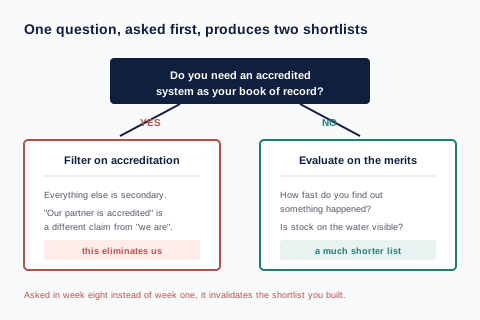
The threshold question, and what follows from each answer
Yes — you need an accredited system as your book of record
Filter the shortlist on accreditation first
Everything else is secondary. Ask each vendor for their accreditation status directly and in writing, and be aware that "our partner is accredited" is a different claim from "we are". This eliminates us, and we would rather say that in the third paragraph than in the third month.
No — or your accredited system of record is already in place
Now you can evaluate on the merits
The interesting questions become operational: how quickly do you find out about a sale, is in-transit stock visible, do approvals actually block, and does landed cost reach the unit cost. That is a genuinely different shortlist and a much less crowded one.
You do not know
Stop and find out, before anything else
One conversation with your accountant, this week. It is the cheapest step in this entire guide and it determines which of the two shortlists above you are building. Buyers who skip it usually discover the answer during implementation.
Then: which layer are you actually buying?
Assuming you are past the threshold question, the same separation applies here as in every market going through a mandate.
The compliance layer
- Structured transmission to the Bureau, inside the window.
- Acknowledgements, failure queues and retries.
- Withholding at source and the certificates that come from it.
- SSS, PhilHealth, Pag-IBIG and withholding tax.
- Thirteenth-month pay, computed and settled.
The operations layer
- Capture at the event, including where there is no network.
- In-transit stock as an owned position rather than a gap.
- Branches as distinct positions with their own approvals.
- Receipts matched against orders before an invoice is approved.
- Landed cost reaching the unit cost you price against.
The dependency runs one way. Transmission can only send what capture produced, and in a business with field staff and provincial branches the capture step consumes most of the reporting window before anything reaches a system at all.
The questions that separate vendors here
Six questions, and what a vague answer tells you
Are you an accredited computerised accounting system?
The answer you often get
We work with accredited partners.
What to press for instead
That is a different claim. Ask whether the vendor itself holds accreditation and a permit to use, in writing. If your position requires it, a partner's accreditation may or may not solve your problem, and your accountant is the person who knows which.
How does it work with no connection?
The answer you often get
It is cloud based, it works anywhere.
What to press for instead
Cloud-based means it needs a connection, which is the opposite of the answer. Ask them to put a device in aeroplane mode, record a delivery, and reconnect — in the meeting. Watch what happens to a conflicting change made on the server meanwhile.
Where does in-transit stock appear?
The answer you often get
Transfers are supported.
What to press for instead
Ask to see the group stock value while goods are between two locations. If the total drops when a transfer is dispatched and rises when it is received, in-transit is a gap rather than a position, and every reorder decision is made against an understated figure.
What happens when a transfer arrives short?
The answer you often get
You adjust the receiving location.
What to press for instead
An adjustment at the receiving end hides the shortage in that branch's variance. Ask whether the shortfall is recorded against the dispatch, on the lane, with the carrier — because that is what turns shrinkage into a claim.
Can approvals block a purchase?
The answer you often get
Yes, there is a workflow.
What to press for instead
Ask what happens when the approver is unreachable — which in a business spread across provinces is a Tuesday rather than an edge case. If it proceeds with a notification, it is a warning, and it will be routed around within a month.
What do you not do?
The answer you often get
A pause, then a roadmap item.
What to press for instead
The most diagnostic question in the set. A vendor who names three real gaps immediately has thought about their boundary. One who cannot has one anyway, and you will meet it during implementation.
Scoring the shortlist
Six criteria for a Philippine buyer with distributed operations
Score out of five. Accreditation is not on this list because it is not a criterion — it is a filter, and it belongs before the list rather than in it.
Offline capture that actually works
Make them prove it: Aeroplane mode, record a delivery, reconnect, and show me a conflict being surfaced.
In-transit as a position
Make them prove it: Show me the group stock value while a transfer is on the water.
Shortages attributed to a leg
Make them prove it: Dispatch ten, receive eight, and show me where the difference lives.
Approvals that refuse
Make them prove it: Raise a purchase order above the limit while the approver is unreachable.
Landed cost
Make them prove it: A shipping invoice arriving three weeks late, covering four consignments.
Stated boundary
Make them prove it: Name three things you do not do that a business like ours often needs.
On thirteenth-month pay, which nobody puts in a software evaluation
It is a statutory entitlement that accrues through the year and settles in December, and the common failure is treating it as a December event rather than a monthly cost. That distorts monthly margins upward for eleven months and produces a cash requirement that arrives with the holidays. Whatever you buy, make sure somebody is accruing it and attributing it to the work that generated it. We do not compute it — our payroll engine covers Kenya only — but we do attribute payroll cost to projects and cost centres, which is what makes an accrual rate useful once your provider has produced one.
Where we fit
Offline capture on mobile
Deliveries, receipts, counts, scans and expenses recorded on the device with no connection and reconciled when one returns, with conflicts surfaced rather than resolved silently.
In-transit stock as an owned position
Goods between locations are dated, owned and visible, with expected arrivals that can be revised when a sailing is cancelled.
Branches as distinct positions
Every warehouse, branch and site store with its own stock, approvals and numbers, rolled up centrally rather than averaged.
Matching, approvals and landed cost
Three-way matching before invoice approval, thresholds that refuse, and shipping and duty reaching the unit cost.
Working week, holidays and delegation
Configured per organization rather than assumed, including per-branch approval limits and delegates.
Your accreditation and classification position
Whether you need an accredited system of record, and where you sit in the electronic invoicing programme. Your accountant, and it comes first.
BIR EIS transmission
No structured submission, no acknowledgements, no retry queue. Buy this from a Philippine provider or use the system you already file from.
Accreditation as a computerised accounting system
We are not accredited and hold no permit to use. For some buyers this is decisive and it should be established first.
Philippine statutory payroll
No SSS, PhilHealth, Pag-IBIG, withholding tax, thirteenth-month computation or withholding certificates.
Local presence
No office, no implementation partner, and a five-hour time difference in which your morning does not overlap us at all.
What AWRA OpsHub does today
- Offline capture on mobile, reconciled on reconnect with conflicts surfaced
- In-transit stock owned, dated and visible
- Multi-branch stock with governed transfers and blind counts
- Three-way matching and procurement approvals that refuse
- Landed cost on the consignment, including inter-island shipping and demurrage
- The peso as a base currency preset
More we can add to your workspace
- BIR EIS transmission of any kind
- Accreditation as a computerised accounting system, and no permit to use
- SSS, PhilHealth, Pag-IBIG, withholding tax and thirteenth-month accrual
- Withholding tax certificate production
- A Filipino-language interface, a local office or a local implementation partner
What we can build for the Philippines on top of the standard product
Everything listed above as something we can add describes what ships in the standard product today — it is a starting point for the Philippines, not a limit on what AWRA OpsHub can do there. Kenya's eTIMS integration and its maintained payroll engine are in the product because Kenyan clients needed them and commissioned them; neither appeared by itself. The same door is open here. If a BIR EIS connection, a Philippine payroll engine, a bank or mobile money feed, a statutory return format, a rule specific to how your operation runs, or a link to a system you already have is what stands between you and a decision, tell us and we will scope it as a build — written spec, timeline and price — before you commit to anything.
BIR EIS transmission
Structured JSON transmission to the BIR Electronic Invoicing System inside the reporting window, with the retries, the failure queue and the daily report of sales that never reached the platform — which is the part that actually decides whether you are compliant, and the part vendors describe least. Withholding at source handled on the purchase side, where the certificates come from.
InstaPay, PESONet and bank feeds
InstaPay and PESONet collection matched to the invoice, e-wallet settlement reconciled rather than exported, and bank statement feeds wired into the Payments Register.
The operational work, which is what most commissions actually are
An extra approval stage in a chain that does not match the standard one, a custom field set on employees or assets that only your sector needs, an expiry that has to block an order rather than send an email, a report your board asks for in a shape nothing produces, or a scanner or weighbridge feeding the goods-in door. These are the commissions we are asked for most often and the smallest ones we quote — and unlike a revenue-authority pipeline, none of them waits on a regulator.
Payroll and statutory returns
SSS, PhilHealth, Pag-IBIG and withholding tax computed on live records, with the contribution and remittance files produced in the layout each agency expects, and thirteenth-month pay accrued through the year rather than found in December.
Systems you already run
The accounting package, CRM, online store or custom database you intend to keep — connected through our API so a fact is entered once and appears everywhere it is needed.
How it works: you describe the requirement, we return a written scope, timeline and cost, and once agreed it is built into your environment and maintained as part of the product. No roadmap slide, and no pretending in a demo that something exists when it does not.
Tell us what you need integratedOur take
Ask the accreditation question first. It is one conversation with your accountant, it costs nothing, and it determines which shortlist you are building rather than how vendors rank within one. After that, the useful evaluation in this market is not about compliance features — it is about how quickly you find out that something happened at a site with no signal, and whether stock on the water is in anybody's figures. Those two questions separate vendors far more sharply than a feature matrix will, and they are also the two that predict whether you will be happy in two years.
If you are past the threshold question
Offline capture, in-transit stock that is actually visible, branches as real positions, and [landed cost](/glossary/landed-cost) on the consignment. The operational layer, not the compliance one.
Talk to us about the PhilippinesFrequently asked questions
What is a BIR-accredited computerised accounting system?
It is a regulatory concept covering systems used as a book of record, with accreditation and a permit to use attached to it. Whether your business requires one, and in what configuration, depends on your circumstances and is a question for your accountant rather than for a vendor. We raise it first because it is a filter rather than a criterion — it can eliminate a vendor outright regardless of how well they perform on everything else, and we are not accredited.
Can we use a non-accredited system alongside an accredited one?
Many businesses run an operations layer alongside their book of record, and that is the shape in which we would typically sit — the operational system knows what physically happened, the accredited system holds the accounts. Whether that arrangement satisfies your specific obligations is squarely an accountant's question and the answer varies with circumstances. Establish it before you evaluate rather than assuming it, because the assumption is the expensive part.
How much should we budget?
Price the whole thing rather than the licence: software, implementation, migration, the internal person who will own it, and the productivity cost of running two ways of working for a period. For a distributed business the implementation is the larger number and the biggest driver is decisions rather than configuration — what a branch is, who approves what, how items are coded. Ask for implementation to be quoted separately, specifically, with a named implementer.
Should we start with head office or the branches?
Start where the pain is measurable and where a win will be visible, which in most distributed businesses is one or two branches rather than the centre. Branch staff are the ones whose working day changes; if the first group has a good experience, the rest is much easier, and if they do not, no amount of head-office enthusiasm will rescue it. Pick a branch with poor connectivity rather than a good one, because that is the real test and you want to fail it early if you are going to.
Do you have Philippine customers?
Not yet. Our operating history is East and Southern Africa, where the conditions we build for — intermittent connectivity, distributed sites, imported goods with real landed cost, high asset mobility — are the everyday case. Those conditions transfer to a Philippine distribution business more directly than most software written for compact markets does. A local reference story does not transfer, and if your board requires one that is a legitimate reason to choose somebody else.
What is the one thing to do this week?
Two things, and both are free. Ask your accountant the accreditation question, and time one transaction end to end from a site with poor coverage on a bad day. The first tells you which shortlist you are building. The second tells you whether your reporting problem is about transmission or about capture — and in our experience it is almost always capture, which changes what you should be shopping for entirely.
