
The Largest Number in Your Accounts That Is Not in Your Accounts
It accrues from month one, it has two values depending on how the employee leaves, and no filing deadline anywhere obliges you to look at it. For most Kuwaiti businesses it is the largest number in the accounts that is not in the accounts.
Most financial disciplines exist because something forces them. A VAT return forces you to classify your sales. A payroll deadline forces you to run the numbers monthly. An audit forces a stocktake. Take away the forcing function and the discipline does not usually survive on merit — not because anybody is negligent, but because there is always something with a date on it competing for the same attention.
End-of-service indemnity in Kuwait has no forcing function at all. It accrues from the first month of service and is settled at the last, and in between there is no return to file, no authority to notify and no deadline of any kind. So in a great many businesses it is not carried as a liability — it is calculated when somebody resigns.
This is not tax or legal advice. The calculation, the reductions and their conditions are set in the labour law, they vary with length of service and contract type, and your adviser or payroll provider is the right source for your own figures. Everything below is illustrative and says so.
How it builds, and why year six matters
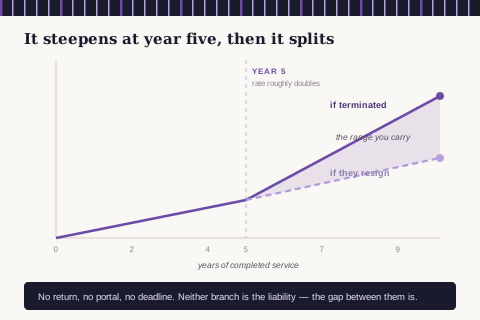
Broadly, the entitlement is half a month's pay for each of the first five years of service and a full month for each year after that, computed on a twenty-six-day divisor, with an overall cap at eighteen months' pay. Two things follow from that shape and both are easy to miss.
- The cost per employee-year roughly doubles after year five. A workforce with average tenure of four and a half years is accruing at a very different rate from one averaging six, and the transition is not gradual — it is a step.
- The cap is high enough not to bind for most people and low enough to matter for a few. Eighteen months is reached deep into a long career, which means your very longest-serving staff are the only ones where the liability stops growing.
Everything else in your accounts has a deadline attached. This is the one thing that will wait indefinitely, and it grows the whole time it is waiting.
The part that makes it genuinely hard: it has two values
Here is what separates this from an ordinary accrual. A termination and a resignation are not computed the same way — a resignation is reduced by a fraction that depends on how long the person has served. So the liability behind any given contract is not a number. It is a range, and which end applies depends on a decision that has not been made yet and may be made by the other party.
That means a single accrued figure is always either optimistic or pessimistic, and which one it is depends on how your workforce happens to turn over. The useful version carries both ends.
An illustrative workforce — figures for shape, not for filing
Two caveats and then the point. The reduction fraction used here is illustrative — the statutory fractions vary with length of service and are in the law, so get yours from your adviser rather than from this table. And "basic pay" is doing work in that calculation; what counts towards the entitlement is defined and is not always what a payroll spreadsheet calls basic. Now the point: the range is ninety-four thousand dinars wide, and no single number you write down is correct. It is a distribution, and the position within it is decided by other people's decisions.
How it goes wrong, in order
Nothing dramatic, which is the recurring theme of every unmeasured thing.
-
It is calculated at settlement, because that is when it is needed
Somebody resigns, the payroll provider computes the figure, it is paid. The process works perfectly. What it never produces is a running total, because nobody asked for one.
-
Project pricing does not include it
This is the expensive consequence and it is almost universal. A three-year project is priced with salary as the labour cost. The indemnity accruing against the people on it is real, is caused by that project, and appears in no job costing anywhere. Your margin on long projects is overstated by a consistent amount that nobody has ever measured.
-
Tenure creeps past year five without anybody modelling it
The accrual rate doubles. Nothing in the monthly reporting changes, because the accrual was not in the monthly reporting.
-
Several people leave in the same quarter
A restructure, a project wind-down, a bad year. The settlements land together as an unbudgeted cash event, and it is a cash event rather than a P&L one, which is what makes it dangerous for a business with ordinary working capital.
-
The number is finally produced, under pressure
Usually for a lender, a buyer or an auditor. It takes a week, it is contested internally, and the range turns out to be wider than anybody expected — which is the moment the two-values problem becomes concrete rather than theoretical.
The project costing point, restated because it is the one worth acting on
If you price multi-year work, indemnity accruing against the staff on that work is a cost of that work. Treating it as a corporate overhead — or as nothing at all until settlement — systematically overstates the margin on exactly the long engagements you most want to price correctly. This costs nothing to fix in principle: it is an accrual rate applied to attributed labour. It is only hard because the accrual is not being calculated in the first place.
What to actually do
None of this requires new software and most of it is a conversation with whoever already runs your payroll.
Five things, in order of return
- Ask your payroll provider for the total accrued entitlement at both values, today. If it takes more than a week to produce, that is itself the finding.
- Get a list of who crosses the five-year threshold in the next twelve months, and what that does to the monthly accrual rate.
- Decide whether the accrual is carried monthly rather than computed annually. Monthly is not much more work once the first one exists, and it is the difference between a trend and a surprise.
- Attribute the accrual to projects and cost centres the same way you attribute salary, so long engagements carry their real labour cost.
- Model the cash requirement if a quarter of your longest-serving staff left in one quarter. Not because it is likely — because it is the scenario nobody has priced.
What AWRA OpsHub does today
- Employee records, contracts and documents with expiry dates watched
- Leave with balances and approval
- Payroll cost attributed to projects, cost centres and departments
- Asset and tool custody with a named holder, which matters for the same reason
More we can add to your workspace
- End-of-service indemnity calculation, at either value
- Monthly accrual of the entitlement against live employee records
- Public Institution for Social Security contributions
- Wage protection files or Kuwaitisation tracking
- A statutory payroll engine outside Kenya
What we can build for Kuwait on top of the standard product
Everything listed above as something we can add describes what ships in the standard product today — it is a starting point for Kuwait, not a limit on what AWRA OpsHub can do there. Kenya's eTIMS integration and its maintained payroll engine are in the product because Kenyan clients needed them and commissioned them; neither appeared by itself. The same door is open here. If indemnity accrued on live records, an Arabic interface, a bank or mobile money feed, a statutory return format, a rule specific to how your operation runs, or a link to a system you already have is what stands between you and a decision, tell us and we will scope it as a build — written spec, timeline and price — before you commit to anything.
A VAT build if Kuwait legislates one
There is no value added tax in Kuwait and no electronic invoicing programme, so there is nothing to integrate with and we are not going to invent a roadmap item. If a law is enacted, this becomes an ordinary build against the published specification. It is listed here for completeness rather than because it is the thing you should be buying for.
Arabic interface, banks and acquirers
Arabic interface text with right-to-left layout and bilingual document templates, plus bank statement feeds and card acquirer settlements wired into the Payments Register.
The operational work, which is what most commissions actually are
An extra approval stage in a chain that does not match the standard one, a custom field set on employees or assets that only your sector needs, an expiry that has to block an order rather than send an email, a report your board asks for in a shape nothing produces, or a scanner or weighbridge feeding the goods-in door. These are the commissions we are asked for most often and the smallest ones we quote — and unlike a revenue-authority pipeline, none of them waits on a regulator.
Payroll and statutory returns
The build that actually matters here: end-of-service indemnity accrued month by month on live employee records under the Kuwaiti calculation — half a month per year for the first five and a full month per year after, on a twenty-six-day divisor, capped at eighteen months — held at both its termination and its resignation value, alongside Public Institution for Social Security contributions for the nationals they apply to and a Kuwaitisation position that is visible before a deadline.
Systems you already run
The accounting package, CRM, online store or custom database you intend to keep — connected through our API so a fact is entered once and appears everywhere it is needed.
How it works: you describe the requirement, we return a written scope, timeline and cost, and once agreed it is built into your environment and maintained as part of the product. No roadmap slide, and no pretending in a demo that something exists when it does not.
Tell us what you need integratedWe have written an entire piece arguing that this is the largest unmeasured number in a Kuwaiti business and then told you we do not measure it. That is deliberate. The measurement belongs with a Kuwaiti payroll provider who does it every month and knows what counts towards the entitlement under a given contract type. What we can do is the adjacent half — hold the employee records it is computed from, and attribute labour cost to the projects that consumed it, so that when you do have an accrual rate there is something to apply it to.
Our take
Ask for the number. That is the whole recommendation. Most operators we have this conversation with have never seen a total accrued indemnity figure, and are surprised by it in both directions — surprised by the size, and surprised by how wide the range is once resignation and termination are separated. It costs one email to your payroll provider and it changes how you price long projects. There is no deadline that will ever make you do it, which is exactly why it is worth putting in a calendar.
The half we can help with
We do not compute the indemnity. We do attribute payroll cost to the projects that consumed the labour, which is what makes an accrual rate useful once you have one — and we hold plant and tools under named custody, which matters for the same turnover reason.
Talk to us about KuwaitFrequently asked questions
How is end-of-service indemnity calculated in Kuwait?
Broadly, half a month's pay for each of the first five years of service and a full month for each year thereafter, computed using a twenty-six-day divisor for the daily rate, subject to an overall cap of eighteen months' pay. A resignation is reduced by a fraction that depends on length of service, while a termination that is not for gross misconduct is generally settled in full. The precise fractions, the conditions and the definition of qualifying pay are in the labour law and vary with contract type — this is a summary for orientation, not a calculation you should file anything on. Get your own figures from your payroll provider or legal adviser.
Does it apply to expatriate employees?
Yes, and that is much of why it matters so much in Kuwait specifically. Social security contributions apply to Kuwaiti nationals and in some circumstances other GCC nationals, with expatriates generally outside the scheme — but end-of-service entitlement is a labour-law entitlement rather than a social security one. In a private-sector workforce that is overwhelmingly expatriate, that makes indemnity the dominant statutory employment liability rather than a secondary one.
Should it be accrued monthly?
That is an accounting policy question for your auditor, and the answer under most frameworks is that a liability that has been incurred should be recognised. The practical argument is separate from the technical one: an annual calculation tells you a number, and a monthly accrual tells you a trend — including the step change when a cohort passes five years of service. The first one is much more work than the ones after it, which is the usual reason it never starts.
How does this affect project pricing?
It is the most actionable consequence in this piece. If you price multi-year work using salary as the labour cost, you are omitting an entitlement that is genuinely caused by that work and will genuinely be paid. The effect is systematic rather than random: it always overstates margin, and it overstates it most on your longest engagements. Attributing the accrual to projects the same way you attribute salary fixes it, and the only prerequisite is having an accrual rate at all.
Does AWRA calculate or accrue it?
No to both, and it is the largest single gap we publish on any market page. We do not compute the entitlement, hold it at both values, or accrue it against live employee records. Keep it with a Kuwaiti payroll provider. What we hold is the employee record behind it and the payroll cost attribution that makes an accrual rate useful once somebody else has produced one.
Is this the same across the Gulf?
The concept is broadly shared — most of the region has an end-of-service entitlement of some form — but the calculations, the reductions on resignation, the caps and the definitions of qualifying pay differ by country, and so does the significance. Do not read a Kuwaiti calculation across to another market, and be wary of any vendor or adviser offering a single "GCC gratuity" module without saying which country's rules it implements.
