Lead Time & Its Hidden Cost in Inventory
Lead time is the gap between ordering and having stock on the shelf — and almost every stockout, every bloated safety buffer, and every emergency order traces back to misjudging it. Here is what it really costs and how to tame it.
Lead time is deceptively simple to define and expensive to get wrong: it is the time between placing an order and the goods being available to use or sell. Every inventory decision you make secretly runs on an assumption about it. Reorder too late relative to lead time and you stock out; carry a buffer sized for a lead time longer than reality and you tie up cash in stock you did not need. Most inventory pain is not a demand problem — it is a lead-time problem wearing a disguise.
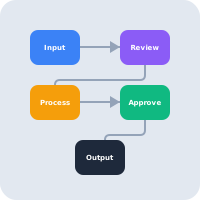
Lead time is longer than you think
Teams tend to remember only the supplier's quoted delivery time and forget the delays on either side. Real, end-to-end lead time is a chain:
- Internal ordering time — from realizing you need stock to actually issuing the purchase order: requisition, approval, sourcing.
- Supplier processing time — how long the supplier takes to prepare and dispatch, which is not the same as their marketing "delivery in X days."
- Transit time — shipping, and for imports, the often unpredictable clearing and transport leg.
- Receiving time — inspection, goods-received checks, and put-away before the stock is genuinely available to sell.
The stockout-causing mistake is planning around one link — usually the supplier's quote — while the other three quietly add days. For imported goods in Kenya, the clearing leg alone can dwarf the quoted supplier time and swing week to week.
The hidden costs of getting it wrong
| Lead-time error | What it costs you |
|---|---|
| Underestimated lead time | Stockouts, lost sales, emergency orders at premium prices, expedited freight |
| Overestimated lead time | Excess safety stock, cash tied up, storage cost, obsolescence risk |
| Ignoring lead-time variability | Either frequent stockouts or a permanently oversized buffer — you pay for the uncertainty |
| No internal-ordering visibility | Approvals sit for days; the "supplier delay" was actually your own process |
It is the variability, not just the length, that hurts
A long but perfectly reliable lead time is easy to plan for — you simply reorder that far in advance. The real enemy is variability: a supplier who takes 10 days one order and 25 the next forces you to hold safety stock sized for the worst case, all the time. This is exactly why lead time sits at the heart of reorder points and safety stock — the buffer you carry is really a buffer against lead-time uncertainty, and the more erratic your suppliers, the more cash that uncertainty costs you to hold.
Measure it, do not guess it
The single highest-return move is to record actual lead times: the date each PO was issued against the date the goods were genuinely available. Within a few months you have real average and variability figures per supplier per item — and those replace the optimistic guesses that quietly drive both your stockouts and your overstocking.

Once lead time is measured rather than assumed, it improves everything downstream. Reorder points become accurate, safety stock shrinks to what the variability actually justifies, and supplier reliability becomes a metric you can put in a negotiation. Persistently erratic suppliers reveal themselves in the data, and the cost of their unpredictability — the extra buffer you carry on their account — becomes visible and chargeable against the relationship. Lead time stops being an excuse and becomes a lever.
Once you have real lead times, they feed straight into the trigger: the reorder point calculator and safety stock calculator will size both from them, and stock control in Kenya covers the wider control set.
Turn lead time into data
Track actual order-to-availability times per supplier and item, so reorder points and buffers rest on evidence instead of optimism.
Explore procurementFrequently asked questions
What is lead time in inventory management?
It is the total time between placing an order and the goods being available to use or sell. Crucially it is end-to-end — internal ordering and approval time, supplier processing, transit and clearing, and receiving — not just the supplier's quoted delivery figure, which is usually only one link in the chain.
Why does lead time affect my inventory costs so much?
Because every reorder decision depends on it. Underestimate lead time and you stock out and pay for emergency orders; overestimate it and you carry excess safety stock that ties up cash. And lead-time variability forces you to hold a buffer sized for the worst case at all times, so unreliable suppliers cost you continuously.
How do I reduce lead time?
Attack the whole chain, not just the supplier: speed up internal approvals so requisitions do not sit for days, choose suppliers on measured reliability rather than quoted speed, and for imports plan realistically around clearing. Reducing variability often matters more than reducing the average, because it lets you shrink safety stock.
Should I track lead time per supplier?
Yes — per supplier and ideally per item. Recording the date each PO was issued against the date the goods became available gives you real average and variability figures, which replace optimistic guesses in your reorder calculations and turn supplier reliability into a number you can negotiate with.