Stock Control in Kenya: The Six Controls That Stop the Leak
Stock is where most Kenyan businesses keep the largest share of their working capital and the smallest share of their attention. The six controls that account for nearly all recoverable loss, in the order they pay for themselves.
Almost every Kenyan business that sells physical goods has more money sitting on its shelves than in its bank account, and almost none of them know that number to within ten per cent on any given Tuesday. That gap is not carelessness — it is what happens when stock is counted once a year, moved on trust, and recorded in a system that finds out about it afterwards.
This guide is the Kenya-wide version of the stock discipline that runs through most of the sector guides on this blog. It is deliberately ordered: the controls are listed in the sequence that pays back fastest, because businesses that install them out of order usually stall on the third one and conclude the exercise did not work.
What "shrinkage" actually is
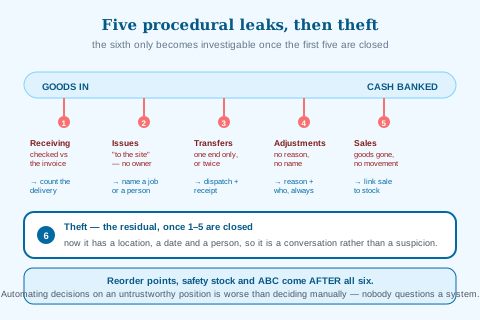
Owners tend to assume unexplained stock loss is theft. Sometimes it is. More often it is five separate problems that produce an identical symptom, and treating all five as a security matter is why the number never improves.
| Cause | What it looks like | What actually fixes it |
|---|---|---|
| Receiving errors | Goods checked against the invoice rather than counted | Receive against the physical delivery; raise a variance at the door |
| Untracked issues | Stock leaves for "the site" or "the branch" with no destination | Every issue names a location, a job or a person |
| Transfer gaps | Recorded at one end only, or twice | Dispatch and receipt as two events, with in-transit owned by neither |
| Adjustments without reasons | Somebody corrects the count to match reality | Reasons and names on every adjustment — see stock adjustments |
| Sales that never moved stock | Goods gone, no transaction recorded | Structurally link every sale to a stock movement |
| Actual theft | The residual once the five above are closed | Now investigable, because it has a location and a person |
That last row is the point of the whole exercise. You cannot investigate theft inside a system that produces unexplained variances for four other reasons — every finding has an innocent explanation available. Close the first five and the remainder becomes a specific question about a specific person on a specific day, which is a conversation you can actually have. The retail-specific anatomy is in how to stop stock shrinkage.
You cannot investigate theft in a system that leaks for four other reasons. Every accusation has an innocent explanation available — which is why closing the boring controls first is what makes the serious ones possible.
The six controls, in payback order
-
Count everything once, properly
A real physical count per location, reconciled and signed off by someone accountable. Every number for the next year is measured from this line, so a soft baseline quietly corrupts twelve months of reporting. This is the step everyone wants to skip.
-
Link every sale to a stock movement
No batch updates at close of business, no exceptions for a rushed order. The moment a sale can happen without inventory moving, your position starts drifting and nobody can say when it began.
-
Receive against the delivery, not the invoice
Count what physically arrived, record the variance at the door, and let the supplier know while the driver is still there. Receiving against the invoice is the most common expensive shortcut in Kenyan stock control.
-
Govern transfers with dispatch and receipt
Two events, two people, in-transit stock belonging to neither location. This ends most of the arguments between warehouse and branch and stops phantom stock being promised to customers.
-
Require a reason on every adjustment
An adjustment with a reason and a name is data about a process; an anonymous correction is a hole in the audit trail. This costs nothing and is skipped almost universally.
-
Cycle count instead of waiting for the annual stocktake
A slice of the warehouse continuously rather than shutting down once a year. The annual ritual finds problems eleven months too late — cycle counting vs annual stocktake.
Only after those six: the clever stuff
Reorder points, safety stock, ABC classification and replenishment suggestions are genuinely valuable and completely dependent on the six above. Configuring reorder points on an unreliable stock position produces automated wrong decisions at scale, which is worse than manual ones because nobody questions them.
The cost side: what a unit actually cost you
Stock control is usually discussed as a quantity problem. For any Kenyan business that imports, it is equally a cost problem — and the cost error is larger and less visible than the quantity error.
A supplier invoice converted at an assumed exchange rate, with duty, freight and clearing arriving separately over the following weeks, produces a unit cost that is wrong by a margin that often exceeds the entire markup. The fix is landed cost applied per consignment, with the rate recorded against the transaction — the Kenya-specific mechanics are in landed costs on imports.
Which costing method resolves two batches of the same item at different costs is a real decision rather than an accounting formality: FIFO or weighted average changes reported margin, and in a volatile-cost environment there is a reasonable argument for the method that shows the volatility rather than smoothing it away.
What to watch once the records are trustworthy
Four numbers, not forty
- Stock cover on your A-class items — weekly. Anything under two weeks is a purchase decision today. Classification method: ABC analysis.
- Variance at the last count, by location and by person, so a pattern becomes visible before it becomes a year-end write-off
- Inventory turnover by category — which lines are working capital and which are storage
- Dead stock value — reviewed quarterly with a decision attached, because dead stock does not improve with age
Notice what is absent: total stock value. It is on every dashboard in Kenya, it has no threshold, and no action follows from it. It belongs in the monthly pack rather than on a screen somebody is meant to scan — the reasoning is in operational dashboards.
What we do and do not do
What AWRA OpsHub does today
- Live stock across every store, branch, van and site, with one position the whole business reads.
- Every sale moving inventory in the same transaction, with eTIMS handled for Kenya.
- Receiving against the delivery, with variances raised at the door and three-way matching before payment.
- Governed transfers — dispatch and receipt as separate events, in-transit visible and owned by neither location.
- Adjustments requiring a reason, with the person and timestamp retained.
- Counts and cycle counting, plus quality holds that structurally remove stock from sellable inventory.
- Landed cost per consignment, with the exchange rate recorded against the purchase.
- Offline-first capture for depots, vans and sites where the connection is unreliable.
More we can add to your workspace
- A demand forecasting engine you can tune — reorder points and safety stock are rules you set, not a statistical model we fit.
- A warehouse robotics, slotting optimisation or pick-path routing.
Where we point you to a specialist
- We do not supply hardware. Scanners and label printers are your procurement decision; we integrate with a scanner bridge rather than selling devices.
- We are not a customs or clearing system — we record what an import cost, we do not clear it.
eTIMS requirements and VAT treatment are set by KRA and change. Confirm current obligations with KRA or your tax adviser.
Anything above that you need, we can build for you
Everything listed above as something we can add describes what ships in the standard product today — it is a starting point, not a limit on what AWRA OpsHub can do for your organisation. Kenya's eTIMS integration and its maintained payroll engine are both in the product because clients needed them and commissioned them; neither appeared by itself, and the same door is open for whatever you just read about. One qualification so this is worth what it claims: a small number of things on this blog we deliberately leave to a specialist rather than build — a statutory ledger we will not sign our name to, a rule that would decide a tax question for you, a clinical or member-funds record that belongs in a regulated system — and where that is true the post says so in those words. Everything else is a scope, a timeline and a price.
The operational work, which is what most commissions actually are
An extra approval stage in a chain that does not match the standard one, a custom field set on employees or assets that only your sector needs, an expiry that has to block an order rather than send an email, a report your board asks for in a shape nothing produces, or a scanner or weighbridge feeding the goods-in door. These are the commissions we are asked for most often and the smallest ones we quote — and unlike a revenue-authority pipeline, none of them waits on a regulator.
The module-shaped additions, which are the ones readers ask for most often
A price list with real discount authority, a customer-facing quotation that expires, a bill of materials or recipe costing, a staff advance that is issued, acquitted and chased, a member or unit ledger, a matching rule that holds a payment. Each of these is a build rather than a setting, and each has been quoted before — a bigger piece of work than a custom field, with a written spec and a date instead of a roadmap slide.
The report, document or pack nothing currently produces
The board pack in the shape your board actually asks for, a donor or funder layout, an invoice or receipt template carrying what your regulator or your customer expects, a dataset the report builder cannot reach yet. Usually the fastest thing on this list to deliver, because the data is already in the system.
Systems, rails and hardware you already run
The accounting package, CRM, online store, core banking or custom database you intend to keep — connected through our API so a fact is entered once and appears everywhere it is needed. Plus the physical edge: a scanner, a scale, a weighbridge or a till peripheral feeding the door it belongs to.
How it works: you describe the requirement, we return a written scope, timeline and cost, and once agreed it is built into your environment and maintained as part of the product. Nothing here waits on a regulator or a published specification, which is why operational builds are the ones we quote fastest. Tell us the requirement that would otherwise rule us out — that is a better first conversation than a demo.
Tell us what your operation needsWhere to go next by sector
The six controls are universal; what differs is which leak dominates. Retailers should read multi-branch retail and the daily close; contractors, site materials control; clinics and pharmacies, pharmacy expiry management; hospitality, bar stock control; manufacturers, raw material yield control; and anyone running vans or field teams, van stock and site custody.
Our take
Count properly once, link every sale to stock, and receive against the delivery. Those three alone close most recoverable loss in a Kenyan business, and they require no new software features — only the discipline to do them without exceptions. Everything else on this page is worth doing afterwards and close to worthless before.
See one stock position you can trust
Live stock across every location, sales that move inventory, receiving against the delivery, governed transfers, reasons on adjustments and [landed cost](/glossary/landed-cost) per consignment.
Explore AWRA InventoryFrequently asked questions
Where should a Kenyan business start with stock control?
With a real physical count per location, reconciled and signed off. It is the step everyone wants to skip because it is disruptive and unglamorous, and skipping it undermines everything afterwards — every variance for the next year is measured against a baseline nobody trusts. Then link every sale to a stock movement, then receive against the delivery rather than the invoice. Those three close most recoverable loss.
Is unexplained stock loss usually theft?
Usually not, or at least not mostly. Receiving against the invoice instead of counting the delivery, issues with no destination, transfers recorded at one end, anonymous adjustments and sales that never moved stock all produce the same symptom as theft. Close those five and what remains is genuinely investigable, because it finally has a location, a date and a person attached rather than an innocent explanation always being available.
Do we need barcode scanners?
Not to start, and we do not sell them. The six controls in this guide are process disciplines rather than hardware requirements, and businesses that buy scanners before fixing receiving and transfers end up scanning inaccurate data faster. Scanners help most once your process is right and volume is high; there is a scanner bridge for that, but treat the hardware as a later procurement decision.
When should we set up reorder points and safety stock?
Only after the six controls are working. Reorder logic is genuinely valuable and entirely dependent on a trustworthy stock position — configured on unreliable data it produces automated wrong purchasing decisions at scale, which is worse than manual errors because nobody questions a system suggestion. Get the records right first, then automate replenishment.
How does this handle imported stock?
Foreign-currency purchases record the exchange rate actually applied to that transaction, and landed cost folds duty, freight, clearing and handling into the true unit cost of the goods received. For importers this is often the largest and least visible error in stock control — the quantity may be right while the cost is wrong by more than the entire markup, which makes every margin and pricing decision downstream unreliable.