What Is Dead Stock? (And How to Get the Cash Back Out)
Dead stock is money you already spent, sitting on a shelf, earning nothing and quietly costing you more every month. Here is how to define it, find it before it fossilizes, and get the cash back out.
Dead stock is inventory that is not selling and, on current trends, will not sell — goods that have stopped moving and turned from an asset into a liability wearing an asset's clothes. Every business has some, and most have far more than they realize, because dead stock is quiet: it does not demand attention the way a stockout does, it simply sits, taking up space and tying up cash that could be working elsewhere. Recognizing it, measuring it, and clearing it is one of the fastest ways to free up cash in an operation without selling a single new thing.
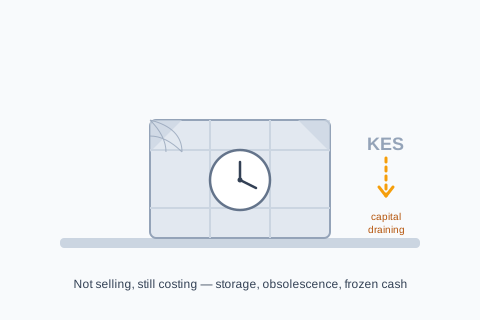
What actually counts as dead
There is no universal rule for when slow-moving becomes dead — it depends on the item and the business. What matters is that you define it explicitly rather than leave it to feel. A common working definition is stock with no sales for a set period (say 6 or 12 months) relative to its normal selling cycle. A fast-moving consumable untouched for three months may be dead; a slow, high-value spare part with one sale a year is not. The discipline is to set thresholds appropriate to each category and let the system flag items that cross them — so dead stock is a report, not a discovery made while looking for something else.
The costs you are still paying on it
Dead stock is not merely money you cannot use; it actively costs you, month after month, in ways that rarely appear on any single report:
- Tied-up capital — the cash you paid for it is frozen, unavailable for stock that would actually sell.
- Storage cost — it occupies space, shelving, and handling that all cost money whether the item moves or not.
- Obsolescence & deterioration — the longer it sits, the more likely it expires, is superseded, or degrades to unsellable.
- Opportunity cost — the shelf space and working capital could be earning through faster-moving lines.
- Masked reality — it inflates your inventory value, making the business look asset-rich when it is really cash-poor.
How dead stock accumulates
Dead stock is almost always a purchasing story told in hindsight: over-ordering on an optimistic forecast, a bulk deal that looked cheap per unit, a product line that never took off, a supplier minimum that forced more than demand justified. Each decision was defensible at the time; the failure is not catching the consequence early. This is where inventory turnover and ABC analysis earn their keep — they surface slowing items while the stock is still sellable, rather than after it has fossilized into a write-off.
Clearing dead stock: take the loss, free the cash
The hardest part is psychological — clearing dead stock means admitting the original purchase was a mistake, often at a loss. But holding it does not undo the loss; it compounds it. Discount it, bundle it, return it to the supplier if terms allow, or write it off and reclaim the space. A one-time discount that converts frozen stock back into cash is almost always better than paying to store a slowly-rotting asset indefinitely.
The real cure for dead stock is upstream: buying to demand rather than optimism, so it never accumulates in the first place. But for the stock you already have, the move is to make it visible — flagged automatically the moment it crosses your defined threshold — and to act while it is still worth something. Dead stock cleared is not just space reclaimed; it is working capital released back into the parts of the business that actually generate returns.
Dead stock is a buying and review problem before it is a clearance problem. Stock control in Kenya covers the habits that stop it forming, and the inventory turnover calculator puts a number on how fast the rest is moving.
What AWRA OpsHub does today
- A daily scan that raises dead stock at you. An item with stock on hand that has not moved for your configured idle period fires a workflow event — once, not nightly — so you decide who hears about it and how. It resets if the item moves again and later goes quiet, and it is switched off by setting the threshold to zero. The report still exists; it is simply no longer the only way to find out.
- A Dead Stock & Aging report listing items with stock but no movement, filtered to 30, 60 or 90+ days idle, with the longest-idle item called out.
- The capital tied up shown alongside, valued at weighted average cost, so the conversation is about money rather than item counts.
- Slow-moving and overstock filters on the item list itself, for a quicker look without running a report.
- CSV and PDF export, because this is a list you take into a meeting.
More we can add to your workspace
- A per-item idle threshold. You pick 30, 60 or 90 days for the whole report; you cannot say this SKU is dead at 45 days and that one at 200.
- An automatic markdown or clearance workflow. Deciding to discount, bundle or write off is a human decision the system then records.
The fix for the first is dull and effective: schedule the report to whoever owns purchasing, monthly, and make it an agenda item rather than an attachment. Dead stock is rarely a detection problem — it is nearly always a nobody-looked problem.
Anything above that you need, we can build for you
Everything listed above as something we can add describes what ships in the standard product today — it is a starting point, not a limit on what AWRA OpsHub can do for your organisation. Kenya's eTIMS integration and its maintained payroll engine are both in the product because clients needed them and commissioned them; neither appeared by itself, and the same door is open for whatever you just read about. One qualification so this is worth what it claims: a small number of things on this blog we deliberately leave to a specialist rather than build — a statutory ledger we will not sign our name to, a rule that would decide a tax question for you, a clinical or member-funds record that belongs in a regulated system — and where that is true the post says so in those words. Everything else is a scope, a timeline and a price.
The operational work, which is what most commissions actually are
An extra approval stage in a chain that does not match the standard one, a custom field set on employees or assets that only your sector needs, an expiry that has to block an order rather than send an email, a report your board asks for in a shape nothing produces, or a scanner or weighbridge feeding the goods-in door. These are the commissions we are asked for most often and the smallest ones we quote — and unlike a revenue-authority pipeline, none of them waits on a regulator.
The module-shaped additions, which are the ones readers ask for most often
A price list with real discount authority, a customer-facing quotation that expires, a bill of materials or recipe costing, a staff advance that is issued, acquitted and chased, a member or unit ledger, a matching rule that holds a payment. Each of these is a build rather than a setting, and each has been quoted before — a bigger piece of work than a custom field, with a written spec and a date instead of a roadmap slide.
The report, document or pack nothing currently produces
The board pack in the shape your board actually asks for, a donor or funder layout, an invoice or receipt template carrying what your regulator or your customer expects, a dataset the report builder cannot reach yet. Usually the fastest thing on this list to deliver, because the data is already in the system.
Systems, rails and hardware you already run
The accounting package, CRM, online store, core banking or custom database you intend to keep — connected through our API so a fact is entered once and appears everywhere it is needed. Plus the physical edge: a scanner, a scale, a weighbridge or a till peripheral feeding the door it belongs to.
How it works: you describe the requirement, we return a written scope, timeline and cost, and once agreed it is built into your environment and maintained as part of the product. Nothing here waits on a regulator or a published specification, which is why operational builds are the ones we quote fastest. Tell us the requirement that would otherwise rule us out — that is a better first conversation than a demo.
Tell us what your operation needsFind dead stock before it fossilizes
A dead stock and aging report over 30/60/90 days with the capital tied up in each item — while there is still cash to recover.
Explore inventory managementFrequently asked questions
What is dead stock?
Dead stock is inventory that has stopped selling and, on current trends, will not sell — goods that have turned from a working asset into a cost. It ties up the cash you spent on it, occupies storage, risks obsolescence, and inflates your inventory value while the business is really cash-poor.
How do you define when stock is dead versus just slow?
There is no universal rule — define it explicitly per category. A common approach is no sales over a set period (6 or 12 months) relative to the item's normal selling cycle, with thresholds appropriate to each type. A fast consumable untouched for three months may be dead; a high-value spare with one sale a year is not. Let the system flag items that cross your thresholds.
What does dead stock actually cost me?
More than the frozen purchase price: ongoing storage and handling, the risk of obsolescence or deterioration, the opportunity cost of shelf space and capital that could fund faster-moving lines, and a distorted inventory value that makes the business look asset-rich while it is cash-poor. These costs accrue every month the stock sits.
What should I do with dead stock I already have?
Act while it is still worth something: discount it, bundle it, return it to the supplier if terms allow, or write it off to reclaim the space. Holding it does not undo the original loss — it compounds it. Converting frozen stock back into cash, even at a markdown, almost always beats paying to store a slowly deteriorating asset.