
Your Import VAT Is Not Calculated on the Invoice
Namibian import VAT is charged on the greater of FOB plus ten per cent, or open market value. Your supplier's invoice does not contain that number, and if your landed cost is built from the invoice, neither does your system.
This is a short piece about one rule, and the reason it is worth a piece of its own is that the rule is easy to state, easy to check, and almost never applied by the systems Namibian businesses actually run.
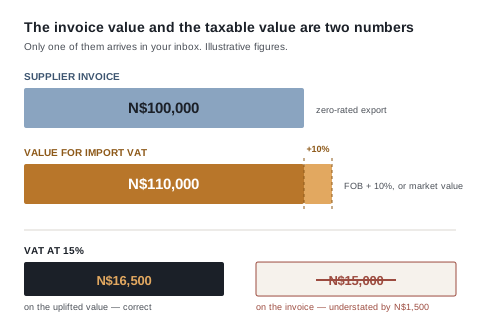
Import VAT in Namibia is payable on the greater of the free-on-board value plus ten per cent, or the open market value of the goods. Not on the figure your supplier put on the invoice. On an ordinary arm's-length purchase the first of those two usually wins, which means the taxable value of your import is ten per cent above a number you were sent, and it appears on no document anybody hands you.
The arithmetic
Round numbers, one import, nothing unusual about it: a South African supplier, a road delivery, no customs duty because both countries are in SACU. Use your own figures — the shape is what matters and the shape does not change with the size.
One import from South Africa, no customs duty, road delivery
Illustrative figures. The rate and the rule are the facts; the numbers are here so you can check the shape against one of your own invoices in five minutes.
For most businesses this is not a hidden cost. It is a hidden number — which is a different problem, and in some ways a more annoying one.
Be careful about what this actually costs you
It would be easy, and commercially convenient, to present this as one and a half per cent quietly leaking out of every import. For most readers that would be wrong, and getting it wrong is the fastest way to lose an audience that already knows the subject.
If you are VAT-registered and making taxable supplies, import VAT is generally recoverable as input tax. The money comes back. So the harm is not usually the money — it is four other things.
| What it actually costs | Who it costs |
|---|---|
| Cash flow, between paying import VAT and claiming it | Everybody who imports, in proportion to volume and cycle length |
| Landed cost accuracy, because a component that never entered the system cannot reach unit cost | Anybody measuring margin, which is to say anybody pricing |
| Reconciliation, because your VAT account was computed on one basis and the authority's import records on another | Your accountant, every period, as a hunt rather than a check |
| Real, unrecoverable cost, at one and a half per cent of everything imported | Only businesses that are partly exempt or not registered — but for them it is permanent |
Which of those you are is a one-minute question
Your accountant can tell you whether you are fully recovering input tax in about a minute, and the answer changes how seriously to take this. Fully recovering: it is an accuracy and cash-timing problem worth fixing properly but not urgently. Partly exempt: it is a real cost you have been absorbing without measuring, and the arithmetic above is the size of it.
Why SACU purchases are where this hides
The rule applies to imports generally. It goes unnoticed specifically on purchases from South Africa, and the reason is behavioural rather than legal.
- There is no customs duty within SACU, so the transaction generates far less paperwork than an overseas import.
- There is often no clearing agent involved, so nobody in the chain is professionally responsible for the customs valuation.
- The goods arrive by road, overnight, like a domestic delivery.
- The currency converts at par, so nothing about the pricing signals a border.
- The supplier's invoice shows no VAT at all, because they zero-rated the export — which reads as "a transaction with no VAT in it".
Five signals, all of them saying "this is a domestic purchase", and one statutory valuation rule quietly saying it is not. The imports that go wrong in Namibia are not the difficult containers from overseas. They are the easy deliveries from next door.
What to do about it
Three things, in order of how quickly they pay for themselves.
-
Check one invoice
Take a recent import from South Africa and compare the supplier invoice to the value your system recorded for import VAT. If they are the same number, the valuation rule is not being applied anywhere in your process, and it has not been for as long as the process has existed. This takes five minutes and needs no software.
-
Give the number somewhere to live
Import VAT belongs on the consignment as a cost component, allocated to the receipt it relates to, so it reaches unit cost with freight and handling. The point is not that a system should compute the statutory rule for you — it is that a system with nowhere to put the number guarantees the number stays absent.
-
Reconcile deliberately, once
Pick a period, compare your input tax on imports against the import records, and find out how large the gap is. Doing this once tells you whether it is a rounding matter or a material one, and that determines whether anything else on this list is worth your time.
Who owns which part
Graded honestly, because this argument invites a bigger claim than any vendor can make and the bigger version is the one that gets found out in month three.
Somewhere for the number to live
Import VAT held on the consignment as a cost component, allocated to the receipt and carried into unit cost with freight and handling. A system with nowhere to put it guarantees it stays absent.
The uplift as a rule you define
Configured once with your accountant so it applies consistently rather than being remembered per import. Configuration, not development — and you own the result.
The statutory rule itself
Whether FOB plus ten per cent or open market value applies to a given import, and what happens when the rule changes. Yours and your accountant's. We are telling you it exists; we are not maintaining it on your behalf, and a vendor claiming to should be asked how they monitor it.
Filing and reconciliation with NamRA
No electronic filing, no return preparation, no ITAS connection and no advice on your registration position. Not built in, and the reconciliation between your input tax and the authority's import records stays a manual exercise.
The honest limit, since we sell software
We do not maintain Namibia's import VAT valuation rule as a built-in calculation. You can model the uplift as a cost component and it will then flow through landed cost properly, which is a real improvement on it being absent — but you configure it, you own it, and you verify it with your accountant. We are telling you the rule exists. We are not maintaining it on your behalf, and a vendor who claims to be should be asked how they monitor it for change.
Everything above is checkable against your own records and against NamRA's published position, and you should check it rather than take it from a vendor blog. The whole reason this rule is worth writing about is that it is verifiable in an afternoon and almost nobody has looked.
What we can build for Namibia on top of the standard product
Everything listed above as something we can add describes what ships in the standard product today — it is a starting point for Namibia, not a limit on what AWRA OpsHub can do there. Kenya's eTIMS integration and its maintained payroll engine are in the product because Kenyan clients needed them and commissioned them; neither appeared by itself. The same door is open here. If NamRA filing output, a Namibian payroll engine, a bank or mobile money feed, a statutory return format, a rule specific to how your operation runs, or a link to a system you already have is what stands between you and a decision, tell us and we will scope it as a build — written spec, timeline and price — before you commit to anything.
NamRA output and the import VAT valuation rule
VAT return output in the shape NamRA expects, and — the piece specific to this market — the statutory import valuation applied as a rule rather than as a habit, so the taxable value of an import is derived rather than assumed to equal the supplier's invoice. That rule catches SACU purchases hardest, because there is no duty and no broker involved to make anybody notice it.
Banks, EFT and cross-border settlement
Bank statement feeds, EFT and debit-order files and card acquirer settlements pulled into the Payments Register, including the South African side of a supplier relationship that settles at par but still crosses a border.
The operational work, which is what most commissions actually are
An extra approval stage in a chain that does not match the standard one, a custom field set on employees or assets that only your sector needs, an expiry that has to block an order rather than send an email, a report your board asks for in a shape nothing produces, or a scanner or weighbridge feeding the goods-in door. These are the commissions we are asked for most often and the smallest ones we quote — and unlike a revenue-authority pipeline, none of them waits on a regulator.
Payroll and statutory returns
PAYE on the Namibian tables, Social Security Commission contributions and the VET Levy, computed on live records and produced in the layout each body expects.
Systems you already run
The accounting package, CRM, online store or custom database you intend to keep — connected through our API so a fact is entered once and appears everywhere it is needed.
How it works: you describe the requirement, we return a written scope, timeline and cost, and once agreed it is built into your environment and maintained as part of the product. No roadmap slide, and no pretending in a demo that something exists when it does not.
Tell us what you need integrated