Oman's Five-Corner Model: The Corner Nobody Is Selling You
Saudi Arabia put the tax authority inside the sale. Oman did something quieter and, for most businesses, more consequential: it built a network, and gave the buyer a reporting position on documents somebody else created.
If you have followed e-invoicing anywhere else in the Gulf, you have probably absorbed a mental model in which the tax authority sits in the middle of your sale, checks the document and hands it back. That is the Saudi model. It is not the Omani one, and reading Fawtara through it will lead you to prepare for the wrong thing.
Oman's programme is a decentralised five-corner arrangement built on Peppol. Invoices travel between accredited service providers. The Tax Authority is not a gate the document passes through — it receives reporting, separately, from both parties. That is a post-audit design, and it moves the interesting problem to a place nobody is selling into.
Nothing here is tax advice, and the specification is the Tax Authority's to change. Phase scope and dates have moved once already. Confirm your own obligation and its timing with the Oman Tax Authority or your tax adviser — not with a software vendor, including this one.
Clearance and post-audit are not two speeds of the same thing
The words get used interchangeably in vendor material and they describe genuinely different architectures. It is worth ten minutes to be precise, because the failure modes are opposites and you cannot plan for one by preparing for the other.
Clearance — the Saudi shape
- The document goes to the authority before it reaches your customer.
- It is validated, stamped and returned. Until it comes back, you have nothing to send.
- A rejection is a stopped transaction — in business hours, with somebody waiting.
- The authority holds the invoice that legally exists. Your system holds a sale.
- You find out about problems immediately, which is unpleasant and extremely useful.
Post-audit five-corner — the Omani shape
- The invoice travels between access points. The authority is not in the path.
- No clearance number, no authority stamp, no QR generated on their side.
- A failure is a quiet mismatch, discovered later by comparing two reports.
- Both parties report separately — the seller their sales data, the buyer their purchase data.
- Nothing stops. That is the appeal, and it is also the entire risk.
Neither is better. They are trade-offs against each other, and each one buys down a different risk. Clearance buys certainty at the cost of putting a live dependency in the middle of your sales process. Post-audit buys resilience — your invoicing does not stop because a government API is having an afternoon — at the cost of letting errors accumulate silently until somebody reconciles.
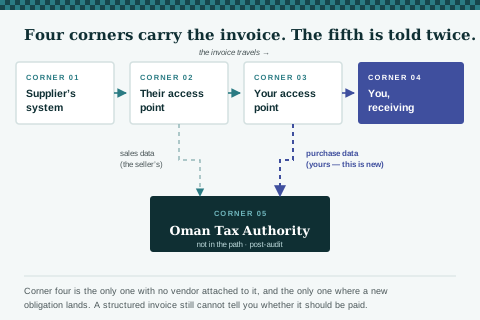
Corner four is the one with no vendor attached to it
Walk the corners in order and notice where the commercial attention is. Corner one is the supplier's system, and every ERP vendor in Muscat is preparing that. Corner two is the supplier's access point, and every accredited provider is selling that. Corner three is your access point, which you will also buy, probably from the same market. Corner five is the authority, which sells nothing.
Corner four is you, receiving. It is the only corner in the diagram that nobody is quoting for, and it is the one where a new obligation lands.
Everyone in this market is being sold the ability to send. Almost nobody is being asked what happens after something arrives.
Two things change at corner four at the same moment, and it is worth separating them because only one is a technology problem.
- Supplier invoices start arriving as structured data. Not a PDF that somebody keys, not a scan that somebody reads — a machine-readable document with fields in known places. This is genuinely good and it is somebody else's build.
- Your purchase side acquires a reporting position. The framework has the buyer reporting purchase tax data to the Tax Authority. Your accounts payable ledger stops being purely an internal management record. It becomes something that is filed, and therefore something that can be compared against what your suppliers filed.
The first of those makes data entry faster. The second makes data entry consequential. Those are not the same improvement, and a business that gets the first without preparing for the second has simply automated the production of a discrepancy.
What a structured invoice does not tell you
Here is the part that gets lost in the enthusiasm. A perfectly formed, cryptographically sound, network-delivered invoice tells you exactly one thing: what your supplier says you owe them. It carries no opinion on any of the questions that actually decide whether it should be paid.
| The question | Does the invoice answer it? | What answers it |
|---|---|---|
| Is this the price we agreed? | No — it states their price | The purchase order, if the agreed price is on it |
| Did we receive this quantity? | No | The goods receipt, taken where the goods arrived |
| Did we receive it at all? | No | The goods receipt, again |
| Was somebody allowed to order this? | No | The requisition and the approval behind the order |
| Is it the right specification? | No | The order line, and whoever inspected it |
| Have we already paid it? | No | Your own payment history against that reference |
| Is the arithmetic correct? | Yes | The document itself |
One row out of seven. That is the honest measure of what corner four delivers on its own, and it explains why "we are getting e-invoicing" is not an accounts payable strategy.
The uncomfortable direction of travel
Speed applied to an unverified invoice does not save money. It shortens the interval between a supplier billing the wrong amount and you paying it. If your purchase process currently works because three people know the suppliers well, structured inbound documents will not fix that — they will remove the friction that was accidentally acting as a control.
How this goes wrong, in order
Nothing dramatic happens, which is what makes it worth writing down in advance.
-
The project is scoped as "e-invoicing compliance"
An access point is appointed and the outbound flow is tested thoroughly, because that is what the deadline is about and what the provider is contracted for. The inbound flow is switched on because it comes in the box, not because anybody designed for it.
-
Inbound invoices arrive somewhere nobody works
The provider's portal, or an inbox, or a folder. Perfectly good software. Simply not the system where purchase orders and goods receipts live, so the match is still a human comparing two screens.
-
Keying disappears and checking disappears with it
This is the pivot. When somebody keyed an invoice, they looked at it — badly, distractedly, but they looked. Automation removes the keying and, unless a rule replaces it, silently removes the glance as well.
-
Buy-side reporting starts
Your purchase data goes to the authority. So does your supplier's sales data. These are now two independent accounts of the same transaction, held by the same party, and they agree or they do not.
-
A discrepancy surfaces long after anyone can explain it
Not a penalty necessarily — an explanation, requested about a period nobody remembers, against documents that were never linked to each other. The cost is the fortnight three people spend reconstructing it.
What to do about it, which is mostly not software
The preparation that matters for corner four is ordinary purchase-to-pay discipline. It is unglamorous, it predates the mandate by about forty years, and it is the reason a structured invoice is either useful or dangerous.
- Every purchase of consequence starts as a requisition with an approval, and the threshold refuses rather than warns.
- Every order carries the agreed price and quantity, so there is something for an invoice to be checked against.
- Goods are received where they arrive — the gate, the yard, the site — against the order, by the person who took delivery, with stock and asset movement captured offline if there is no signal.
- Order, receipt and invoice are matched by the system, with a tolerance you set, and an exception is held rather than passed on.
- The proportion of purchase invoices with no order behind them at all is measured, and somebody owns bringing it down.
Four questions, and what a vague answer usually means
What happens to an invoice after it arrives from the network?
The answer you often get
It lands in the portal and can be exported or accessed via our API.
What to press for instead
Landing is not the same as being useful. Ask which system it ends up in, what it is automatically compared against, and who sees it. If the answer is a portal, the match is still a person looking at two screens — and that person is the control you thought you were automating.
Can you match an inbound invoice to our purchase order and goods receipt?
The answer you often get
Yes, the data is all there.
What to press for instead
Ask to watch it happen on a real invoice with a real discrepancy. "The data is there" describes a possibility. What you need is a rule that holds the exception rather than passing it to the payment run, and a tolerance you set rather than one they chose.
How would we answer a query about a difference between our purchase reporting and a supplier's sales reporting?
The answer you often get
You would run a report.
What to press for instead
Which report, over what period, joining which two records? If nobody has designed that query before it is needed, it becomes a fortnight of three people reconstructing links that were never made. Ask to see the report, not the possibility of one.
What proportion of our purchase invoices arrive with no order behind them?
The answer you often get
This one is for you, not the vendor.
What to press for instead
Nobody knows until they measure it, and the guess is almost always low. Take one month and count. If it is high, no amount of structured inbound data will help, because there is nothing on your side for it to be checked against. That is a process finding, and it is worth more than any demo.
What AWRA OpsHub does today
- Requisitions and approvals that refuse above a threshold
- Purchase orders carrying agreed price and quantity
- Goods receipt at the point of delivery, offline-capable
- Three-way matching with tolerances, holding exceptions
- Landed cost allocated onto the consignment
- Supplier documents attached, with expiry dates watched
More we can add to your workspace
- A Peppol access point — we are not an accredited service provider anywhere
- OM PINT or UBL XML parsing, in either direction
- The Tax Data Document, or any reporting to the Oman Tax Authority
- An Arabic interface or right-to-left layout
- Social Protection Fund, wage protection files or Omanisation tracking
What we can build for Oman on top of the standard product
Everything listed above as something we can add describes what ships in the standard product today — it is a starting point for Oman, not a limit on what AWRA OpsHub can do there. Kenya's eTIMS integration and its maintained payroll engine are in the product because Kenyan clients needed them and commissioned them; neither appeared by itself. The same door is open here. If inbound Fawtara documents landing on your purchase records, an Arabic interface, a bank or mobile money feed, a statutory return format, a rule specific to how your operation runs, or a link to a system you already have is what stands between you and a decision, tell us and we will scope it as a build — written spec, timeline and price — before you commit to anything.
The receiving end of Fawtara
A link to your accredited service provider that works in both directions: our sale handed over in the shape their access point expects, and — the part nobody quotes for — an inbound supplier document arriving as data and landing against the purchase order and goods receipt it belongs to, so the three-way match happens before anyone approves payment rather than after. We will not become your access point or hold the accreditation; that belongs with a provider registered on the network, and we would rather say so than sell you the pipe.
Arabic interface, banks and acquirers
Arabic interface text with right-to-left layout and bilingual document templates, plus bank statement feeds and card acquirer settlements wired into the Payments Register so collections match invoices without anyone re-keying a statement.
The operational work, which is what most commissions actually are
An extra approval stage in a chain that does not match the standard one, a custom field set on employees or assets that only your sector needs, an expiry that has to block an order rather than send an email, a report your board asks for in a shape nothing produces, or a scanner or weighbridge feeding the goods-in door. These are the commissions we are asked for most often and the smallest ones we quote — and unlike a revenue-authority pipeline, none of them waits on a regulator.
Payroll and statutory returns
An Omani payroll engine with Social Protection Fund contributions calculated on live employee records, wage files in the layout the Ministry of Labour and Central Bank system expects, and the Omanisation position visible before a deadline rather than after one.
Systems you already run
The accounting package, CRM, online store or custom database you intend to keep — connected through our API so a fact is entered once and appears everywhere it is needed.
How it works: you describe the requirement, we return a written scope, timeline and cost, and once agreed it is built into your environment and maintained as part of the product. No roadmap slide, and no pretending in a demo that something exists when it does not.
Tell us what you need integratedWe are aware of how that reads directly under an argument about the inbound side being under-served. It is deliberate. The network delivery is a real build and a fairly ordinary one, and there will be competent providers selling it. The layer underneath — knowing what you ordered, what arrived and what you agreed to pay — is the part that has never been solved by a file format, and it is the part that decides whether corner four is an improvement or an exposure.
The short version
Oman built a network, not a gate. That means nothing stops when something goes wrong, and it means the buyer now reports too. Prepare the sell side because you must, but spend the harder half of the attention on what happens after an invoice arrives — because for the first time it will arrive complete, correct in form, fast, and still quite capable of being wrong.
Bring one month of purchase invoices
Not a demo — one real month of your own supplier invoices checked against your own orders and receipts. The proportion that match cleanly is the most useful number in this decision, and it is yours whether or not you ever buy anything from us.
Talk to us about OmanFrequently asked questions
When does Fawtara actually apply to my business?
The published rollout begins in August 2026 with a pilot group of around a hundred large VAT-registered companies, extends in February 2027 to the remaining large VAT-registered businesses, and in August 2027 to all remaining VAT-registered taxpayers including SMEs, with government-to-business transactions following in 2028. Dates in published rollouts move — this one has already been revised once. Confirm your own position with the Oman Tax Authority or your tax adviser rather than with any vendor.
Is Oman really not using clearance like Saudi Arabia?
On the published model, no. Oman's design is decentralised and post-audit: the Tax Authority is not expected to generate the QR code, issue a clearance invoice number or apply its own digital stamp. Invoices travel between accredited service providers using PINT and UBL-based XML formats, with a Tax Data Document as the reporting vehicle to the authority. Saudi Arabia's standard invoices, by contrast, are cleared synchronously before issuance. Specifications get revised, so check the current one — but the architectural difference is real and it is not a matter of degree.
Do I have to receive electronically, or only send?
The framework describes three exchanges for a B2B transaction: the invoice between the parties, sales tax reporting from the supplier to the authority, and purchase tax data reporting from the buyer's side. So receiving is part of the design, and your access point registers your receiving capability in the network directory so other people's providers know where to deliver. Treat the buy side as in scope from the beginning rather than as something that will sort itself out.
What is an accredited service provider and do I need one?
It is a provider accredited to operate on the network on your behalf — converting, signing and transmitting documents, handling onboarding, and registering you in the service metadata directory so you can be delivered to. In a decentralised model you do not connect directly to the authority, so yes, you will appoint one. It is a separate purchase from your business system, and worth treating as its own decision rather than a line item in an ERP project.
Does AWRA connect to the network?
No. We are not an accredited service provider in Oman or anywhere else, we operate no Peppol access point, we are not registered in any service metadata directory, and we neither produce nor consume OM PINT documents or the Tax Data Document. Our only fiscal e-invoicing integration anywhere in the product is Kenya's eTIMS, which is a direct authority integration and does not translate to a four-corner network. What we run is the layer a structured invoice gets checked against.
We are a small business. Is any of this worth doing before our phase arrives?
The compliance part, no — wait for your phase and confirm it with the authority. The purchase discipline, yes, and it is worth doing whether or not the mandate ever reaches you. Measuring what proportion of your purchase invoices arrive with no order behind them takes an afternoon, costs nothing, and tends to change the conversation. Most operators guess ten per cent and find something considerably higher.