
The Tax You Paid Is Part of What the Goods Cost
A sales tax with no input credit is not a smaller VAT. It is a different instrument, and the account it has been going into for the last three years is not an asset.
Almost every accounting system in use across East Africa was configured by somebody who had worked in a VAT jurisdiction, because almost everywhere in the region is one. VAT has a defining property that becomes invisible through familiarity: the tax you pay on a purchase is not yours to keep paying. You net it off what you collect, and only the difference reaches the revenue authority. Input tax is therefore a receivable, and it is booked like one.
South Sudan levies a sales tax. The standard rate is 18% under Schedule 1 of the Financial Act, charged on produced goods, imported goods and specified services — hotel, restaurant and bar, telecommunications and financial services, with other categories rated separately in the same schedule. There is no input credit mechanism. The tax you pay stays paid.
That is one sentence, and everything in this piece follows from it mechanically.
We had this wrong ourselves, which is the reason to trust the rest of it
Until August 2026 our own reference data described South Sudan's tax as "Value Added Tax" at 18%. The rate was correct, which is exactly why it survived: every check anybody runs asks whether a figure has moved, and this figure had not. A wrong instrument with a right number passes all of them. We corrected it and we are writing this rather than quietly editing a config file, because the failure is more useful to you than the fix.
What the wrong booking actually does
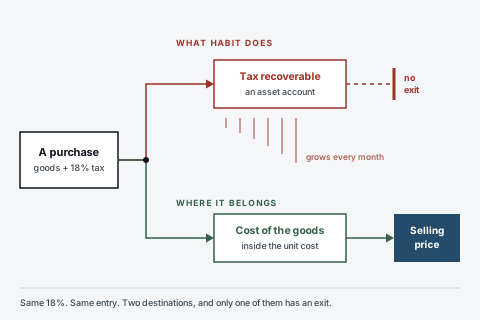
Suppose the tax has been going where habit sends it: a debit to input tax, VAT recoverable, or whatever your chart calls it. Nothing breaks. No entry is rejected, no reconciliation fails, no auditor stops you at the door. Two things happen slowly instead.
| What goes wrong | How it shows up |
|---|---|
| An asset that is not one | The recoverable balance grows every month and nothing ever comes back against it. It is a real number in the accounts and there is nothing behind it — which means the balance sheet overstates assets by whatever has accumulated, for as long as it accumulates |
| Every unit costed too low | The tax should have been part of what the goods cost. Excluded from unit cost, it understates cost by the tax and overstates gross margin by the same amount on every single sale made from that stock |
| Prices set from the wrong base | A margin target applied to an understated cost produces a price that misses the target by the tax. On thin-margin distribution that is often the whole margin |
| Closing stock valued below cost | Inventory carries the understated figure at year end. When the correction eventually happens it lands as a period adjustment rather than against the stock it belonged to, so two sets of numbers are wrong in opposite directions at once |
Nothing about this fails on the day it happens. It is a slow error, which is why it survives — the entry is accepted, the account balances, and only the two numbers you actually manage against are wrong.
The test, which takes one query and no vendor
Two figures from your own trial balance.
The balance of your recoverable or input tax account, and the date any of it was last actually recovered.
If the second answer is a date, this piece is not about you — either you are operating somewhere with a credit mechanism, or somebody has already worked this out. If the second answer is "never", then the first number is not an asset, it is an accumulated cost sitting in the wrong place, and it belongs to specific consignments and specific periods that can still be identified.
What to do about it is a question for your accountant and we are not going to answer it here. The restatement affects stock valuation and reported margin, the treatment depends on materiality and on how far back it goes, and a software vendor with an opinion on that is a software vendor to be careful with.
The part that is genuinely a software question
Where the number lands, and whether it can land there at all. That is narrow, and it is the whole of our claim.
- Can tax on a purchase be posted into the cost of the goods rather than to a recoverable account, as a configuration rather than a workaround?
- When it lands there, does the unit cost recalculate — or is the receipt cost now fixed and the tax an adjustment somewhere else?
- Can a cost be added to a consignment after the goods have been received and put away? Freight, clearing and handling invoices for an overland shipment arrive weeks late, and they carry tax too.
- Can you see, per consignment, every cost that landed on it and when each one arrived?
- Is the rate a setting you control, rather than a regional default the vendor chose? Two of the countries next door are at 18% VAT and it is not the same 18%.
That last one is worth dwelling on, because it is where a vendor's country list does real damage. A system that ships with "East Africa: 18%" is arithmetically right about South Sudan and structurally wrong about it, and the arithmetic is what gets checked.
Why the neighbours make this harder rather than easier
Uganda, Tanzania, Rwanda and Burundi all levy VAT at 18%. Kenya is at 16%, Ethiopia at 15%. A finance team that has operated anywhere in that group arrives with a correct habit and applies it to a number that looks identical.
So the error is not carelessness — it is competence transferred across a boundary that is invisible because the two sides carry the same figure. A tax rate tells you how much. It does not tell you which direction the money moves afterwards, and the second question is the one that decides where the entry goes.
What this piece is not claiming
Not that anybody has been evading anything, and not that a filing is wrong. Sales tax charged and remitted on your own sales is a separate question from where you booked the tax you paid on your purchases, and nothing here suggests the first has been mishandled. The claim is narrower: an internal booking decision, made once by habit, that quietly misstates unit cost and inflates a balance nobody reconciles.
Where the boundary sits
A tax rate per country that you set
One default per jurisdiction rather than one regional assumption, and yours to change. What the product holds is the rate and the amount; it does not hold a view about the instrument.
Landed cost that stays open after receipt
Freight, clearing, storage, handling and the tax on them attached to the consignment whenever the invoice arrives, with the unit cost recalculating. This is the mechanism that lets an unrecoverable tax reach the goods it belongs to.
Original currency and the applied rate retained
A supplier invoiced in dollars keeps its amount and the rate actually used alongside the pound figures, so a margin can be explained months later rather than recalculated from a rate nobody wrote down.
Documents against the transaction
The clearing paperwork and the tax receipts held against the consignment rather than in a folder, retrievable by shipment.
Deciding whether a charge is recoverable
Not built and never will be. Whether a particular amount is creditable, and what your organisation is exempt from, is a question for your adviser and your own registration. A system that answered it would be selling a tax opinion with a licence attached.
Filing with the National Revenue Authority
Not built. The NRA runs eTax for registration, filing and payment and we hold no connection to it. What we hold is the detail a return is built from.
The restatement decision
Yours, with your accountant. How far back a correction goes and how it is presented are judgements about materiality and audit, not configuration.
Everything above is checkable against records you already hold, which is deliberate. Two numbers from your own trial balance settle whether any of it applies to you, and neither of them requires a demonstration.
What we can build for South Sudan on top of the standard product
Everything listed above as something we can add describes what ships in the standard product today — it is a starting point for South Sudan, not a limit on what AWRA OpsHub can do there. Kenya's eTIMS integration and its maintained payroll engine are in the product because Kenyan clients needed them and commissioned them; neither appeared by itself. The same door is open here. If an eTax filing connection, a South Sudanese payroll engine, a bank or mobile money feed, a statutory return format, a rule specific to how your operation runs, or a link to a system you already have is what stands between you and a decision, tell us and we will scope it as a build — written spec, timeline and price — before you commit to anything.
Filing output to eTax, and no opinion about what is recoverable
Return output against the National Revenue Authority's eTax platform, produced from live records with a reconciliation report rather than a black box. Worth being precise about what this is and is not: eTax is registration, filing and payment, not a requirement that each invoice be validated before it can be issued, so this is a filing pipeline rather than a fiscalisation one and the two are often confused. What we will not build at any price is a rule that decides whether a particular charge is creditable. The 18% here is a single-stage sales tax with no input credit, where the amount belongs is your adviser's call, and software that made that call for you would be selling a tax opinion.
Mobile money, bank feeds and multi-currency at the applied rate
Mobile money settlement files and bank statement feeds pulled into the Payments Register so collections match invoices without re-keying, alongside genuine multi-currency where the original amount and the rate actually applied stay on the transaction. That second half matters more here than the first: a purchase committed at one rate and settled at another leaves a difference that belongs to the order which caused it.
The operational work, which is what most commissions actually are
An extra approval stage in a chain that does not match the standard one, a custom field set on employees or assets that only your sector needs, an expiry that has to block an order rather than send an email, a report your board asks for in a shape nothing produces, or a scanner or weighbridge feeding the goods-in door. These are the commissions we are asked for most often and the smallest ones we quote — and unlike a revenue-authority pipeline, none of them waits on a regulator.
Payroll and statutory returns
Personal income tax and statutory contribution schedules produced in the layout each filing body expects, generated from live payroll records. Not built today — our maintained engine covers Kenya only, and a local payroll provider will be cheaper and correct.
Systems you already run
The accounting package, CRM, online store or custom database you intend to keep — connected through our API so a fact is entered once and appears everywhere it is needed.
How it works: you describe the requirement, we return a written scope, timeline and cost, and once agreed it is built into your environment and maintained as part of the product. No roadmap slide, and no pretending in a demo that something exists when it does not.
Tell us what you need integrated