A Threshold Measured on the Payment, Not the Invoice
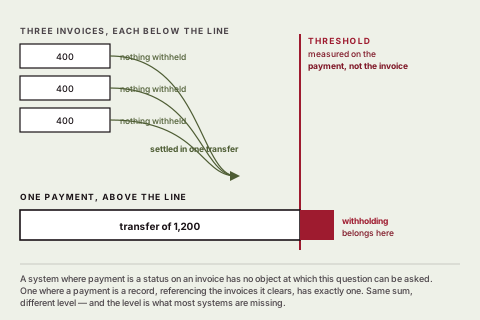
The threshold is measured on the payment, not the invoice. So three invoices below it, settled in one transfer, are above it — and a system that decides at invoice entry is wrong in both directions at the same time.
Most tax decisions are made when a document is created. This one is not. Withholding on local purchases in Tunisia applies to payments over a threshold, the threshold is assessed against the payment rather than against the invoice, and the deduction happens at settlement. Every part of that sentence is a software consequence, and the usual arrangement gets all three wrong.
The rule, stated carefully because the careless version is the one that circulates. The ceiling is 1.5% on payments exceeding TND 1,000 including VAT, for the acquisition of goods and services not subject to a specific rate. That ceiling is reduced — to 1% for companies on the 15% corporate rate and to 0.5% for those on the 10% rate. So there is no single number to quote, and a vendor who quotes one has not read the rule. It depends on the payer's own tax position, which is not a property of the supplier, the item or the invoice.
Three properties, three ways to be wrong
| The rule says | The usual system assumes | What goes wrong |
|---|---|---|
| The threshold applies to the payment | It applies to the invoice | Three invoices of 400 settled in one transfer of 1,200 are over the threshold. Nothing checks, so nothing is withheld. |
| The deduction happens at settlement | It is decided when the invoice is entered | An invoice entered above the threshold and later settled in two part-payments below it has been withheld on incorrectly. |
| The rate depends on the payer's tax bracket | The rate is a property of the tax code or the supplier | One rate is configured and applied to everything, and it is right for one class of company only. |
| It is an advance against the recipient's tax | It is a deduction to be reconciled later | The certificate is treated as paperwork rather than as the evidence a credit depends on. |
The first row is the one worth dwelling on, because it is the only one that produces an under-deduction and therefore the only one with a real exposure attached. Aggregation is the mechanism. A supplier you pay weekly in small amounts may never cross the threshold on any single invoice and cross it on every single transfer.
A threshold measured on the payment cannot be evaluated by anything that only knows about invoices. It is not a harder calculation — it is a calculation at a level most systems do not have.
Why the invoice cannot answer the question
This is a structural point rather than a configuration one. At the moment an invoice is entered, the facts that decide the withholding do not exist yet: how much will be paid, when, in one transfer or several, and alongside which other invoices. The invoice is upstream of its own tax treatment.
Which means the arrangement has to be the other way round from the familiar one. The payment is the taxable event and the invoice is what it clears. A system that models payments as a status on an invoice — paid, part-paid, outstanding — has no object at which the question can be asked. A system with a payment record that references the invoices it settles has exactly one.
The other end of it: what is withheld from you
Everything above is about being the payer. The mirror problem is being the recipient, and it is where actual money is lost rather than merely mis-recorded.
When a customer settles your invoice net of withholding, the shortfall is an advance against your own tax — claimable, but only against the certificate. And the certificate has the three properties that make evidence hard to keep anywhere: it arrives separately from the payment, it arrives to a person rather than to a system, and it refers to the transaction by the payer's reference rather than yours.
From 1 January 2026 those certificates move through the TEJ platform, in XML, for every company regardless of size. That changes the route and it does not change the reconciliation problem: a certificate that exists on a platform and is not attached to the invoice it relates to is still unclaimable in practice, because nobody can assemble the schedule at assessment.
Withholding you deduct
- Decided at the payment, on the aggregate of what that payment settles.
- Rate depends on your own corporate tax position, not the supplier's.
- You are holding money on somebody else's behalf, remittable on a calendar.
- Your supplier is entitled to a certificate and will ask for it.
- Failure mode: an under-deduction nobody notices, and a liability that was never recorded.
Withholding deducted from you
- Decided by somebody else, and you find out when the payment arrives short.
- The amount is whatever they applied. You are not consulted.
- It is an advance against your tax, so writing it off pays the same tax twice.
- You need their certificate, and it arrives later and separately.
- Failure mode: real money, permanently lost, in amounts too small to notice individually.
What the arrangement has to look like
Two properties, and neither of them is a tax module.
First, the payment has to be a record in its own right, with the invoices it clears attached to it, so that a question about an aggregate has an object to be asked of. Second, the withheld amount has to be a balance with a document against it — a liability with a certificate you owe when you are the payer, a receivable with a certificate you are waiting for when you are not.
- Is a payment a record that references the invoices it settles, or is payment a status on an invoice?
- When one transfer clears several invoices, can you see the total of that transfer as a figure somebody could test against a threshold?
- When a customer settles short, can the difference be recorded as withholding receivable rather than written off to a discount or a bank charge?
- Can the certificate be attached to the invoice when it arrives weeks later, and found again by invoice number?
- Is there an ageing list of withheld amounts with no certificate attached, that somebody can chase from?
- When you deduct from a supplier, is the amount held as a liability to remit with a certificate produced from the record?
The fifth item is the one that changes behaviour rather than reporting. A list of unevidenced credits, ageing, is the difference between chasing a certificate while the person who issued it still remembers the transaction and chasing it eleven months later, in a hurry, from an inbox.
What we do and do not do here
We hold payments as records with the invoices each one clears, we hold the withheld amount as a balance rather than a deduction line, and we attach the certificate to the invoice it relates to. What we do not do is decide the withholding for you — the threshold test and the rate that applies to your company are yours to apply, because the rate is a function of your own tax position and we are not going to infer it. And we produce nothing that TEJ accepts: the declaration is a local filing obligation and it should stay with whoever handles your returns. We are the record and the evidence, not the submission.
One thing this piece is deliberately not
A rate table. Which payments attract withholding, at what percentage, with what exemptions and against which corporate tax bracket is exactly the material that moves with each annual finance law, and printing a schedule here would produce a page that is confidently wrong within a year. The ceiling and the mechanism are stable enough to publish. The detail is your adviser's, and they have this year's version.
What is stable is the shape, and the shape is the whole argument: a tax decided at settlement cannot be modelled by a system that decides at invoicing, and a threshold measured on an aggregate needs the aggregate to exist somewhere as a record.
Payments as records, with the invoices each one clears
Transfers, cash and card settlements in one register, each referencing what it settled — the level at which a per-payment threshold can be evaluated at all.
Withheld amounts as balances rather than deductions
A receivable when it is withheld from you, a liability to remit when you withhold it, instead of a short settlement written off to a discount line.
Certificates attached to the invoice they evidence
Previewable in place and retrievable by invoice rather than by whoever received the email, with an ageing view of what has no certificate yet.
Deciding the withholding for you
Not built and deliberately so. The rate turns on your own corporate tax bracket, and a system that guessed at it would be quietly wrong for most companies.
TEJ declaration output
Not built. Withholding declarations and certificates move through TEJ in XML for every company from 1 January 2026, and we generate nothing it accepts.
The verdict
A withholding threshold measured on the payment is not a harder sum than one measured on the invoice — it is a sum at a level most systems do not model. Get the level right and both halves fall out: the aggregate can be tested, the deduction happens where it actually happens, and the certificate has somewhere to live. Get it wrong and you are simultaneously withholding on invoices that were settled below the line and missing transfers that cleared three small ones at once, while the credits owed to you accumulate in an inbox. Ask any vendor whether a payment is a record or a status. It is a one-word answer and it tells you most of what you need.
What we can build for Tunisia on top of the standard product
Everything listed above as something we can add describes what ships in the standard product today — it is a starting point for Tunisia, not a limit on what AWRA OpsHub can do there. Kenya's eTIMS integration and its maintained payroll engine are in the product because Kenyan clients needed them and commissioned them; neither appeared by itself. The same door is open here. If a compounding tax base, El Fatoora clearance, TEJ declarations, a French or Arabic interface, a bank or mobile money feed, a statutory return format, a rule specific to how your operation runs, or a link to a system you already have is what stands between you and a decision, tell us and we will scope it as a build — written spec, timeline and price — before you commit to anything.
The base before the pipeline, in that order
Two builds, and the smaller one has to come first. The arithmetic: a tax base that can contain another levy, so FODEC at 1% of the net and VAT at 19% of the net plus the FODEC produce 201.900 on a thousand rather than the 200.000 our totals return today by adding the two rates — with the two amounts separated on the document and on the return rather than blended into one figure. Then the pipelines, and there are two of them: El Fatoora clearance through Tunisie TradeNet in TEIF XML with signature and QR code, and TEJ withholding declarations in XML. We would build them in that order, because a cleared invoice carrying a total that is short by 19% of the FODEC is worse than no clearance at all.
French and Arabic interface, banks and payments
Interface text and document templates in French, or in Arabic with right-to-left layout, plus bank feeds and local payment gateways wired into the Payments Register — with withholding decided at settlement rather than at invoicing, because the threshold is measured per payment.
The operational work, which is what most commissions actually are
An extra approval stage in a chain that does not match the standard one, a custom field set on employees or assets that only your sector needs, an expiry that has to block an order rather than send an email, a report your board asks for in a shape nothing produces, or a scanner or weighbridge feeding the goods-in door. These are the commissions we are asked for most often and the smallest ones we quote — and unlike a revenue-authority pipeline, none of them waits on a regulator.
Payroll and statutory returns
A Tunisian payroll engine with income tax bands, CNSS contributions and the TFP and FOPROLOS levies calculated on live employee records, producing declarations in the layout the administration expects rather than rebuilt each month.
Systems you already run
The accounting package, CRM, online store or custom database you intend to keep — connected through our API so a fact is entered once and appears everywhere it is needed.
How it works: you describe the requirement, we return a written scope, timeline and cost, and once agreed it is built into your environment and maintained as part of the product. No roadmap slide, and no pretending in a demo that something exists when it does not.
Tell us what you need integratedBring one transfer that cleared three invoices
We will show you the payment as a record, what it settled, where a withheld amount sits, and how the certificate gets attached to the invoice it evidences.
Talk to us about payments and evidence