
The Tax Deducted From Your Invoices Is Yours to Claim
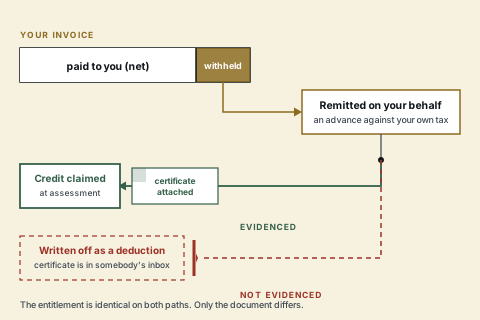
It used to be a final tax in most cases, so it was expensed and forgotten. It is now an advance, which makes it yours to claim — against a certificate that is probably in somebody's inbox.
The companion piece to this one is about a tax everybody treats as recoverable that is not. This one is the mirror: a tax most systems treat as a cost that is, in fact, money you are entitled to get back. The two errors sit in the same trial balance, they point in opposite directions, and neither of them is caught by the check that would catch the other.
The Financial Act 2023/2024 changed how withholding works in South Sudan. Where withholding on several categories used to be treated as a final tax — settled, done, nothing further to claim — the change means withholding payments are deemed an advance tax irrespective of the source and irrespective of whether the recipient is resident. An advance is an instalment. An instalment is a credit against the eventual assessment.
Which means the amount your customer deducted from your invoice last March is not a cost of doing business. It is a payment you have already made towards your own business profit tax, and it is claimable — if you can evidence it.
The two failures, and only one of them is about money
Withholding deducted from you
- Your customer pays you net and remits the difference.
- Because the invoice was settled short, the shortfall gets written off — a discount, a bank charge, a deduction line.
- It is an advance against your own tax, so writing it off pays the same tax twice.
- Claiming it requires the certificate, and the certificate arrives separately from the payment.
- Failure mode: real money, permanently lost, in amounts nobody notices individually.
Withholding you deduct from a supplier
- You pay a supplier net and are holding the difference on their behalf.
- One payment, one entry — so the liability to remit and the obligation to certify both go unrecorded.
- It is not your money at any point, and it is remittable on a calendar.
- Your supplier will ask for their certificate, and they are entitled to it.
- Failure mode: an unrecorded liability, plus a supplier relationship managed by apology.
The deduction is recorded, because it had to be — the bank only moved the net. What is not recorded is that the difference has a name, an owner and a document.
Why the certificate is the whole problem
The entitlement to credit is not in dispute. What is difficult is proving, at assessment, which withholdings relate to which income, in what period, from which payer — and producing the certificate for each.
The certificate has three properties that make it hard to keep. It arrives separately from the payment, often weeks later and by a different route. It arrives to a person rather than to a system, usually whoever handles that customer. And it refers to the transaction by the payer's reference, not yours, so matching it back to your own invoice is a small act of translation each time.
None of that is anyone's fault, and all of it is why the reconciliation is normally attempted once a year, in a hurry, from an inbox. The credit is not lost because the entitlement failed. It is lost because the evidence was never held against the thing it evidences.
What this costs, stated without a worked example
We are not going to invent figures for this, because the arithmetic is trivial and yours is better than ours: take the withholding deducted from your invoices over a year and ask how much of it appeared as a credit at assessment. The gap is the number.
What is worth stating is the shape of it. Withholding is deducted at a percentage of the invoice, so the amount lost scales with revenue rather than with margin. On a business running thin margins, a withholding credit that goes unclaimed is a large fraction of profit rather than a rounding error — and it recurs every year, in the same way, for the same reason.
The arrangement that fixes it, which is not a module
One property: the certificate has to be attachable to the invoice it relates to, and the withheld amount has to be a receivable rather than a deduction line. Everything else follows.
- When a customer settles an invoice short, can the difference be recorded as withholding receivable rather than written off to a discount or charge?
- Can the certificate be attached to that invoice when it eventually arrives — weeks later, from somebody else — and found again by invoice number?
- Is there a list of withholding receivable with no certificate attached, ageing, that somebody can chase from?
- When you deduct withholding from a supplier payment, is the amount held as a liability to remit, with the certificate you owe them produced from the record?
- At assessment, can the whole schedule be produced as a report rather than assembled from an inbox and a spreadsheet?
The third item is the one that changes behaviour. A list of unevidenced credits, ageing, is the difference between chasing a certificate while the person who issued it still remembers the transaction and chasing it eleven months later.
The precision that matters here
Advance, not final. That single word is the whole basis of the claim, and it is worth confirming with your own adviser against your own circumstances rather than taking from a vendor's blog — including this one. What we are confident enough to publish is the change of character and its software consequence: a tax treated as final needs an expense account, and a tax treated as an advance needs a receivable and a document. Those are different arrangements and the first one cannot be corrected at year end.
One thing this piece is deliberately not about
Rates and categories. Which payments attract withholding, at what percentage, and how the schedules interact with business profit tax is exactly the material that changes with each annual Financial Act, and printing it here would produce a page that is confidently wrong within a year.
Your accountant has the current schedule. What they cannot do from outside your system is make the certificate reachable from the invoice, and that is the part worth solving before the next assessment rather than during it.
Where the boundary sits
The certificate stored, checksummed and access-logged
Document Vault holds it immutably with every view and download logged. What it is not is attached to the invoice: a customer invoice takes no attachments, so the link is a convention — put the invoice number in the title or tags and retrieve it by searching. Attachment on the record itself works for expenses, purchase orders, requisitions, quotations and assets, which covers withholding you deducted and not withholding suffered on what you invoiced.
Balances that carry a state, not just an age
Not built as a state. Receivables age and settle; there is no evidenced-versus-unevidenced dimension on a credit, so "which short settlements are still missing a certificate" is a custom field you maintain by hand, or a column in a spreadsheet beside the ageing report. This is the weakest link in the chain and worth knowing before relying on the pattern.
One register for money out, with documents attached
Supplier payments captured in one place whether they settled by transfer, cash or mobile wallet, with the supporting document against each — which is where a withholding you deducted has to be visible.
Alerts on the thing that is slipping
Not built. There are no attachment-based conditions anywhere in the workflow engine, so "a credit past thirty days with no certificate against it" cannot be expressed as a rule. Invoice reminders and overdue digests are real and they watch the money, not the evidence. A recurring task on a monthly review is the working substitute.
Computing withholding rates or categories
Not built. Which payments attract withholding and at what rate is set by legislation that changes annually, it belongs with your adviser, and a vendor maintaining it as a feature would be maintaining a liability.
Filing or claiming anything with the NRA
Not built. eTax is where registration, filing and payment happen and we hold no connection to it. We hold the schedule and the evidence; the claim is made by you.
Chasing the certificate
Yours. Somebody has to ask the payer for the document. What changes is that they know which ones are missing, and how long each has been missing, without assembling that list first.
Read alongside the piece on unrecoverable sales tax, the pattern is the point: one flow that everyone treats as an asset is a cost here, and one flow that everyone treats as a cost is an asset. Getting one right by luck does not help with the other, because they fail for opposite reasons.
What we can build for South Sudan on top of the standard product
Everything listed above as something we can add describes what ships in the standard product today — it is a starting point for South Sudan, not a limit on what AWRA OpsHub can do there. Kenya's eTIMS integration and its maintained payroll engine are in the product because Kenyan clients needed them and commissioned them; neither appeared by itself. The same door is open here. If an eTax filing connection, a South Sudanese payroll engine, a bank or mobile money feed, a statutory return format, a rule specific to how your operation runs, or a link to a system you already have is what stands between you and a decision, tell us and we will scope it as a build — written spec, timeline and price — before you commit to anything.
Filing output to eTax, and no opinion about what is recoverable
Return output against the National Revenue Authority's eTax platform, produced from live records with a reconciliation report rather than a black box. Worth being precise about what this is and is not: eTax is registration, filing and payment, not a requirement that each invoice be validated before it can be issued, so this is a filing pipeline rather than a fiscalisation one and the two are often confused. What we will not build at any price is a rule that decides whether a particular charge is creditable. The 18% here is a single-stage sales tax with no input credit, where the amount belongs is your adviser's call, and software that made that call for you would be selling a tax opinion.
Mobile money, bank feeds and multi-currency at the applied rate
Mobile money settlement files and bank statement feeds pulled into the Payments Register so collections match invoices without re-keying, alongside genuine multi-currency where the original amount and the rate actually applied stay on the transaction. That second half matters more here than the first: a purchase committed at one rate and settled at another leaves a difference that belongs to the order which caused it.
The operational work, which is what most commissions actually are
An extra approval stage in a chain that does not match the standard one, a custom field set on employees or assets that only your sector needs, an expiry that has to block an order rather than send an email, a report your board asks for in a shape nothing produces, or a scanner or weighbridge feeding the goods-in door. These are the commissions we are asked for most often and the smallest ones we quote — and unlike a revenue-authority pipeline, none of them waits on a regulator.
Payroll and statutory returns
Personal income tax and statutory contribution schedules produced in the layout each filing body expects, generated from live payroll records. Not built today — our maintained engine covers Kenya only, and a local payroll provider will be cheaper and correct.
Systems you already run
The accounting package, CRM, online store or custom database you intend to keep — connected through our API so a fact is entered once and appears everywhere it is needed.
How it works: you describe the requirement, we return a written scope, timeline and cost, and once agreed it is built into your environment and maintained as part of the product. No roadmap slide, and no pretending in a demo that something exists when it does not.
Tell us what you need integrated