
Buying Operations Software in Oman: A Straight Guide
Fawtara has made every shortlist in Muscat an e-invoicing shortlist. That is the wrong axis to buy on, and the reason is that the network delivery is the easy half — the part nobody is scoring is what happens after a document arrives.
Almost every operations software conversation in Oman right now opens with the same question, and it is the least useful one available: are you Fawtara-ready? It sounds like diligence. In a five-corner model it is close to meaningless, because the network compliance is going to be delivered by an accredited service provider that is not your ERP vendor, and everybody's answer is going to be some version of yes.
This is a guide to the questions underneath that one. It is written by a vendor, so read it accordingly — but it is written to be useful even if you never speak to us, and about half of it argues for buying something other than us.
Nothing here is tax advice. Phase scope and dates are the Oman Tax Authority's and have already moved once. Confirm your own obligation with them or with your adviser.
Three decisions, and only one of them is an ERP decision
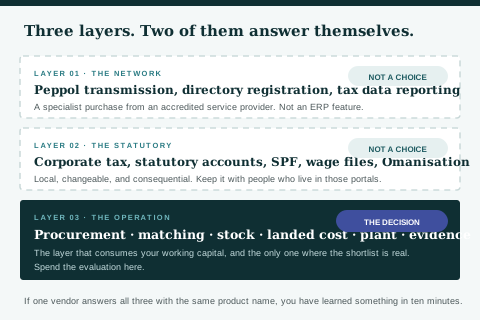
Most Omani buyers are shopping for three things simultaneously and calling all of them "the system". Separating them is the single highest-return hour of the whole exercise, because two of the three have obvious answers once they are named.
The network layer
Buy this from an accredited service provider
Transmission and receipt on the Peppol network, registration in the service metadata directory, and Tax Data Document reporting. This is a specialist purchase from a specialist. It is not an ERP feature, and a vendor implying otherwise is describing a partnership — which is fine, but ask whose accreditation it actually is and what happens to your history if the partnership ends.
The statutory layer
Buy this locally, or leave it where it is
Corporate income tax, statutory accounts, and payroll against the Social Protection Fund, the wage protection system and Omanisation quotas. These are local, they change, and getting them wrong has consequences beyond money. An Omani payroll bureau or accounting firm lives inside those systems every day and you do not.
The operations layer
This is the actual decision
Procurement, approvals, matching, stock across locations, landed cost, plant and tools, project cost and evidence. It is the layer that consumes your working capital, the only one where the choice is genuinely open, and the only one this guide is really about.
If a vendor answers all three of those with the same product name, you have learned something important in the first ten minutes.
What the market is scoring on, and what it should be
Shortlists in this market currently weight heavily toward outbound compliance. Here is what a more predictive scorecard looks like — these seven correlate with implementations that survive their second year, in our experience, and they are all things you can test rather than things you have to take on trust.
Seven things worth scoring, and how to test each one
All seven are testable in a demo. If a vendor will not run one on your own data, that is itself an answer.
Does an approval refuse, or only warn?
Make them prove it: Try to raise an order above your own threshold during the demo and watch what happens. A warning is a suggestion, and a suggestion is not a control. Our own answer, so you can score us with everyone else: purchase orders have no value ceiling, and where a budget is exceeded the request is approved and a warning is sent afterwards. Stock write-offs are the exception and they refuse properly.
What happens to a failed three-way match?
Make them prove it: Ask to see a real discrepancy rather than a clean record. Held, or flagged? If it is flagged, your control is whoever is least busy that afternoon.
Can goods be received where they actually arrive?
Make them prove it: Gate, yard, site, van — and with the connection off. A mobile app that needs signal is a desktop screen on a small display, and the yard is where coverage is worst.
Does landed cost reach the unit, or an overhead line?
Make them prove it: Add a freight invoice three weeks after a receipt and ask whether the unit cost changes. If it does not, you are pricing against a number you know is wrong.
Is a branch a location, or a separate database?
Make them prove it: Ask to see stock in transit between two locations and a transfer that must be accepted at the far end — not a consolidated report.
Where does an inbound document go?
Make them prove it: The one Fawtara question worth asking an ERP vendor. Not "can you receive" but where it lands, what it is compared against, and who sees it.
Who answers the phone in month seven?
Make them prove it: Ask whether you are contracting with the vendor or a reseller, where that person sits, and what happens if the two part company.
Where we fit, and where we do not
The layer table below is the version of this we would give you on a call. The rows marked as not built are not a roadmap — they are a boundary, and three of them are things a Muscat vendor would include as standard.
AWRA OpsHub against an Omani requirement, row by row
Procurement, approvals and thresholds
Requisition, approval routing, RFQ comparison and three-way matching. Read the limits carefully: no value ceiling on a purchase order, and no field for the award reason. A stock write-off does refuse above a threshold you set.
Three-way matching
Order against receipt against invoice, separate price and quantity tolerances, exceptions held rather than passed to the payment run.
Multi-location stock
Governed transfers, in-transit visibility, batch and expiry, blind counts and valued variance across Muscat, the coast, sites and vans.
Landed cost
Freight, duty, clearance, port handling and inland haulage allocated onto the receipt at the rate actually paid.
Plant, equipment and tools
Named custody, check-out and check-in, condition at each hand-over, last verification and warranty expiry. No service schedule, no maintenance record, and an indicative value trend rather than accounting depreciation.
Project budget, time and cost
Cost attribution carried from purchases, stock issues, expenses and payroll cost. Budget and time, not contractor valuation.
Offline-first capture
Receiving, counting, issuing and dispatch that keep working with no signal and sync once without duplicating.
Document vault
Files attached to the transaction they justify, checksummed and access-logged, with supplier document expiry watched.
Rial and a 5% VAT preset
Base currency and rate ship as presets; the treatment of zero-rated and exempt categories is yours to configure with your adviser.
Friday and Saturday working week
Set once, and leave arithmetic, workflow due dates, escalation timers and helpdesk response clocks all read it.
Peppol access point or accreditation
None, in Oman or anywhere. We do not transmit on the network and hold no accreditation with any authority.
OM PINT or UBL XML
Neither generated nor parsed, in either direction. This is the caveat that matters most given the argument above.
Tax Data Document reporting
No reporting of any kind to the Oman Tax Authority, on the sales side or the purchase side.
Arabic interface and RTL layout
English only, documents included. The most common reason the standard product does not fit here — and, because it needs no regulator, the build we are asked for most often in this region.
SPF, wage files, Omanisation
Our maintained statutory payroll engine covers Kenya only. This stays with an Omani payroll provider.
Corporate income tax and statutory accounts
We hold the costed records a computation is built from. We do not calculate, apportion or file anything.
Customs or port community integration
No connection to Bayan or any port system at Sohar, Salalah or Duqm. Paperwork is attached as evidence, not exchanged as data.
Four questions, and what a vague answer usually means
Are you Fawtara-ready?
The answer you often get
Yes, fully compliant.
What to press for instead
In a decentralised model, compliance is the accredited provider's. Ask which provider, whose accreditation, and what the ERP vendor is actually contributing. If the answer is a partnership, ask what happens to your data and your history if that partnership ends.
Can you handle multi-location stock?
The answer you often get
Yes, unlimited warehouses.
What to press for instead
Unlimited warehouses is a database statement. Ask to see goods in transit between two of them, a transfer that requires acceptance at the far end, and a valued variance after a blind count. Those three separate real multi-location handling from a location field on a record.
How long does implementation take?
The answer you often get
Six to eight weeks.
What to press for instead
Ask what that assumes about your data. Every timeline in this market assumes clean item master data and a supplier list without duplicates. Ask what the number becomes if neither is true, and ask who does the cleaning.
Do you have local support?
The answer you often get
Yes, we have a regional presence.
What to press for instead
Ask where the person who answers a Tuesday afternoon question actually sits, in which time zone, and whether they are the vendor or a reseller. Ours sit in Nairobi, an hour behind Muscat, and we say so rather than implying an office in Ruwi.
What AWRA OpsHub does today
- Rial base currency and a 5% VAT preset, net and tax split at capture
- Stock write-offs that refuse above a threshold, with the raiser barred from approving
- Three-way matching, tolerances you set, exceptions held
- Stock across Muscat, Sohar, Salalah, Duqm, sites and vans
- Landed cost onto the consignment at the rate actually paid
- Plant, equipment and tools under named custody
- Project budget, time and cost attribution
- Offline-first receiving, counting and dispatch
More we can add to your workspace
- A Peppol access point and a service provider accreditation, anywhere
- An OM PINT or UBL XML parsing or generation, in either direction
- A Tax Data Document and reporting to the Oman Tax Authority
- An Arabic interface and a right-to-left layout
- A Social Protection Fund, a wage protection file, Omanisation tracking
- A corporate income tax computation and statutory accounts
- Customs, Bayan or port community system integration
Three of those seven are standard from a Muscat vendor. If you need them from one box, buy locally — we will tell you so on the first call rather than in month four.
What we can build for Oman on top of the standard product
Everything listed above as something we can add describes what ships in the standard product today — it is a starting point for Oman, not a limit on what AWRA OpsHub can do there. Kenya's eTIMS integration and its maintained payroll engine are in the product because Kenyan clients needed them and commissioned them; neither appeared by itself. The same door is open here. If inbound Fawtara documents landing on your purchase records, an Arabic interface, a bank or mobile money feed, a statutory return format, a rule specific to how your operation runs, or a link to a system you already have is what stands between you and a decision, tell us and we will scope it as a build — written spec, timeline and price — before you commit to anything.
The receiving end of Fawtara
A link to your accredited service provider that works in both directions: our sale handed over in the shape their access point expects, and — the part nobody quotes for — an inbound supplier document arriving as data and landing against the purchase order and goods receipt it belongs to, so the three-way match happens before anyone approves payment rather than after. We will not become your access point or hold the accreditation; that belongs with a provider registered on the network, and we would rather say so than sell you the pipe.
Arabic interface, banks and acquirers
Arabic interface text with right-to-left layout and bilingual document templates, plus bank statement feeds and card acquirer settlements wired into the Payments Register so collections match invoices without anyone re-keying a statement.
The operational work, which is what most commissions actually are
An extra approval stage in a chain that does not match the standard one, a custom field set on employees or assets that only your sector needs, an expiry that has to block an order rather than send an email, a report your board asks for in a shape nothing produces, or a scanner or weighbridge feeding the goods-in door. These are the commissions we are asked for most often and the smallest ones we quote — and unlike a revenue-authority pipeline, none of them waits on a regulator.
Payroll and statutory returns
An Omani payroll engine with Social Protection Fund contributions calculated on live employee records, wage files in the layout the Ministry of Labour and Central Bank system expects, and the Omanisation position visible before a deadline rather than after one.
Systems you already run
The accounting package, CRM, online store or custom database you intend to keep — connected through our API so a fact is entered once and appears everywhere it is needed.
How it works: you describe the requirement, we return a written scope, timeline and cost, and once agreed it is built into your environment and maintained as part of the product. No roadmap slide, and no pretending in a demo that something exists when it does not.
Tell us what you need integratedWhen you should not buy from us
Worth stating directly, because it saves everybody a fortnight.
- If Arabic is the working language of the people who would key transactions. Not the finance director — the storekeeper, the site clerk, the receiving supervisor. Treat "they will manage" as a no.
- If you want compliance and operations from the same vendor. A completely legitimate preference, and the standard product does not meet it today. The nearest thing we will stand behind is a clean two-way seam to your accredited provider, built and priced as a scope. If one throat to choke on compliance is genuinely the requirement, weigh that honestly against us.
- If you need payroll to be statutory out of the box. Our maintained payroll engine covers Kenya only. Everything else is employee records, contracts, leave and cost allocation.
- If you are a contractor whose main problem is valuation — payment applications, retention, remeasurement. Our project module is budget, time and cost. That is the wrong half for you.
When we are worth a conversation
- If your compliance layer is already settled and what is actually costing money is purchasing, stock and landed cost.
- If you hold stock in more than two places and the reconciliation between them is monthly, manual and disputed.
- If your plant and tools move between sites and you have hired in something you already owned.
- If you are staring at the buy side of Fawtara and have worked out that a structured invoice arriving faster is only an improvement if there is something to check it against.
Our take
Stop scoring vendors on Fawtara readiness. In a five-corner model that question resolves to which accredited provider you appoint, and it is a separate purchase from a separate market. Spend the evaluation on the layer that is genuinely open — whether an approval refuses, whether a match holds, whether a receipt can be taken where the goods land, and whether landed cost reaches the unit. Those four decide whether the system pays for itself. The mandate decides only whether you are allowed to trade.
Bring one month of purchase invoices
Checked against your own orders and your own receipts. The proportion that match cleanly tells you more about what to buy than any demo, and you keep the number whichever way you go.
Talk to us about OmanFrequently asked questions
Do we need an accredited service provider, or can our ERP do it?
In a decentralised five-corner model you do not connect directly to the authority — an accredited service provider transmits and receives on your behalf and registers your receiving capability in the network directory. Some ERP vendors partner with a provider and present it as one purchase, which is a reasonable arrangement, but it is worth knowing whose accreditation you are relying on and what happens to your history if the partnership ends. Ask the question early; it is much cheaper than discovering the answer later.
When does Fawtara apply to us?
The published rollout begins in August 2026 with a pilot group of around a hundred large VAT-registered companies, extends in February 2027 to the remaining large ones, and in August 2027 to all remaining VAT-registered taxpayers including SMEs, with government-to-business following in 2028. Dates have already moved once. Confirm your own position with the Oman Tax Authority or your adviser rather than with a vendor.
What does AWRA cost, and how is it priced?
Pricing is published rather than quoted per deal, and it is set in Kenya shillings with other currencies derived from a live rate, so what you see is what applies. There is no per-country premium and no separate charge for a second location, which matters here because multi-location is the normal case rather than an upgrade. What is not included is implementation effort where your item master or supplier list needs cleaning first — we would rather scope that honestly than bury it.
Is there an Arabic interface?
No, and there is no right-to-left layout. English only, documents included. Muscat's commercial floor is comfortably bilingual and this is frequently survivable, but a site store in Duqm or a receiving yard in Sohar is a different test. Run it with the people who would actually key transactions before you decide, because on the standard product this is the most common reason the fit fails. It is also the most commissioned build in the region: Arabic text with right-to-left layout and bilingual documents, scoped and priced like any other requirement rather than promised as a switch.
Do you handle Oman payroll?
Not statutorily. Our maintained payroll engine covers Kenya only, so no Social Protection Fund contribution is calculated, no wage protection file is produced for the Ministry of Labour and Central Bank system, and no Omanisation position is tracked. Employee records, contracts, leave with balances and approvals, and payroll cost allocated to projects and cost centres all work — but the statutory filing stays with an Omani provider and we would keep it there even if you asked us to try.
We move goods through the free zones or Duqm. Does that change anything?
It changes your cost base rather than your software. Goods held in a free zone or the special economic zone sit outside the customs territory with duty suspended rather than waived, so the same item can carry two true landed costs depending on whether it clears into the domestic market or leaves on a re-export. We can model both, and landed cost is allocated per receipt rather than averaged. What we cannot do is exchange data with customs or any port community system — that paperwork is attached as evidence, and somebody records the event.
