
Buying Operations Software in Qatar: A Straight Guide
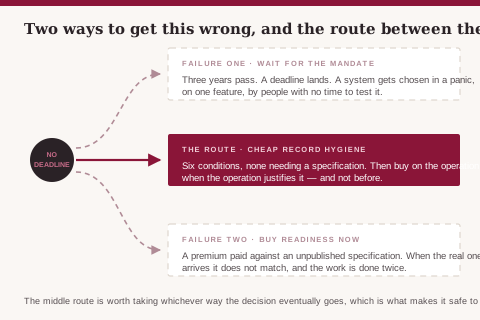
Without a compliance deadline to organise the decision around, a Qatari shortlist has to be built on operational evidence. That is harder, slower, and produces a much better answer.
Most buyer's guides for this region open by telling you what the mandate requires. This one cannot, because Qatar has no value added tax and no electronic invoicing mandate in force. That absence is the most useful fact about buying software here and it changes the whole shape of the exercise.
Written by a vendor, so weigh it accordingly. A fair amount of it argues for buying something other than us, and one section argues for buying nothing yet.
Nothing here is tax advice. What applies to you is the General Tax Authority's to say, and it differs inside the Qatar Financial Centre.
First, work out whether you should be buying at all
This section exists in no other buyer's guide we publish, because in every other market a deadline has already answered the question. Here it is genuinely open, and getting it wrong in either direction is expensive.
Buy nothing yet
Your operation is not straining, and the case is theoretical
One site, a handful of suppliers, projects you can hold in your head, an owner who would spot a wrong invoice. Do the cheap record hygiene, keep the spreadsheets, and revisit in a year. Any vendor who tells you otherwise is telling you about their pipeline rather than your business — including us, if we ever do.
Buy for the operation
Something specific is costing money and you can name it
Plant you hired in twice. A project whose true cost arrived at the final account. Landed cost sitting in an overhead line. Stock in three places reconciled monthly by argument. These are worth solving on their own arithmetic and they do not need a mandate to justify them.
Do not buy readiness
Nobody can be ready for an unpublished specification
A "VAT-ready" premium in a market with no published rate, return format or filing mechanism is a deposit on a guess. Every accounting system has a configurable tax field. Pay for the operational capability; treat readiness claims as a signal about the vendor rather than about the product.
The best thing about a market with no deadline is that nobody can rush you. The hardest thing is that nobody can rush you.
What to score, when compliance is not on the list
Strip out the compliance questions that dominate a Saudi or Omani shortlist and what remains is the stuff that actually predicts whether an implementation survives its second year. All seven below are testable in a demo, on your own data, before you sign anything.
Seven things worth scoring, and how to test each one
If a vendor will not run one of these on your data before contract, that is itself the answer to the question.
Does a project carry its cost before the final account?
Make them prove it: Load one live job. Ask for its position today — materials, plant, labour cost, subcontract — without anybody assembling it. In this market that single test separates most of the field.
Does plant have a named holder?
Make them prove it: Ask who currently holds a specific generator and when it was checked out. "It is on the register" is not an answer; a person and a date is.
Does landed cost reach the unit?
Make them prove it: Add a clearance invoice three weeks after a receipt and ask whether the unit cost changes. If it does not, you are pricing against a number you know is wrong.
Does an approval refuse, or only warn?
Make them prove it: Try to raise an order above your threshold during the demo. A warning is a suggestion, and a suggestion is not a control. Score us on it too: we have no value ceiling on a purchase order, and an over-budget request is approved with a warning sent after. Stock write-offs do refuse, and bar the raiser from approving.
Can cost be attributed by entity as well as by project?
Make them prove it: The tax that exists today reaches the foreign-owned share of profits. Ask whether attribution happens at capture or by allocation afterwards.
What is the honest answer on gratuity?
Make them prove it: Accrued monthly on live records, or calculated at settlement? Most systems do the latter and describe it as the former. Ask to see the accrual.
Who answers the phone in month seven?
Make them prove it: Vendor or reseller, which time zone, and what happens if the two part company. Ask before you need to know.
The joint venture question, which nobody raises early enough
Corporate income tax in Qatar reaches the foreign-owned share of profits. In a market where joint ventures are structurally common, that has a consequence for your accounting records that is easy to miss during a software evaluation and painful to discover afterwards.
It means profit has to be attributable — not estimated, not allocated retrospectively by a percentage, but traceable to the entity, the project and the cost centre the underlying transactions belonged to. And it means that attribution has to have happened when the cost was incurred, because nobody can reconstruct it faithfully a year later.
What retrospective allocation actually costs
The figure that matters is the last one. Six hundred thousand riyals of attributed profit moves depending on which defensible allocation basis you pick, and every one of those bases is arguable. That is not a tax risk so much as an argument risk — with your partner, with your auditor, and eventually with the authority. Capturing the attribution at the point of cost removes the argument entirely, and it costs a required field.
Where we fit, and where we do not
AWRA OpsHub against a Qatari requirement, row by row
Project budget, time and cost attribution
Budget and hours per project, cost and bill rates, milestones, and cost carried from purchases, stock issues, expenses and payroll.
Plant, equipment and tools
Named custody, check-out and check-in, condition at each hand-over, last verification and warranty expiry. No service schedule, no maintenance record, and an indicative value trend rather than accounting depreciation.
Procurement, approvals and matching
Requisition, approval routing, RFQ comparison and three-way matching before money moves. There is no value ceiling on a purchase order and no field for the award reason; the hard threshold in this product is on stock write-offs.
Landed cost
Freight, duty, clearance, port handling and inland haulage allocated onto the receipt at the rate actually paid.
Multi-location stock
Yards, stores, site stores and vans as distinct positions, with governed transfers, in-transit visibility and valued variance.
Entity, project and cost-centre attribution at capture
Carried on the transaction as it is created rather than allocated afterwards — the row that matters most for a joint venture.
Document vault
Files attached to the transaction they justify, checksummed and access-logged, with supplier document expiry watched.
Riyal base currency, tax fields at nil
Pegged base currency preset, and a populated tax field on every line even where the rate is zero — cheap now, awkward to retrofit.
Friday and Saturday working week
Set once, and leave arithmetic, workflow due dates, escalation timers and helpdesk response clocks all read it.
Qatari e-invoicing integration
None. There is no published specification, so there is nothing to have built and no readiness to claim.
Corporate income tax computation and filing
We hold the attributed records a computation is built from. We do not calculate the foreign-owned share, apportion, or file with Dhareeba.
Arabic interface and RTL layout
English only, documents included. Usually survivable in Doha; test it with the people who would key transactions.
Wage Protection System files and Qatarisation
Our maintained statutory payroll engine covers Kenya only. This stays with a Qatari payroll provider.
End-of-service gratuity accrual
Not accrued month by month on live employee records. Named separately from payroll because it is a real liability rather than a filing chore.
Payment applications, retention, BOQ remeasurement
Our project module is the cost side, not the valuation side. In a contracting economy this is the boundary that matters most.
Four questions, and what a vague answer usually means
Are you ready for Qatar VAT?
The answer you often get
Yes, fully ready.
What to press for instead
Ask which specification they built against. There is no published rate, return format or filing mechanism, so readiness resolves to a configurable tax field. Worth having, not worth a premium, and a vendor who will not concede that in the first meeting will not concede much later.
Can you handle project cost?
The answer you often get
Yes, full project accounting.
What to press for instead
Load one live job and ask for its position today without anybody assembling it. "Full project accounting" frequently means a budget field and a report. What you need is cost arriving automatically from purchases, stock issues and payroll.
Do you do payment applications and retention?
The answer you often get
That can be configured.
What to press for instead
Configured by whom, and at what cost? A valuation cycle is a measurement discipline, not a form. Ask to see retention held and released against a certificate on a real project. If the answer is a custom field, you are being sold a workaround.
Do you have local presence in Doha?
The answer you often get
We have regional coverage.
What to press for instead
Ask where the person answering a Tuesday afternoon question actually sits and whether they work for the vendor. Ours sit in Nairobi, on the same clock as Doha, and we say so rather than implying an office in West Bay.
When you should not buy from us
- If you are a main contractor whose central problem is valuation — interim applications, retention, remeasurement, variations. Our project module is budget, time and cost. That is the wrong half, and in Qatar it is the wrong half more often than anywhere else in this wave.
- If Arabic is the working language of the people who would key transactions. Not the finance director — the storekeeper and the site clerk. Treat "they will manage" as a no.
- If you want compliance and operations from one vendor when a mandate eventually lands. A reasonable preference, and not one the standard product meets today. When Qatar publishes a specification we will build against it and quote it; what we will not do now is name a date for a regulator that has not named one.
- If your operation genuinely is not straining yet. Wait. There is no deadline, and we would rather tell you that than sell you a project you will resent in month four.
Our take
Qatar is the only market in this region where the software decision has to stand on its own, and that is a gift rather than a difficulty. Refuse the readiness premium, refuse the urgency nobody can actually supply, and score vendors on four things: whether a project carries its cost before the final account, whether plant has a named holder, whether landed cost reaches the unit, and whether attribution happens at capture. If none of those is currently costing you money, the correct decision is to do the cheap record hygiene and buy nothing this year.
What we can build for Qatar on top of the standard product
Everything listed above as something we can add describes what ships in the standard product today — it is a starting point for Qatar, not a limit on what AWRA OpsHub can do there. Kenya's eTIMS integration and its maintained payroll engine are in the product because Kenyan clients needed them and commissioned them; neither appeared by itself. The same door is open here. If a tax pipeline once there is one to build to, an Arabic interface, a bank or mobile money feed, a statutory return format, a rule specific to how your operation runs, or a link to a system you already have is what stands between you and a decision, tell us and we will scope it as a build — written spec, timeline and price — before you commit to anything.
Built when Qatar publishes a specification, not before
Whatever the General Tax Authority eventually publishes — a VAT return, an electronic invoicing interface, or both — built against the actual specification rather than against a rumour of one. We are deliberately not naming a rate or a date, because Qatar has not, and a vendor pretending otherwise is telling you something about how they will handle the rest of the project. What we would do in the meantime is the readiness work that makes the build small: tax codes carried on every line at whatever rate applies today, one invoice numbering series, and a document trail that survives a change of regime.
Arabic interface, banks and acquirers
Arabic interface text with right-to-left layout and bilingual document templates, plus bank statement feeds, card acquirer settlements and payment files wired into the Payments Register so collections match invoices without anyone re-keying a statement.
The operational work, which is what most commissions actually are
An extra approval stage in a chain that does not match the standard one, a custom field set on employees or assets that only your sector needs, an expiry that has to block an order rather than send an email, a report your board asks for in a shape nothing produces, or a scanner or weighbridge feeding the goods-in door. These are the commissions we are asked for most often and the smallest ones we quote — and unlike a revenue-authority pipeline, none of them waits on a regulator.
Payroll and statutory returns
A Qatari payroll engine producing wage files in the layout the Wage Protection System expects, with end-of-service gratuity accrued on live employee records rather than estimated once a year, and the Qatarisation position visible before a deadline.
Systems you already run
The accounting package, CRM, online store or custom database you intend to keep — connected through our API so a fact is entered once and appears everywhere it is needed.
How it works: you describe the requirement, we return a written scope, timeline and cost, and once agreed it is built into your environment and maintained as part of the product. No roadmap slide, and no pretending in a demo that something exists when it does not.
Tell us what you need integratedBring one live project
Not a demo dataset — one real job, with its materials, its plant and its subcontract. We will run it through and show you the position at the end. If it tells you nothing new, we will say so.
Talk to us about QatarFrequently asked questions
Does Qatar have VAT?
No. Qatar signed the GCC unified VAT framework agreement in 2016 and has not enacted implementing legislation, so there is no VAT in force, no registration and no VAT charged on supplies. It is widely expected and undated. Our tax configuration carries Qatar at nil rather than at an anticipated rate — a change we made deliberately rather than a default we inherited — because a rate in a configuration file gets written into an organization's own settings and then quietly persists. Confirm the current position with the General Tax Authority or your adviser.
What taxes apply today?
Broadly a corporate income tax reaching the foreign-owned share of profits, withholding on certain payments to non-residents, and excise on a narrow list of goods, filed through the Dhareeba portal. The Qatar Financial Centre operates a separate regime. Which one applies to you is a question for your adviser, and the answer determines what your records need to be able to prove about attribution.
How should we treat a vendor claiming VAT readiness?
As a data point about the vendor. There is no published specification, so readiness can only mean a configurable tax rate — which every accounting system has had for thirty years. The useful follow-up is to ask what they would actually have to build when a specification lands. A vendor who has maintained a real fiscal integration somewhere can describe that work concretely; one who has not will stay abstract, and abstract is the tell.
We are a contractor. Is AWRA the right fit?
Only for half of your system, and we would rather say which half now. There is no interim payment application, no bill-of-quantities remeasurement, no retention held and released against a certificate, no variation register and no subcontractor back-charge workflow. What we cover properly is the half that usually leaks: materials procured and received against a job, site stores as real stock locations, plant and tools under named custody, consumption attributed to the project, and offline capture that works where there is no signal. Most contractors we work with keep a measurement package for valuation and run us underneath it, which is a stable arrangement provided the export between them is agreed at the start rather than discovered later.
Do you handle Qatari payroll?
Not statutorily. Our maintained payroll engine covers Kenya only, so no Wage Protection System file is produced in the layout the Ministry of Labour and the central bank expect, no Qatarisation position is tracked, and end-of-service gratuity is not accrued month by month on live employee records. That last one is worth naming separately because it is a genuine balance-sheet liability under Qatari labour law rather than a filing chore, and in most operations it lives in an accountant's workbook and is discovered at settlement. Employee records, contracts, leave with balances, and payroll cost allocated to projects and cost centres all work.
What does it cost?
Pricing is published rather than quoted per deal, set in Kenya shillings with other currencies derived from a live rate, so what you see is what applies. There is no per-country premium and no separate charge for additional locations, which matters here because multi-site is the normal case. What is not included is implementation effort where your item master or supplier list needs cleaning first — we would rather scope that honestly than discover it in week three.
